

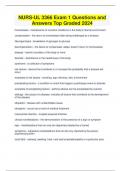
NURS-UL 3366 Exam 1 Questions and Answers Top Graded 2024
homeostasis - maintenance of constant conditions in the body's internal environment compensation - the return to homeostasis after being challenged by a stressor Glycogenolysis - breakdown of glycogen to glucose decompensation - the failure to compensate, adapt, doesn't return to homeostasis disease - harmful condition of the body or mind disorder - disturbance in the healthiness of the body syndrome - a collection of symptoms risk factors - decors that contribute to or increase the probability that a disease will occur examples of risk factors - smoking, age, ethnicity, diet, environment precipitating factors - a condition or event that triggers a pathologic event or disorder examples of precipitating factors - asthma attacks can be precipitated by exertion etiology - the cause of a disease, includes all factors that contribute tot he development of the disease idiopathic - disease with unidentifiable cause iatrogenic - occurs as a result of medical treatment nosocomial infection - hospital acquired infection clinical manifestations - the demonstration of the presence of a sign or symptom sign - manifestations that can only be objectively ideated by a trained symptoms - subjective manifestations that can be only reported by the person experiencing them local S&S - redness, swelling, heat, rash and lymphadenopathy in a particular area system S&S - fever, urticaria, malaise, systemic lymphadenopathy acute S&S - fairly rapid appearance of disease of several days, usually only last a short time chronic S&S - develop slowly and often insidious and last longer remissions - periods when S&S disappear of diminish signitcantly exacerbations - periods when S&S become worse or more severe central - a problem that is occurring towards the center or core of the body proximal - closer to the central area of the body shock - low blood pressure and signs and symptoms of not getting enough blood to different parts of the body prognosis - the predicted outcome of a disease based certain factors like the usual course of that disease, age, and comorbidities sequela - abnormal condition that follows and is the result of disease, injury, or treatment, a complication genetic disorders - a disease caused by abnormalities in an individuals genetic material teratogen - anything that can cause a congenital defect example of a teratogenic disorder - fetal alcohol syndrome occurs because of the toxicity of alcohol causing gene mutations thalidomide babies born without arms or legs because of the drug thalidomide taken for nausea during early pregnancy chromosomal disorders - a genetic disorder that results from alterations to the numbers or structures of chromosomes which disrupts gene function aneuploidy - alterations to the number of chromosomes polysomy - more than the usual number of chromosomes down's syndrome - trisomy 21 example of alterations to the structure of chromosomes - Philadelphia chromosome, a translocation that results in a shortened chromosome
Información del documento
- Subido en
- 20 de mayo de 2024
- Número de páginas
- 8
- Escrito en
- 2023/2024
- Tipo
- Examen
- Contiene
- Preguntas y respuestas

