MACBETH ESSAY: Guilt and Madness
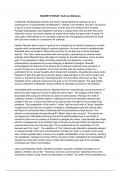
In Macbeth, Shakespeare presents the theme of guilt (leading to madness) to be a
consequence of Lady Macbeth and Macbeth’s “vaulting” over-ambition. But also, how guilt is
a sign of a moral compass and conscience, as they both are limited by their mortality.
Perhaps Shakespeare uses Macbeth’s hamartia to critique those who use their free will to
trade their honour and moral compass for power which defies the great chain of being. He
uses guilt to demonstrate to his Jacobean audience the inescapable punishment for those
who use their morality in a transaction for authority.
Initially, Macbeth feels a sense of guilt as he is tempted by the witches' prophecy to commit
regicide which juxtaposes Banquo’s rational scepticism. His inner turmoil is metaphorically
illustrated when he exclaims “Stars hide your fires, let not light see my black and deep
desires”. The “stars” were associated with divine justice, representing an external moral
authority which Macbeth fears will judge him harshly for his dark intentions, hence he feels
guilt. The juxtaposition of light (connoting purity/truth) and darkness ( connoting
evil/deception) emphasises the moral ambiguity of Macbeth's thoughts. Macbeth
acknowledges the darkness of his desires and is willing to embrace moral corruption in
pursuit of power as a transaction. It’s his free will that uses the prophecy (fate) as a
justification for his corrupt thoughts which brings forth deception, disrupting the natural order.
Perhaps he feels this guilt due to Duncan being a paternal figure to him as his chivalry and
honour is “planted” by Duncan, emphasising the nurturing nature of Duncan as king. His
insatiable lust for authority overpowers his guilt, so he commits regicide. This guilt initially
acts as a deterrent to Macbeth's actions before he ultimately succumbs to his ambition.
Immediately after murdering Duncan, Macbeth feels an overwhelming, consuming sense of
guilt as he asks “Neptune's ocean to wash this blood clean”. The imagery of the water is
associated with purity and memories but also its extensiveness. Perhaps, the motif of
“washing” alludes to Christian baptism, implying his want to be spiritually cleansed and
purified of his sins. It shows the extent of his guilt but also his regret in succumbing to his
ambitions. The juxtaposition of the motif of “water” and the sinful motif of “blood” amplifies
his guilt and shows how his corruption is infectious. Shakespeare uses the motif of water
and blood to contrast the idea of cleansing with the permanence of guilt and sin. This
infection is demonstrated through Macduff's “Bleed, bleed, poor country!”. This shows the
consequences of Macbeth becoming king and his guilt/deceptiveness is not limited to
himself but also how the entirety of Scotland is plunged into chaos. Lady Macbeth also deals
with the consequences of her ambition later in the play as she plummets into madness and
paranoia due to her all-consuming guilt. This is epitomised by her exclamation of “Out
damned spot! Out I say!”. The repetition of "Out" reflects Lady Macbeth's desperate attempt
to cleanse herself of their sins and bloodshed. Perhaps the “spot” is symbolic of the moral
stain of their regicidal deed. It serves as a tangible manifestation of her conscience, haunting
her relentlessly. Despite her intense efforts, her plea is futile, highlighting the impossibility of
erasing the moral stain of their crimes; further demonstrating how guilt is the inevitable
consequences of their over-ambition.
Upon Lady Macbeth’s death, Macbeth’s ambition and guilt completely dissipates as he
adopts a nihilistic view of life. “Tomorrow, tomorrow, and tomorrow” epitomises this as the
assonance creates a long, drawn-out atmosphere of dread. The motif of time symbolises the
In Macbeth, Shakespeare presents the theme of guilt (leading to madness) to be a
consequence of Lady Macbeth and Macbeth’s “vaulting” over-ambition. But also, how guilt is
a sign of a moral compass and conscience, as they both are limited by their mortality.
Perhaps Shakespeare uses Macbeth’s hamartia to critique those who use their free will to
trade their honour and moral compass for power which defies the great chain of being. He
uses guilt to demonstrate to his Jacobean audience the inescapable punishment for those
who use their morality in a transaction for authority.
Initially, Macbeth feels a sense of guilt as he is tempted by the witches' prophecy to commit
regicide which juxtaposes Banquo’s rational scepticism. His inner turmoil is metaphorically
illustrated when he exclaims “Stars hide your fires, let not light see my black and deep
desires”. The “stars” were associated with divine justice, representing an external moral
authority which Macbeth fears will judge him harshly for his dark intentions, hence he feels
guilt. The juxtaposition of light (connoting purity/truth) and darkness ( connoting
evil/deception) emphasises the moral ambiguity of Macbeth's thoughts. Macbeth
acknowledges the darkness of his desires and is willing to embrace moral corruption in
pursuit of power as a transaction. It’s his free will that uses the prophecy (fate) as a
justification for his corrupt thoughts which brings forth deception, disrupting the natural order.
Perhaps he feels this guilt due to Duncan being a paternal figure to him as his chivalry and
honour is “planted” by Duncan, emphasising the nurturing nature of Duncan as king. His
insatiable lust for authority overpowers his guilt, so he commits regicide. This guilt initially
acts as a deterrent to Macbeth's actions before he ultimately succumbs to his ambition.
Immediately after murdering Duncan, Macbeth feels an overwhelming, consuming sense of
guilt as he asks “Neptune's ocean to wash this blood clean”. The imagery of the water is
associated with purity and memories but also its extensiveness. Perhaps, the motif of
“washing” alludes to Christian baptism, implying his want to be spiritually cleansed and
purified of his sins. It shows the extent of his guilt but also his regret in succumbing to his
ambitions. The juxtaposition of the motif of “water” and the sinful motif of “blood” amplifies
his guilt and shows how his corruption is infectious. Shakespeare uses the motif of water
and blood to contrast the idea of cleansing with the permanence of guilt and sin. This
infection is demonstrated through Macduff's “Bleed, bleed, poor country!”. This shows the
consequences of Macbeth becoming king and his guilt/deceptiveness is not limited to
himself but also how the entirety of Scotland is plunged into chaos. Lady Macbeth also deals
with the consequences of her ambition later in the play as she plummets into madness and
paranoia due to her all-consuming guilt. This is epitomised by her exclamation of “Out
damned spot! Out I say!”. The repetition of "Out" reflects Lady Macbeth's desperate attempt
to cleanse herself of their sins and bloodshed. Perhaps the “spot” is symbolic of the moral
stain of their regicidal deed. It serves as a tangible manifestation of her conscience, haunting
her relentlessly. Despite her intense efforts, her plea is futile, highlighting the impossibility of
erasing the moral stain of their crimes; further demonstrating how guilt is the inevitable
consequences of their over-ambition.
Upon Lady Macbeth’s death, Macbeth’s ambition and guilt completely dissipates as he
adopts a nihilistic view of life. “Tomorrow, tomorrow, and tomorrow” epitomises this as the
assonance creates a long, drawn-out atmosphere of dread. The motif of time symbolises the