MACBETH ESSAY: Kingship
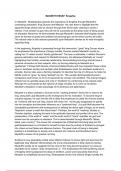
In ‘Macbeth’, Shakespeare presents the importance of Kingship through Macbeth’s
contrasting characters: King Duncan and Malcolm. He uses them to highlight that the
appointed kings should only be chosen through their divine right, catering to James I
interest. If not chosen by god, they will not be successful as the great chain of being would
be disrupted. Moreover, he demonstrates through Macbeth’s hamartia that kingship should
never be formed on greed and ambition for personal gain as the entire country will suffer.
The natural order is only restored peacefully upon Macbeth's demise as he was wrongfully
appointed king.
In the beginning, Kingship is presented through the benevolent, “great” king Duncan where
he emphasises the importance of kingly morality. Duncan praises Macbeth’s loyalty by
calling him “O valiant cousin! Worthy gentleman!” The tone is admirable, it reflects Duncan's
genuine admiration and respect for Macbeth's bravery. He addresses Macbeth as “cousin”
highlighting their familial, proximate relationship, demonstrating how kings should have a
personal connection to their subjects. Also, by the king referring to Macbeth as a
“gentleman” it brings forth themes of honour/nobility/chivalry and how important those virtues
were in Jacobean society and perhaps what Shakespeare wants his Jacobean audience to
emulate. Duncan also uses a farming metaphor to describe the role of a King as he helps his
faithful Lords to "grow," by being "planted" by him. This visually demonstrates Duncan’s
compassion and honour as he is not governed by corrupt over-ambition. The natural imagery
reflects how he upholds peace and unity in “Scotland” by conforming to the natural order.
Although he is presented as the epitome of kingly morality, he is naive as he allows
Macbeth’s deception to take advantage of his kindness and paternalism.
Macbeth is a direct contrast to Duncan as his “vaulting ambition” drives him to want to be
king, along with Lady Macbeth as the inciting force for his motivation. To become king he
commits regicide, he uses his free will to allow the prophecies to justify his immoral actions
as “if chance will have me king, chance will crown me”. As the play progresses he spirals
into his corruption and becomes infamous as a “tyrannical king”. It is guilt that becomes his
inescapable punishment and consequence for defying the divine right of kings, as he wants
“Neptune's ocean to wash this blood clean”. Perhaps, the motif of “washing” alludes to
Christian baptism, implying his want to be spiritually cleansed and purified of his sins. The
juxtaposition of the motif of “water” and the sinful motif of “blood” amplifies his guilt and
shows how his corruption is infectious. This is demonstrated through Macduff's “Bleed,
bleed, poor country!”. This shows the consequences of Macbeth becoming king and his
guilt/deceptiveness is not limited to himself but also how the entirety of Scotland is plunged
into chaos as trust fades and alliances fracture. The great chain of being is disrupted,
leading to a breakdown in society and a descent into violence and bloodshed due to
Macbeth’s misuse of his position as King.
Scotland is only peacefully unified when Malcom follows his divine right and becomes the
legitimate king. Malcolm demonstrates the moral characteristics a king needs by testing
Macduff’s loyalty as he suggests he has none of the “king becoming graces” by using an
asyndetic list of “justice, verity, temperance [..]”. This emphasises the self-sacrificing nature
of kingship which juxtaposes the ideas of ambition, power and masculinity that drove
Macbeth to unrightfully become king. Shakespeare shows how without Kingly morality the
In ‘Macbeth’, Shakespeare presents the importance of Kingship through Macbeth’s
contrasting characters: King Duncan and Malcolm. He uses them to highlight that the
appointed kings should only be chosen through their divine right, catering to James I
interest. If not chosen by god, they will not be successful as the great chain of being would
be disrupted. Moreover, he demonstrates through Macbeth’s hamartia that kingship should
never be formed on greed and ambition for personal gain as the entire country will suffer.
The natural order is only restored peacefully upon Macbeth's demise as he was wrongfully
appointed king.
In the beginning, Kingship is presented through the benevolent, “great” king Duncan where
he emphasises the importance of kingly morality. Duncan praises Macbeth’s loyalty by
calling him “O valiant cousin! Worthy gentleman!” The tone is admirable, it reflects Duncan's
genuine admiration and respect for Macbeth's bravery. He addresses Macbeth as “cousin”
highlighting their familial, proximate relationship, demonstrating how kings should have a
personal connection to their subjects. Also, by the king referring to Macbeth as a
“gentleman” it brings forth themes of honour/nobility/chivalry and how important those virtues
were in Jacobean society and perhaps what Shakespeare wants his Jacobean audience to
emulate. Duncan also uses a farming metaphor to describe the role of a King as he helps his
faithful Lords to "grow," by being "planted" by him. This visually demonstrates Duncan’s
compassion and honour as he is not governed by corrupt over-ambition. The natural imagery
reflects how he upholds peace and unity in “Scotland” by conforming to the natural order.
Although he is presented as the epitome of kingly morality, he is naive as he allows
Macbeth’s deception to take advantage of his kindness and paternalism.
Macbeth is a direct contrast to Duncan as his “vaulting ambition” drives him to want to be
king, along with Lady Macbeth as the inciting force for his motivation. To become king he
commits regicide, he uses his free will to allow the prophecies to justify his immoral actions
as “if chance will have me king, chance will crown me”. As the play progresses he spirals
into his corruption and becomes infamous as a “tyrannical king”. It is guilt that becomes his
inescapable punishment and consequence for defying the divine right of kings, as he wants
“Neptune's ocean to wash this blood clean”. Perhaps, the motif of “washing” alludes to
Christian baptism, implying his want to be spiritually cleansed and purified of his sins. The
juxtaposition of the motif of “water” and the sinful motif of “blood” amplifies his guilt and
shows how his corruption is infectious. This is demonstrated through Macduff's “Bleed,
bleed, poor country!”. This shows the consequences of Macbeth becoming king and his
guilt/deceptiveness is not limited to himself but also how the entirety of Scotland is plunged
into chaos as trust fades and alliances fracture. The great chain of being is disrupted,
leading to a breakdown in society and a descent into violence and bloodshed due to
Macbeth’s misuse of his position as King.
Scotland is only peacefully unified when Malcom follows his divine right and becomes the
legitimate king. Malcolm demonstrates the moral characteristics a king needs by testing
Macduff’s loyalty as he suggests he has none of the “king becoming graces” by using an
asyndetic list of “justice, verity, temperance [..]”. This emphasises the self-sacrificing nature
of kingship which juxtaposes the ideas of ambition, power and masculinity that drove
Macbeth to unrightfully become king. Shakespeare shows how without Kingly morality the