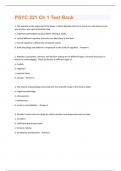
PSYC 221 Ch 1 Test Bank Questions & Answers Already Graded A +
1. The example at the beginning of the book, in which Raphael talks to his friend on a cell phone on his way to class, was used to illustrate how a. cognitive psychologists study problem solving in adults. b. several different cognitive processes can take place at one time. c. human cognition is affected by emotional events. d. both physiology and behavior is important to the study of cognition. - Answer-b 2. Attention, perception, memory, and decision making are all different types of mental processes in which the mind engages. These are known as different types of a. models. b. cognition. c. reaction times. d. savings. - Answer-b 3. The branch of psychology concerned with the scientific study of the mind is called a. cognitive psychology. b. introspection. c. behaviorism. d. memory consolidation. - Answer-a 4. Donders' main reason for doing his choice reaction time experiment was to study a. sensation. b. childhood attachment styles. c. decision making. d. personality development. - Answer-c5. By comparing reaction times across different tasks, Donders was able to conclude how long the mind needs to perform a certain cognitive task. Donders interpreted the difference in reaction time between the simple and choice conditions of his experiment as indicating how long it took to a. perceive the stimulus. b. process the stimulus. c. attend to the stimulus. d. make a decision about the stimulus. - Answer-d 6. The main point of the Donders' reaction time experiments was to a. show that reaction times can be measured accurately. b. measure the amount of time it takes to make a decision. c. determine differences in the way people react to stimuli. d. show that our cognitions are often based on unconscious inferences. - Answer-b 7. In Donders' experiment on decision making, when participants were asked to press a button upon presentation of a light, they were engaged in a a. reaction time task. b. simple reaction time task. c. choice reaction time task. d. presentation task. - Answer-b
Escuela, estudio y materia
- Institución
- PSYC 221
- Grado
- PSYC 221
Información del documento
- Subido en
- 19 de mayo de 2024
- Número de páginas
- 12
- Escrito en
- 2023/2024
- Tipo
- Examen
- Contiene
- Preguntas y respuestas
Temas
-
psyc 221

Documento también disponible en un lote