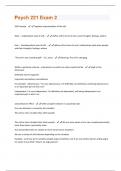
Psych 221 Exam 2 Questions & Answers Already Passed!!
Self-Concept - Cognitive representation of the self West -- Independent view of self: - define self in terms of one's own thoughts, feelings, actions East -- Interdependent view of self: - define self in terms of one's relationships with other people and their thoughts, feelings, actions "The self is not a bowling ball" - E.E. Jones - Meaning: The self is changing Within a particular schema - a dimension on which one rates oneself will be - High on the dimension Definitely not the opposite Important and without contradiction For example - Adventurous: "I'm very adventurous, I'm definitely not withdrawn and being adventurous is an important part of who I am" Independent: I'm very independent, I'm definitely not dependent, and being independent is an important part of who I am actor/observer effect - Other people's behavior is caused by traits Our own behavior is caused by the situation The self as more complex than other people The self as more complex than other people - We are more aware of our own complex personality traits than others' personality traits Our personality traits are viewed as more varied across situations We see a variety of self-schemas depending on the situation Example - we know we're complex and get angry sometimes, but if we see another person acting angry it's easier to just think "they're an angry person"The Coherent Self - Accessibility -- Working self-concept Situational attributions -- Blame the situation for inconsistent behavior Understanding the self - We understand ourselves in a social context We use other people to learn about ourselves Introspection - Nisbett & Wilson (1977) studies How accurately can people report the causes of their feelings, judgments, and behaviors? How do they make such causal judgments? Research has shown that we make fairly inaccurate judgements about ourselves and our decisions Wilson, Laser, & Stone (1982) - Students rated their daily mood each day for 5 weeks Also rated several predictor variables that might correlate with their mood: day of the week amount of sleep the night before how relationships with friends were going At the end of the study they rated how much each predictor variable was related to their mood, on a scale from -3 to +3 Wilson, Laser, & Stone (1982) Result 1 - People showed only modest accuracy when estimating the predictors of their mood ** Of relationships, sleep, and days of the week, relationships were the only one of the three that significantly impacted mood** Wilson, Laser, & Stone (1982) Result 2 - People relied a lot on causal theories about what predicts their mood. Ratings of a separate group of students were as accurate as participants' own ratings Why? Because we're not relying on self-knowledge, relying instead on causal theoriesThe consequences of introspection - Is it wise to analyze the reasons for our feelings and judgments? Pros/Cons Wilson & Kraft (1993) - Students involved in dating relationships Measured relationship satisfaction (3 weeks earlier) Reasons condition Write down why their relationship was going the way it was Control condition wrote about an unrelated topic People in reasons condition were more likely to change their minds about how they felt about the relationship 8 months later - whose attitudes predicted status?
Escuela, estudio y materia
- Institución
- Psych 221
- Grado
- Psych 221
Información del documento
- Subido en
- 19 de mayo de 2024
- Número de páginas
- 25
- Escrito en
- 2023/2024
- Tipo
- Examen
- Contiene
- Preguntas y respuestas
Temas
-
psych 221

Documento también disponible en un lote