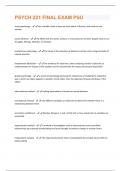
PSYCH 221 FINAL EXAM PSU QUESTIONS WITH CORRECT ANSWERS
social psychology - the scientific study of how we think about, influence, and relate to one another social influence - the effect that the words, actions, or mere presence of other people have on our thoughts, feelings, attitudes, or behavior evolutionary psychology - the study of the evolution of behavior and the mind, using principles of natural selection fundamental attribution - the tendency for observers, when analyzing another's behavior, to underestimate the impact of the situation and to overestimate the impact of personal disposition gestalt psychology - a school of psychology stressing the importance of studying the subjective way in which an object appears in people's minds rather than the objective, physical attributes of the object observational method - making observations of human or animal behavior correlational method - two different variables are observed to determine whether there is a relationship between them correlation coeffecient - Number between -1 and +1 that tells us how closely the co-variables are associated experimental method - A method of investigation used to demonstrate cause-and-effect relationships by purposely manipulating one factor thought to produce change in another factor. independent variable - The experimental factor that is manipulated; the variable whose effect is being dent variable - The measurable effect, outcome, or response in which the research is interested. random assignment - placing research participants into the conditions of an experiment in such a way that each participant has an equal chance of being assigned to any level of the independent variable hindsight bias - the tendency to believe, after learning an outcome, that one would have foreseen it internal validity - extent to which we can draw cause-and-effect inferences from a study external validity - the extent to which the results of a study can be generalized to other situations and to other people social cognition - the mental processes that people use to make sense of the social world around them thin-slicing - drawing meaningful conclusions about another person's personality or skills based on an extremely brief sample of behavior automatic thinking - Thinking that is nonconscious, unintentional, involuntary, and effortless controlled thinking - thinking that is conscious, intentional, voluntary, and effortful schemas - conceptual frameworks a person uses to make sense of the world accessibility schema - extent to which schemas are at the forefront of people's minds; used when judging the social worldpriming schema - the process by which recent experiences increase the accessibility of a schema, trait, or concept self-fulfilling prophecy - an expectation that causes you to act in ways that make that expectation come true. availability heuristic - estimating the likelihood of events based on their availability in memory; if instances come readily to mind (perhaps because of their vividness), we presume such events are common counterfactual thinking - imagining alternative scenarios and outcomes that might have happened, but didn't social perception - the study of how we form impressions of and make inferences about other people nonverbal communication - communication using body movements, gestures, and facial expressions rather than speech
Escuela, estudio y materia
- Institución
- PSYCH 221
- Grado
- PSYCH 221
Información del documento
- Subido en
- 19 de mayo de 2024
- Número de páginas
- 14
- Escrito en
- 2023/2024
- Tipo
- Examen
- Contiene
- Preguntas y respuestas
Temas
-
psych 221

Documento también disponible en un lote