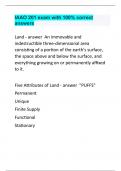
IAAO 201 exam with 100% correct answers
Land An immovable and indestructible three-dimensional area consisting of a portion of the earth's surface, the space above and below the surface, and everything growing on or permanently affixed to it. Five Attributes of Land "PUFFS" Permanent Unique Finite Supply Functional Stationary Four Value Characteristics of Land "DUST" Demand Utility Scarcity Transferability Raw Land is in its natural state, prior to grading, construction, and subdividing. It is UNDEVELOPED, in agricultural use, or intended for development. Site Improvements that prepare the land for development (to be built upon). Six rights associated with land ownership "SLUGER" Sell Lease or rent Use Give away Enter or leave Refuse to do any of these Fee Simple Absolute Ownership When all six rights of land ownership are owned. Government restrictions on ownership rights. "TEPE" Taxation Eminent Domain Police power Escheat Four Agents of Production Land, Labor, Capital, Management Entrepreneurial Profit The return to the investor for taking the investment risk on a development, as part of the Management Sale Price - (Total Development Cost + Land) Highest & Best Use Producing the greatest economic net return to the property over a period of time: legally permissible >physically possible >finanically feasible >most profitable Principle of Anticipation The present value of future benefits. Principle of Surplus Productivity Net income remaining after the cost of labor, management, and capital has been paid Principle of Balance The highest market value is reached when the four Agents of Production are proportionate. Principle of Supply and Demand Supply of land is limited - cannot increase like other goods. Supply The amount of land Sellers are willing to Sell at any given time. Demand The amount of land Buyers are willing and able to Buy at any given time. Principle of Change Four factors (physical, economic, social, and Governmental) constantly change the property and its market value. Market is in a constant state of change. Principle of Substitution The market value of land is determined by the cost of buyinga substitute property that is equally desirable and valuable. Substitution affects the three approaches to value. - cost, sales, comparison, and income. Principle of Competition Buyers and sellers enter the market when there is competition for potential profits. Principle of Progression and Regression Progression - the value of a lower priced parcel of land increases when it is associated with higher value parcels of land. Regression - the value of higher valued land decreases when it is associated with lower value parcels of land. Principle of Conformity A parcel of land's surroundings will help determine its value. Principle of Increasing and Decreasing Returns Increasing returns - when one of the Agents of Production is added to fixed amounts of the other three agents, benefits increase. Decreasing returns - The point at which the process of increasing returns reaches the maximum, and begins to decline, resulting in diminishing returns.
Escuela, estudio y materia
- Institución
- IAAO Course
- Grado
- IAAO Course
Información del documento
- Subido en
- 16 de mayo de 2024
- Número de páginas
- 17
- Escrito en
- 2023/2024
- Tipo
- Examen
- Contiene
- Preguntas y respuestas
Temas
-
iaao 201 exam

Documento también disponible en un lote