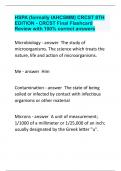
HSPA (formally IAHCSMM) CRCST 8TH EDITION - CRCST Final Flashcard Review with 100% correct answers
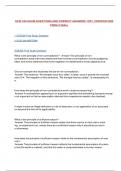
Microbiology The study of microorganisms. The science which treats the nature, life and action of microorganisms. Me Him Contamination The state of being soiled or infected by contact with infectious organisms or other material Microns A unit of measurement; 1/1000 of a millimeter or 1/25,000 of an inch; usually designated by the Greek letter "u". Protoplasm Describes all living materials in a cell. A thick mucous-like substance that is colorless and translucent that forms the biochemical basis of life within the cell nucleus. Components of a cell cell wall, cell membrane, cytoplasm, capsule, flagella, nucleus Phagotization The process by which some cells can ingest bacteria or other foreign particles. (process where white blood cells in the human body destroy bacteria by engulfing them). Cytoplasm The living matter of a cell between the cell's membrane and nucleus. Nucleus The functional center of a cell that governs activity and heredity. DNA Deoxyribonucleic Acid. The protein found in the chromosomes of a cell nucleus which is the basis of heredity.. Cell wall A tough rigid structure that helps maintain the cell's shape. Cell membrane This layer is located just beneath the cell wall which is semi-permeable. Capsule A mucus material that protects the bacteria from the host cells that try to destroy it. Flagella Thread-like tails attached to the cell that enable the bacteria to move through liquids. Acid-fast bacteria Mycobacterium tuberculosis (which causes tuberculosis) and Mycobacterium leprae (which cause leprosy). Spore Microrganisms capable of forming a thick wall around themselves enabling them to survive in adverse conditions; a resistant form of bacterium. Chlorophyll A molecule in plants that absorbs sunlight, and converts it to energy in a process called photosynthesis. Aerobic bacteria Capable of growing in the presence of free oxygen. Requiring oxygen. Anaerobic bacteria Capable of growing in the absence of free oxygen. Not requiring oxygen. Psychrophiles (bacteria) Cold-loving bacteria (59-68 degrees F) Mseophiles (bacteria) Bacteria that grows best at moderate temperatures (68-113 degrees F) Thermophiles (bacteria) Bacteria which grow best at a temperatures (122-158 degrees F). Vegetative stage State of active growth of microorganisms (as apposed to the resting or spore stages)
Escuela, estudio y materia
- Institución
- CRCST
- Grado
- CRCST
Información del documento
- Subido en
- 16 de mayo de 2024
- Número de páginas
- 99
- Escrito en
- 2023/2024
- Tipo
- Examen
- Contiene
- Preguntas y respuestas
Temas
-
hspa formally iahcsmm crcst 8th edition

Documento también disponible en un lote