Final SOES2003 Summative Assessment – 2020-2021
Part A:
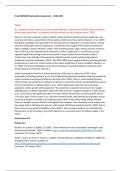
Q1. Outline the factors taken into account when defining a critical element [30%]. What are the key
drivers that ensure that Li is considered a critical element by the European Union? [70%]
There are 3 factors required in order to define critical elements: demand growth, supply risk, and
recycling restrictions, and all 30 EU critical metals in 2020 meet these factors (Buchert, et al., 2009).
The global availability and expectations for development are important to consider due to a critical
element having high economic expectancy, and therefore the supply of the elements needs to be
high in multiple countries (Roberts, 2020). If the demand growth is high, with an increase of 50% or
more in the year, this denotes that the element is critical. Supply risk is a crucial factor, as the
regional supply from mining must be shared with 3 major countries to be classed as critical.
Furthermore, the criticality of the element is reflected on the scarcity and time lag between
production and demand (Roberts, 2020). The 2009 UNEP report suggests that the recycling potential
should also be a factor for critical metals, as this allows predictions of future conditions (Buchert, et
al., 2009). The physical limitations, price and technology of recycling should be considered when
determining how critical the element is.
Lithium was added to the list of critical elements in 2020 and it is classed as an FST; Future
Sustainable Technology element, as its role in batteries and electrical equipment has the potential to
result in positive environmental effects in the future (EU, 2020). There is a clear demand growth
which includes the production of Lithium-ion batteries in electrical vehicles and EV batteries (around
25% of all production of lithium) (Speirs, et al., 2021). With hybrid electrical cars increasing in
popularity, further growth will be expected. The production is expected to increase from roughly
100,000 tonnes in 2020 to 200,000 in 2030, with 78% of the EU’s supply of Lithium is in Chile (Speirs,
et al., 2021). Due to the significant battery increase, lithium demand has an annual growth rate of
7.5% since 2010. The EU classes Li as a mid-term timeline metal, with rapid demand growth, serious
recycling restrictions, meaning Li is becoming crucial, with its main driver being battery demand.
There are multiple reserves found in salt deposits and seawater; this is therefore a safe supply and a
low supply risk for obtaining the element, with around 150 lithium metals known (EU, 2020). Due to
these vast reserves, global availability is not in deficit. The recycling incentives are a beneficial for
this element, as the recycling of end-of-life batteries is a successful source for lithium supply in the
future.
Word count: 413
References:
Buchert. M, Schuler. D, Bleher. D, (2009), ‘Critical Metals for Future Sustainable Technologies and
the Recycling Potential’, UNEP, Available: https://www.oeko.de/oekodoc/1070/2009-129-en.pdf
(accessed: 13th January, 2021)
Speirs. J, Gross. B, Gross. R, Yassine. H, (2020), ‘Energy Materials Availability: Handbook’, UKERC UK
Energy Research Centre, available at:
https://d2e1qxpsswcpgz.cloudfront.net/uploads/2020/03/materials-availability-handbook.pdf
(accessed: 13th January 2021)
, European Commission, (2021), ‘Critical Raw Materials’, Official EU Website, Available at:
https://ec.europa.eu/growth/sectors/raw-materials/specific-interest/critical_en (accessed: 13th
January, 2020)
Roberts, S. (2020), ‘Geopolitics’, University of Southampton, Available on Blackboard (accessed: 13 th
January, 2021)
Part A:
Q1. Outline the factors taken into account when defining a critical element [30%]. What are the key
drivers that ensure that Li is considered a critical element by the European Union? [70%]
There are 3 factors required in order to define critical elements: demand growth, supply risk, and
recycling restrictions, and all 30 EU critical metals in 2020 meet these factors (Buchert, et al., 2009).
The global availability and expectations for development are important to consider due to a critical
element having high economic expectancy, and therefore the supply of the elements needs to be
high in multiple countries (Roberts, 2020). If the demand growth is high, with an increase of 50% or
more in the year, this denotes that the element is critical. Supply risk is a crucial factor, as the
regional supply from mining must be shared with 3 major countries to be classed as critical.
Furthermore, the criticality of the element is reflected on the scarcity and time lag between
production and demand (Roberts, 2020). The 2009 UNEP report suggests that the recycling potential
should also be a factor for critical metals, as this allows predictions of future conditions (Buchert, et
al., 2009). The physical limitations, price and technology of recycling should be considered when
determining how critical the element is.
Lithium was added to the list of critical elements in 2020 and it is classed as an FST; Future
Sustainable Technology element, as its role in batteries and electrical equipment has the potential to
result in positive environmental effects in the future (EU, 2020). There is a clear demand growth
which includes the production of Lithium-ion batteries in electrical vehicles and EV batteries (around
25% of all production of lithium) (Speirs, et al., 2021). With hybrid electrical cars increasing in
popularity, further growth will be expected. The production is expected to increase from roughly
100,000 tonnes in 2020 to 200,000 in 2030, with 78% of the EU’s supply of Lithium is in Chile (Speirs,
et al., 2021). Due to the significant battery increase, lithium demand has an annual growth rate of
7.5% since 2010. The EU classes Li as a mid-term timeline metal, with rapid demand growth, serious
recycling restrictions, meaning Li is becoming crucial, with its main driver being battery demand.
There are multiple reserves found in salt deposits and seawater; this is therefore a safe supply and a
low supply risk for obtaining the element, with around 150 lithium metals known (EU, 2020). Due to
these vast reserves, global availability is not in deficit. The recycling incentives are a beneficial for
this element, as the recycling of end-of-life batteries is a successful source for lithium supply in the
future.
Word count: 413
References:
Buchert. M, Schuler. D, Bleher. D, (2009), ‘Critical Metals for Future Sustainable Technologies and
the Recycling Potential’, UNEP, Available: https://www.oeko.de/oekodoc/1070/2009-129-en.pdf
(accessed: 13th January, 2021)
Speirs. J, Gross. B, Gross. R, Yassine. H, (2020), ‘Energy Materials Availability: Handbook’, UKERC UK
Energy Research Centre, available at:
https://d2e1qxpsswcpgz.cloudfront.net/uploads/2020/03/materials-availability-handbook.pdf
(accessed: 13th January 2021)
, European Commission, (2021), ‘Critical Raw Materials’, Official EU Website, Available at:
https://ec.europa.eu/growth/sectors/raw-materials/specific-interest/critical_en (accessed: 13th
January, 2020)
Roberts, S. (2020), ‘Geopolitics’, University of Southampton, Available on Blackboard (accessed: 13 th
January, 2021)