NATALIE FOXX
PREVIEW
PORTFOLIO, PICTURES INCLUDED.
NATALIE FOXX
TPF2601
ASSIGNMENT 51 2024
,NATALIE FOXX
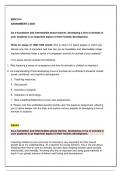
7 SECTION A: MARKING GRID
Please ensure that you complete all the activities in this document. Write your answers as fully
and as detailed as you can. This document sums up everything you are expected to do in the
five weeks of teaching practice. You worked hard and you should be credited for it. The
following marking grid is used in the marking of this portfolio or workbook
(TPF2601/104/0/2021).
SECTIONS MARK ALLOCATIONS
SECTION A: 13
GENERAL STUDENT INFORMATION 4
STUDENT DECLARATION 2
STUDENT DECLARATION FORM 2
ATTENDANCE REGISTER OF STUDENT TEACHER AT SCHOOL
5
SECTION B: EMERGENT MATHEMATICS
80
Activity 1 10
Activity 2 10
Activity 3 50
Activity 4 10
SECTION C: EMERGENT LITERACY
75
Activity 5 30
Activity 6 17
Activity 7 28
SECTION D: CURRICULUM PROGRESSION 32
Activity 8 32
Take Note
Submission of one portfolio Absent from exam
, Register not included O% - portfolio will not be
marked
Register with incomplete dates – e.g., 01/June O mark
No school stamp and signatures 0%
8. SECTION B: EMERGENT MATHEMATICS
ACTIVITY 1 (9)
In EMA1501 Unit 1, we have learned that children are exposed to emergent mathematics
through play. Play is often referred to as child’s work because it is the way that children
experience life and can make sense of the world around them. It is therefore, as we have
said, through play that children discover and learn mathematical concepts. It is important
that many opportunities be provided for play. We have also learned that there are six types
of play. Observe your mentor teacher in practice and identify at least three types of play.
Explain how she/he provided or planned activities that afforded learners opportunities to
learn.
Play 1 (e.g., Parallel Play):
During free playtime, I noticed that children were engaged in activities alongside each other,
such as building with blocks or playing in the sandpit. Although they were not directly
interacting, they were observing each other's actions and learning through their own
exploration.
Play 2 (e.g., Associative Play):
In small group activities, the teacher encouraged children to work together on tasks like
puzzles or board games. This type of play allowed them to share ideas and materials,
fostering cooperation and social interaction.
Play 3 (e.g., Cooperative Play):
During structured group activities, the teacher organized games that required teamwork,
such as relay races or building projects. These activities encouraged children to collaborate,
communicate, and problem-solve together, promoting a deeper understanding of
mathematical concepts.
2
PREVIEW
PORTFOLIO, PICTURES INCLUDED.
NATALIE FOXX
TPF2601
ASSIGNMENT 51 2024
,NATALIE FOXX
7 SECTION A: MARKING GRID
Please ensure that you complete all the activities in this document. Write your answers as fully
and as detailed as you can. This document sums up everything you are expected to do in the
five weeks of teaching practice. You worked hard and you should be credited for it. The
following marking grid is used in the marking of this portfolio or workbook
(TPF2601/104/0/2021).
SECTIONS MARK ALLOCATIONS
SECTION A: 13
GENERAL STUDENT INFORMATION 4
STUDENT DECLARATION 2
STUDENT DECLARATION FORM 2
ATTENDANCE REGISTER OF STUDENT TEACHER AT SCHOOL
5
SECTION B: EMERGENT MATHEMATICS
80
Activity 1 10
Activity 2 10
Activity 3 50
Activity 4 10
SECTION C: EMERGENT LITERACY
75
Activity 5 30
Activity 6 17
Activity 7 28
SECTION D: CURRICULUM PROGRESSION 32
Activity 8 32
Take Note
Submission of one portfolio Absent from exam
, Register not included O% - portfolio will not be
marked
Register with incomplete dates – e.g., 01/June O mark
No school stamp and signatures 0%
8. SECTION B: EMERGENT MATHEMATICS
ACTIVITY 1 (9)
In EMA1501 Unit 1, we have learned that children are exposed to emergent mathematics
through play. Play is often referred to as child’s work because it is the way that children
experience life and can make sense of the world around them. It is therefore, as we have
said, through play that children discover and learn mathematical concepts. It is important
that many opportunities be provided for play. We have also learned that there are six types
of play. Observe your mentor teacher in practice and identify at least three types of play.
Explain how she/he provided or planned activities that afforded learners opportunities to
learn.
Play 1 (e.g., Parallel Play):
During free playtime, I noticed that children were engaged in activities alongside each other,
such as building with blocks or playing in the sandpit. Although they were not directly
interacting, they were observing each other's actions and learning through their own
exploration.
Play 2 (e.g., Associative Play):
In small group activities, the teacher encouraged children to work together on tasks like
puzzles or board games. This type of play allowed them to share ideas and materials,
fostering cooperation and social interaction.
Play 3 (e.g., Cooperative Play):
During structured group activities, the teacher organized games that required teamwork,
such as relay races or building projects. These activities encouraged children to collaborate,
communicate, and problem-solve together, promoting a deeper understanding of
mathematical concepts.
2