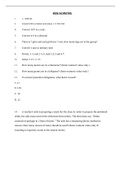
NSG5003 WEEK 2, ADVANCED PATHOPHYSIOLOGY STUDY GUIDE
1. Which action is a purpose of the inflammatory process? a. To provide specific responses toward antigens b. To lyse cell membranes of microorganisms c. To prevent infection of the injured tissue d. To create immunity against subsequent tissue injury 2. How do surfactant proteins A through D provide innate resistance? a. Initiate the complement cascade. c. Secrete mucus. b. Promote phagocytosis. d. Synthesize lysosomes. 3. Which secretion is a first line of defense against pathogen invasion that involves antibacterial and antifungal fatty acids, as well as lactic acid? a. Optic tears c. Sweat gland perspiration b. Oral saliva d. Sebaceous gland sebum 4. Which bacterium grows in the intestines after prolonged antibiotic therapy? a. Lactobacillus c. Clostridium difficile b. Candida albicans d. Helicobacter pylori 5. What causes the edema that occurs during the inflammatory process? a. Vasodilation of blood vessels c. Endothelial cell contraction b. Increased capillary permeability d. Emigration of neutrophils 6. What process causes heat and redness to occur during the inflammatory process? a. Vasodilation of blood vessels c. Decreased capillary permeability b. Platelet aggregation d. Endothelial cell contraction 7. Activation of the classical pathway begins with: a. Viruses c. Mast cells b. Antigen-antibody complexes d. Macrophages 8. What plasma protein system forms a fibrinous meshwork at an inflamed site? a. Complement c. Kinin b. Coagulation d. Fibrinolysis 9. Which component of the plasma protein system tags pathogenic microorganisms for destruction by neutrophils and macrophages? a. Complement cascade c. Kinin system b. Coagulation system d. Immune system 10. What is the vascular effect of histamine released from mast cells? a. Platelet adhesion c. Vasodilation b. Initiation of the clotting cascade d. Increased endothelial adhesiveness 11. What is an outcome of the complement cascade? a. Activation of the clotting cascade
Escuela, estudio y materia
- Institución
- NSG5003 W
- Grado
- NSG5003 W
Información del documento
- Subido en
- 13 de mayo de 2024
- Número de páginas
- 48
- Escrito en
- 2023/2024
- Tipo
- Examen
- Contiene
- Preguntas y respuestas
Temas
-
nsg5003 week 2 advanced pathophysiology study gi
-
nsg5003 week 2 advanced pathophysiology study g
-
nsg5003 week 2 advanced pathophysiology study g