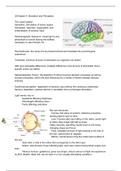
22Chapter 4: Sensation and Perception
The visual system:
Sensation: stimulation of sense organs
Perception: selection, organization and
interpretation of sensory input
Electromagnetic Spectrum: visual light is only
percentual to human lacking the abilities
necessary to see infrared, UV…
Psychophysics: the study of how physical stimuli are translated into psychological
experience
Threshold: minimum amount of stimulation an organism can detect
JND (just noticeable difference): smallest difference in the amount of stimulation that a
specific sense can detect
Signal-Detection Theory: the detection of stimuli involves decision processes as well as
sensory processes, which are both influenced by a variety of factors besides stimulus
intensity
Subliminal perception: registration of sensory input without the conscious awareness
Sensory adaptation: gradual decline in sensibility due to prolonged stimulation
Light waves vary in:
Amplitude affecting brightness
Wavelength affecting colour
Purity affecting saturation
Key eye structures:
Cornea: first place of contact, refractive properties,
bending light to land on lens
Lens: focuses light rays falling on the retina, sends light
to retina, flips image right left up down
Ciliary muscles: squinting, exerts force on the lense,
changing shape and focus
Pupil: regulates amount of light passing in the rear of
the eye, open/closes to regulate
Retina: neutral tissue lining the inside back surface of
the eye
Optic disk: a hole in the retina that corresponds to the blind spot
Sclera: area at back of eye reflecting light, area near sclera having blood supply (red
eye)
Vitreous humour: gelatinous, gives eye shape, reduce amount of light we experience
by 80% (floater: dead cell, can be seen in a non-visually stimulating condition)
, Fovea: a tiny spot in the centre of the retina where visual acuity is greatest
Myopia (close sighted)
Hyperopia (farsighted, older people,
eyeballs shrink as we age,
corrective lense to compensate)
Lasik eye surgery: anesthetize
tissue, device that insicies cornea,
reshape, replace flap, effective for a
variety of different conditions
20/20 vision: Snellen chart, what
you can see at (insert number)/what
normal people can see at (insert
number)
Cells of the retina:
Rods: low illumination, black and
white, not on
fovea (where image flips)
Cones: colour, high illumination, prominent on
the fovea
Electromagnetic radiation (light waves, trying to
be convert into neural impulses (which brain
can understand, physical energy to electric)
Ganglion cells: 1 million axons of G
cells, bundle together forming the optic nerve,
information beyond passed on out of the eye to
the brain sensory relay centre aka thalamus, to
occipital lobe and primary visual cortex for
visual processing (optic chiasm, left to write
and vice versa, crossover)
Dark adaptation: vision improves in the dark, progressive improvement in light
sensitivity under conditions of low illumination (ex. engine that is cold), sensitivity to light
Colour vision:
Trichromatic theory: cone receptors sensitive to different wavelengths (red, blue,
green)
Opponent-process theory: red-green, yellow-blue, white-black
Color Blindness: trichromat (every colour), monochromat (absolutely no color), deuratomalia
(colours are less vibrant), protanopia (subduing of the red-green), tritanopia (yellow-blue)
Visual perception: selection, organization and interpretation of visual sensory input
Feature detection: areas of the brain fire selectively in response to stimuli that have
specific characteristics, allow understanding of words on page (combination of lines
perceived as letters)
Gestalt psychologists: “The whole is greater than the sum of its parts”
Figure ground
The visual system:
Sensation: stimulation of sense organs
Perception: selection, organization and
interpretation of sensory input
Electromagnetic Spectrum: visual light is only
percentual to human lacking the abilities
necessary to see infrared, UV…
Psychophysics: the study of how physical stimuli are translated into psychological
experience
Threshold: minimum amount of stimulation an organism can detect
JND (just noticeable difference): smallest difference in the amount of stimulation that a
specific sense can detect
Signal-Detection Theory: the detection of stimuli involves decision processes as well as
sensory processes, which are both influenced by a variety of factors besides stimulus
intensity
Subliminal perception: registration of sensory input without the conscious awareness
Sensory adaptation: gradual decline in sensibility due to prolonged stimulation
Light waves vary in:
Amplitude affecting brightness
Wavelength affecting colour
Purity affecting saturation
Key eye structures:
Cornea: first place of contact, refractive properties,
bending light to land on lens
Lens: focuses light rays falling on the retina, sends light
to retina, flips image right left up down
Ciliary muscles: squinting, exerts force on the lense,
changing shape and focus
Pupil: regulates amount of light passing in the rear of
the eye, open/closes to regulate
Retina: neutral tissue lining the inside back surface of
the eye
Optic disk: a hole in the retina that corresponds to the blind spot
Sclera: area at back of eye reflecting light, area near sclera having blood supply (red
eye)
Vitreous humour: gelatinous, gives eye shape, reduce amount of light we experience
by 80% (floater: dead cell, can be seen in a non-visually stimulating condition)
, Fovea: a tiny spot in the centre of the retina where visual acuity is greatest
Myopia (close sighted)
Hyperopia (farsighted, older people,
eyeballs shrink as we age,
corrective lense to compensate)
Lasik eye surgery: anesthetize
tissue, device that insicies cornea,
reshape, replace flap, effective for a
variety of different conditions
20/20 vision: Snellen chart, what
you can see at (insert number)/what
normal people can see at (insert
number)
Cells of the retina:
Rods: low illumination, black and
white, not on
fovea (where image flips)
Cones: colour, high illumination, prominent on
the fovea
Electromagnetic radiation (light waves, trying to
be convert into neural impulses (which brain
can understand, physical energy to electric)
Ganglion cells: 1 million axons of G
cells, bundle together forming the optic nerve,
information beyond passed on out of the eye to
the brain sensory relay centre aka thalamus, to
occipital lobe and primary visual cortex for
visual processing (optic chiasm, left to write
and vice versa, crossover)
Dark adaptation: vision improves in the dark, progressive improvement in light
sensitivity under conditions of low illumination (ex. engine that is cold), sensitivity to light
Colour vision:
Trichromatic theory: cone receptors sensitive to different wavelengths (red, blue,
green)
Opponent-process theory: red-green, yellow-blue, white-black
Color Blindness: trichromat (every colour), monochromat (absolutely no color), deuratomalia
(colours are less vibrant), protanopia (subduing of the red-green), tritanopia (yellow-blue)
Visual perception: selection, organization and interpretation of visual sensory input
Feature detection: areas of the brain fire selectively in response to stimuli that have
specific characteristics, allow understanding of words on page (combination of lines
perceived as letters)
Gestalt psychologists: “The whole is greater than the sum of its parts”
Figure ground