OEC Test Questions with Correct Answers
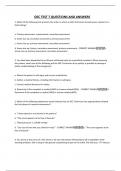
OEC Test Questions with Correct Answers Who and when founded NSP? - Answer-Minnie Dole 1938 What is the difference between standard of training and standard of care. - Answer-The standard of training is the all the information in the OEC text book and training. The standard of care is controlled by the protocols of the mountain. When the public sees you at an accident in uniform even if you are off duty they may expect you to act. This is called what? - Answer-Public reliance Radio Etiquette is dictated by what? - Answer-Mountain policy and protocol. The umbrella that covers every facet of health care is called what? - Answer-Public Health. What is the difference between indirect and direct oversight. - Answer-Direct oversight is when the EMR is being guided directly by a doctor by any means of communication. Where indirect oversight deals with the protocols for care that EMR's can administer without the need of doctor guidance. What is the key goal of a first responder. - Answer-To identify and modify a medical condition. The hypothalamus does what? - Answer-Regulates body temperature. What can carry and transfer vector borne illnesses? - Answer-Ticks, Mosquitoes and other insects. Good Samaritan laws apply to who? - Answer-Volunteers and Volunteer organizations. Due the the increase of adrenaline and epinephrine in a flight or fight response, what physiological changes occur? - Answer-Increased blood flow to skeletal muscles, increased heart rate, and increased blood pressure. What part of the body plays a major role in the body's autonomic systems? - AnswerThe brain stem. What is the primary responsibility of an Incident Command System. (ICS) - AnswerGathers and organizes all emergency responders and establishes common terminology. What are the five functional areas of an ICS. - Answer-Assume command of incident, establish an incident command post, provide overall incident management, determine incident objectives and strategies, determine/develop the organizational structure needed to manage the incident. When in triage we use the acronym START (Triage and rapid transport) What are the the three key components that must be assessed for each patient. - AnswerRespiration, Pulse, and Mental Status. A patient in the Semi-Fowler position would look like what? - Answer-A sitting position with the thoracic area at 45 degrees. How does one accomplish a power grip? - Answer-Palms up and and 10 inches apart. What is the primary benefit of Triage? - Answer-To quickly identify patient need based upon clinical signs and symptoms. Involuntary muscles are found where? - Answer-Organs and blood vessels. A patient lying on their back with their left leg turned in could be described as what? - Answer-Suspine with a medial rotation of the lower left extremity. Describe the difference between proximal and distal. - Answer-Proximal means closer to the core, where distal means away from the core. What is MOI? - Answer-Mechanism of Injury. What is NOI? - Answer-Nature of Illness. Describe a primary assessment. - Answer-ABCD's Describe a secondary assessment. - Answer-History (SAMPLE), Exam, Vitals
Escuela, estudio y materia
- Institución
- OEC
- Grado
- OEC
Información del documento
- Subido en
- 10 de mayo de 2024
- Número de páginas
- 7
- Escrito en
- 2023/2024
- Tipo
- Examen
- Contiene
- Preguntas y respuestas
Temas
-
oec
-
oec test
-
oec test questions
-
oec test questions with correct answers

Documento también disponible en un lote