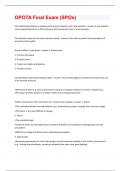
OPOTA Final Exam (SPOs) questions and answers all are graded A+
The relationship between a student performance objective and a test question - Answer-A test question must respond directly to an SPO and every SPO may be the basis of a test question The ultimate reason for law enforcement training - Answer-To be able to protect life and property of yourself and the public A peace officer's main goals - Answer-1. Enforce laws 2. Preserve the peace 3. Prevent crimes 4. Protect civil rights and liberties 5. Provide services Considerations when exercising discretion - Answer-•Use sound judgment to determine which laws are to be formally enforced •Determine if there is a more constructive remedy to a situation without an arrest or citation (e.g., referring a homeless person to a shelter rather than a trespassing arrest) Factors necessary for the commission of a crime (crime triangle) - Answer-1. Desire •The motivation behind criminal behavior (e.g., financial gain, power, revenge, fear, narcotics usage) •This factor is the most difficult to change 2. Victim •The potential target •Criminals prefer an easy target that is unaware of his/her surroundings or lacking proper security precautions •Difficult to change this factor due to individual personalities 3. Opportunity •Removing opportunity for crime with proper security measures applied to the victim's environment (e.g., locking doors/windows, removing valuables from open view, good lighting)•Most effective area to concentrate crime prevention strategies Core concepts of community policing - Answer-- a partnership between the police and the community - crime prevention - organizational change of the agency - a problem- solving approach to the police role that is proactive Considerations for off duty situations - Answer-1. Behavior •An officer's behavior is often scrutinized by the community even when not on duty •Not only does this refer to physical and verbal actions, but also online activity on social media •An officer is expected to uphold the law enforcement code of ethics 2. Situational awareness •An officer should make every effort to remain alert even when not working •You never know when you may need to transition quickly from a private citizen to a peace officer •Make certain to preplan with your family should a situation arise while together. Create a number of scenarios for your family to practice •Familiarize yourself with your agency's off duty weapon policy Be a good witness if a situation arises when police intervention is necessary •If the situation involves a reasonable belief of serious physical harm, provide a response as soon as practical •However, if the situation is less serious, the best course of action is to observe the incident until uniformed officers respond •If you become involved, make contact withdispatch as soon as possible to provide information about the incident and information about yourself (e.g., clothing you are wearing, car you are driving, description of offenders and victims, pertinent officer safety information) State the purpose of the bill of rights - Answer-- protect an individual's freedoms - prevent the government from interfering in protected rightsDescribe the major components of the criminal justice system - Answer-1. Law enforcement 2. Courts 3. Corrections List the goals of sentencing - Answer-1. punish the offender and in many cases, rehabilitate the offender 2. Protect society 3. Restore the victim as much as possible The concepts of lawful actions and police legitimacy - Answer-1. Lawful - defined by laws and standards •Criminal law - identifies what actions are prohibited •Rules of agency (e.g., administrative rules, general orders, standard operating procedures) •Constitutional law (e.g., Fourth, Fifth, Sixth Amendments) •Officers can act lawfully and within the parameters of agency policy and the citizenry still not perceive there to be police legitimacy - there can be lawful, but awful interactions 2. Police legitimacy - exists when the public views the police as authorized to exercise power in order to maintain social order, manage conflicts, and solve problems in the community
Escuela, estudio y materia
- Institución
- OPOTA
- Grado
- OPOTA
Información del documento
- Subido en
- 9 de mayo de 2024
- Número de páginas
- 139
- Escrito en
- 2023/2024
- Tipo
- Examen
- Contiene
- Preguntas y respuestas
Temas
-
opota

Documento también disponible en un lote