

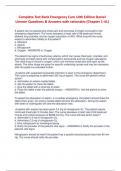
Complete Test Bank Emergency Care 14th Edition Daniel Limmer Questions & Answers with rationales (Chapter 1 -41) A patient who is experiencing chest pain and shortness of breath is brought to the emergency department. The nurse assesses a heart rate of 98 beats per minute, bilateral lung crackles, and an oxygen saturation of 93%. What drug will the nurse expect to ad minister initially to this patient? a. Albuterol b. Aspirin c. Nitroglycerin d. Oxygen - ANSWERS d. Oxygen The patient has signs of pulmonary edema, which can cause chest pain, crackles, and shortness of breath along with compensatory tachycardia and low oxygen saturations. The initial drug of choice is oxygen, which can minimize chest pain and open up the alveoli. The other drugs are given for specific underlying causes and may be necessary after the patient is evaluated further. A patient with suspected myocardial infarction is seen in the emergency department. The nurse is preparing to administer 325 mg of aspirin. The nurse will perform which action? a. Administer an enteric -coated tablet. b. Ask the patient to chew the tablet. c. Give the tablet with a small sip of water. d. Place the tablet under the patients tongue. - ANSWERS b. Ask the patient to chew the tablet. To speed the absorption of aspirin, in a cardiac emergency, the patient should chew the tablet when given. An enteric -coated tablet will slow the absorption. Giving the aspirin with water or sublingually will slow the absorption rate. A patient with angina has been given 0.4 mg of nitroglycerin SL. The patient reports continued chest pain 5 minutes later. The nurse assesses a heart rate of 84 beats per minute and a blood pressure of 88/68 mm Hg. The nurse will take which action? a. Administer 0.4 mg of nitroglycerin SL. b. Administer 0.3 mg of nitroglycerin SL. c. Give nitroglycerin by translingual spray. d. Notify the provider of the patients vital signs. - ANSWERS d. Notify the provider of the patients vital signs. Nitroglycerin should be held if the patient has a systolic blood pressure less than 90 mm Hg. The nurse should notify the provider.
Vista previa 1 fuera de 4 páginas
Examen
Complete Test Bank Emergency Care 14th Edition Daniel Limmer Questions & Answers with rationales (Chapter 1-41
Vista previa 1 fuera de 4 páginas
Complete Test Bank Emergency Care 14th Edition Daniel Limmer Questions & Answers with rationales (Chapter 1-41) A patient who is experiencing chest pain and shortness of breath is brought to the emergency department. The nurse assesses a heart rate of 98 beats per minute, bilateral lung crackles, and an oxygen saturation of 93%. What drug will the nurse expect to administer initially to this patient? a. Albuterol b. Aspirin c. Nitroglycerin d. Oxygen - ANSWERS d. Oxygen The patient has signs of pulmonary edema, which can cause chest pain, crackles, and shortness of breath along with compensatory tachycardia and low oxygen saturations. The initial drug of choice is oxygen, which can minimize chest pain and open up the alveoli. The other drugs are given for specific underlying causes and may be necessary after the patient is evaluated further. A patient with suspected myocardial infarction is seen in the emergency department. The nurse is preparing to administer 325 mg of aspirin. The nurse will perform which action? a. Administer an enteric-coated tablet. b. Ask the patient to chew the tablet. c. Give the tablet with a small sip of water. d. Place the tablet under the patients tongue. - ANSWERS b. Ask the patient to chew the tablet. To speed the absorption of aspirin, in a cardiac emergency, the patient should chew the tablet when given. An enteric-coated tablet will slow the absorption. Giving the aspirin with water or sublingually will slow the absorption rate. A patient with angina has been given 0.4 mg of nitroglycerin SL. The patient reports continued chest pain 5 minutes later. The nurse assesses a heart rate of 84 beats per minute and a blood pressure of 88/68 mm Hg. The nurse will take which action? a. Administer 0.4 mg of nitroglycerin SL. b. Administer 0.3 mg of nitroglycerin SL. c. Give nitroglycerin by translingual spray. d. Notify the provider of the patients vital signs. - ANSWERS d. Notify the provider of the patients vital signs. Nitroglycerin should be held if the patient has a systolic blood pressure less than 90 mm Hg. The nurse should notify the provider. A patient with congestive heart failure and pulmonary edema is experiencing chest pain. The patient has an order for morphine sulfate IV 4 mg every 5 to 30 minutes PRN until chest pain is relieved. The last dose of 4 mg was 15 minutes prior, and the patient is complaining of chest pain and exhibiting increased work of breathing. The nurse notes a heart rate of 82 beats per minute, a respiratory rate of 18 breaths per minute, and a blood pressure of 135/88 mm Hg. What will the nurse do next? a. Administer morphine sulfate IV 4 mg over 1 to 5 minutes. b. Administer naloxone (Narcan) to reverse respiratory depression. c. Request an order for morphine sulfate IV 2 mg over 1 to 5 minutes. d. Hold the next dose and notify the provider of the patients symptoms. - ANSWERS a. Administer morphine sulfate IV 4 mg over 1 to 5 minutes. Morphine acts to relieve pain, dilate venous vessels, and decrease the workload on the heart to treat acute cardiogenic pulmonary edema and can relieve the dyspnea caused by this condition. The nurse should administer 4 mg since the patients pain has not abated. Respiratory depression would be characterized by a decreased respiratory rate. A patient is brought to the emergency department after coming in contact with organophosphate insecticides while at work. The nurse will expect to administer which medication to reverse the toxic effects of this substance? a. Atropine sulfate b. Diazepam c. Epinephrine d. Flumazenil - ANSWERS a. Atropine sulfate Atropine is used to counter the toxic effects of organophosphate insecticides. Diazepam is given for seizures and for acute alcohol withdrawal. Epinephrine is used for anaphylactic shock. Flumazenil is given as an antidote for benzodiazepine overdose. An 18-month-old toddler is in the emergency department with poor feeding and lethargy. The nurse assesses a rapid, thready pulse, which is too fast to count. The nurse will expect the provider to order which medication to treat this condition? a. Adenosine b. Albuterol c. Atropine d. Theophylline - ANSWERS a. Adenosine Adenosine is given for supraventricular tachycardia. Albuterol and theophylline are bronchodilators, and both will increase the heart rate. Atropine is given for bradycardia and is contraindicated. The nurse is administering amiodarone to a patient who is being treated for a ventricular arrhythmia. The patient has received a bolus of 150 mg of amiodarone IV and is now receiving a continuous infusion of 1 mg/minute. The nurse notes a heart rate of 60 beats per minute and a blood pressure of 88/54 mm Hg. The nurse will notify the provider and perform which other action? a. Continue the amiodarone infusion at 1 mg/minute. b. Decrease the rate of the amiodarone infusion to 0.5 mg/minute. c. Increase the rate of the amiodarone infusion to 1.5 mg/minute. d. Stop the infusion of amiodarone. - ANSWERS b. Decrease the rate of the amiodarone infusion to 0.5 mg/minute. Amiodarone has significant adverse effects of hypotension and bradycardia. When these occur, the nurse should slow the infusion rate to prevent or treat these effects. The nurse is caring for a patient who is receiving magnesium sulfate for ventricular tachycardia. The nurse assesses a heart rate of 68 beats per minute, a respiratory rate of 10 breaths per minute, a blood pressure of 90/60 mm Hg, and decreased deep tendon reflexes. The nurse understands that these are signs of which condition? a. Hyperkalemia b. Hypermagnesemia c. Impending cardiac arrest d. Renal compromise - ANSWERS b. Hypermagnesemia Patients with hypermag
Vista previa del contenido
Información del documento
- Subido en
- 9 de mayo de 2024
- Número de páginas
- 4
- Escrito en
- 2023/2024
- Tipo
- Examen
- Contiene
- Preguntas y respuestas
$14.49
¿Documento equivocado? Cámbialo gratis
Dentro de los 14 días posteriores a la compra y antes de descargarlo, puedes elegir otro documento. Puedes gastar el importe de nuevo.
Escrito por estudiantes que aprobaron
Inmediatamente disponible después del pago
Leer en línea o como PDF

Los indicadores de reputación están sujetos a la cantidad de artículos vendidos por una tarifa y las reseñas que ha recibido por esos documentos. Hay tres niveles: Bronce, Plata y Oro. Cuanto mayor reputación, más podrás confiar en la calidad del trabajo del vendedor.
