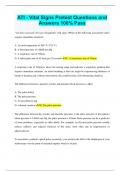
ATI - Vital Signs Pretest Questions and Answers 100% Pass
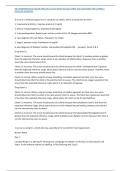
You have assessed a 45-year-old patient's vital signs. Which of the following assessment values requires immediate attention? A. An oral temperature of 100° F (37.8° C) B. A blood pressure of 148/88 mm Hg C. A respiratory rate of 30/min D. A radial pulse rate of 45 beats per 30 seconds C. A respiratory rate of 30/min A respiratory rate of 30/min is above the normal range and indicates a respiratory problem that requires immediate attention. An adult breathing at that rate might be experiencing shortness of breath or dyspnea and, without intervention, this could become a life-threatening situation. The difference between a patient's systolic and diastolic blood pressure is called A. The pulse deficit B. The pulse pressure C. An auscultatory gap D. a diurnal variation B. The pulse pressure The difference between the systolic and diastolic pressures is the pulse pressure; if the patient's blood pressure is 130/85 mm Hg, the pulse pressure is 45/min. Pulse pressure can be a predictor of heart problems, especially in older adults. For example, an elevated pulse pressure usually reflects stiffness and reduced elasticity of the aorta, most often due to hypertension or atherosclerosis. To auscultate a patient's apical pulse accurately, you position the bell or the diaphragm of your stethoscope over the point of maximal impulse which is located
Escuela, estudio y materia
- Institución
- ATI - Vital Signs Pretest Q
- Grado
- ATI - Vital Signs Pretest Q
Información del documento
- Subido en
- 8 de mayo de 2024
- Número de páginas
- 6
- Escrito en
- 2023/2024
- Tipo
- Examen
- Contiene
- Preguntas y respuestas
Temas
-
ati vital signs pretest questions and answers 10

Documento también disponible en un lote