Organizational change (Articles 1-3)
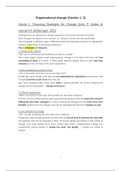
Article 1: Choosing Strategies for Change (John P. Kotter &
Leonard A. Schlesinger, 2013
All people who are affected by change experience some level of emotional turmoil.
Even changes that appear to be ‘’positive’’ or ‘’rational’’ involve loss and uncertainty.
This can appear in different ways in different people from passively resisting it to aggressively
trying to undermine it to sincerely embracing it
Part 1 4 Reasons of resistance
1. Parochial self-interest.
‘’Will I (as an individual) lose something of value as a result?’’
One major reason people resist organizational change is that they think they will lose
something of value as a result. In these cases, because people focus on their own best
interests and not on those of the total organization
2. Misunderstanding and lack of trust.
‘’How is this better from the one we are using now?’’
People also resist change when they do not understand its implications and perceive that
it might cost them much more than they will
gain. Such situations often occur when trust is lacking between the person initiating the
change and the employees → flexible work hours
3. Different assessments.
‘’Won’t this result to more costs than benefits for the whole company?’’
Another common reason people resist organizational change is that they assess the situation
differently from their managers or those initiating the change and see more costs than
benefits resulting from the change, not only for themselves but for their company as well.
4. Low tolerance for change.
‘’Will I be able to develop the new skills I’d be needing?’’
People also resist change because they fear they will not be able to develop the new skills
and behavior that will be required of them. All human beings are limited in their ability to
change, with some people much more limited than others. Organizational Change can
inadvertently require people to change too much, too quickly. → people are unable to
change
1
, Dealing with resistance
The most common mistake managers make is to use only one approach or a limited set of
Them regardless of the situation
.Education + communication:
- 1 of the most common ways to overcome resistance to change is to educate people
about it beforehand
→ helps the people to see the need and logic for change
- One-on-one discussions, presentations to groups or memos and reports
Participation + involvement
- If the initiators involve the potential resisters in some aspect of the design and
implementation of the change, they can often forestall resistance.
- Can lead to a poor solution if not carefully managed + timeconsuming
Facilitation + support:
- Another way that managers can deal with potential resistance to change is by being
supportive
- can include: providing training in new skills, or giving employees time off after a
demand- ing period, or simply listening and providing emotional support.
- Can be time-consuming and expensive and still fail
Negotiation + agreement
- To offer incentives to active or potential resisters
- Negotiation is particularly appropriate when it is clear that someone is going to lose
out as a result of a change and yet his or her power to resist is significant.
Manipulation + co-optation
- In some situations, managers also resort to covert attempts to influence others.
Manipulation, in this context, normally involves the very selective use of information
and the conscious structuring of events.
2
Article 1: Choosing Strategies for Change (John P. Kotter &
Leonard A. Schlesinger, 2013
All people who are affected by change experience some level of emotional turmoil.
Even changes that appear to be ‘’positive’’ or ‘’rational’’ involve loss and uncertainty.
This can appear in different ways in different people from passively resisting it to aggressively
trying to undermine it to sincerely embracing it
Part 1 4 Reasons of resistance
1. Parochial self-interest.
‘’Will I (as an individual) lose something of value as a result?’’
One major reason people resist organizational change is that they think they will lose
something of value as a result. In these cases, because people focus on their own best
interests and not on those of the total organization
2. Misunderstanding and lack of trust.
‘’How is this better from the one we are using now?’’
People also resist change when they do not understand its implications and perceive that
it might cost them much more than they will
gain. Such situations often occur when trust is lacking between the person initiating the
change and the employees → flexible work hours
3. Different assessments.
‘’Won’t this result to more costs than benefits for the whole company?’’
Another common reason people resist organizational change is that they assess the situation
differently from their managers or those initiating the change and see more costs than
benefits resulting from the change, not only for themselves but for their company as well.
4. Low tolerance for change.
‘’Will I be able to develop the new skills I’d be needing?’’
People also resist change because they fear they will not be able to develop the new skills
and behavior that will be required of them. All human beings are limited in their ability to
change, with some people much more limited than others. Organizational Change can
inadvertently require people to change too much, too quickly. → people are unable to
change
1
, Dealing with resistance
The most common mistake managers make is to use only one approach or a limited set of
Them regardless of the situation
.Education + communication:
- 1 of the most common ways to overcome resistance to change is to educate people
about it beforehand
→ helps the people to see the need and logic for change
- One-on-one discussions, presentations to groups or memos and reports
Participation + involvement
- If the initiators involve the potential resisters in some aspect of the design and
implementation of the change, they can often forestall resistance.
- Can lead to a poor solution if not carefully managed + timeconsuming
Facilitation + support:
- Another way that managers can deal with potential resistance to change is by being
supportive
- can include: providing training in new skills, or giving employees time off after a
demand- ing period, or simply listening and providing emotional support.
- Can be time-consuming and expensive and still fail
Negotiation + agreement
- To offer incentives to active or potential resisters
- Negotiation is particularly appropriate when it is clear that someone is going to lose
out as a result of a change and yet his or her power to resist is significant.
Manipulation + co-optation
- In some situations, managers also resort to covert attempts to influence others.
Manipulation, in this context, normally involves the very selective use of information
and the conscious structuring of events.
2