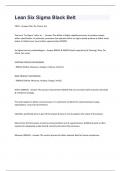
Lean Six Sigma Black Belt Complete Questions And Answers
PDCA - Answer-Plan, Do, Check, Act The term "Six Sigma" refers to... - Answer-The ability of highly capable processes to produce output within specification. In particular, processes that operate within six sigma quality produce a defect levels below 3.4 defects per (one) million opportunities (DPMO). Six Sigma two key methodologies - Answer-DMAIC & DMADV (both inspired by W. Deming's Plan, Do, Check, Act cycle) EXISTING PROCESS OR BUSINESS - DMAIC (Define, Measure, Analyze, Improve, Control) NEW PRODUCT OR PROCESS - DMADV (Define, Measure, Analyze, Design, Verify) Define (DMAIC) - Answer-The process improvement GOALS that are consistent with customer demands & enterprise strategy. First asks leaders to define core processes. It is important to define the selected project scope, expectations, resources & timeliness. Identifies specifically what is part of the project & what is not, & explains the scope of the project. Many times the first passes at process documentation are at a general level. Additional work is often required to adequately understand & correctly document the processes. Measure (DMAIC) - Answer-The current process & collect relevant data for future comparison.Six Sigma approach asks the Black Belt project manager to quantify & benchmark the process using actual data. at a minimum consider the mean or average dispersion or variation (maybe, even calculate the standard deviation). Trends & cycles can also be very revealing. Process capabilities can be calculated once there is performance data. Analyze (DMAIC) - Answer-To verify relationship & causality of factors. Determine what the relationship is & attempt to ensure that all factors have been considered. Once the project is understood & the baseline performance documented & verified that there is real opportunity, it is time to do the analysis of the process. In this step, apply statistical tools to validate root causes of problems. Any number of tools & tests can be used. The objective is to understand the process at a level, sufficient to be able to formulate options for improvement. We should be able to compare the various options with each other to determine the most promising alternatives. Superficial analysis & understanding will lead to unproductive options being selected, forcing recycle through the process to make improvements. At the other extreme is thorough analysis of only a few activities. Improve (DMAIC) - Answer-Or "Optimize" the process based upon the analysis using techniques like "Design of Experiments". During this phase, ideas & solutions are put to work. The Black Belt has discovered & validated all known root causes for the existing opportunity. Approach requires Black Belt to identify solutions. There must be checks to assure that the desired results are being achieved. Some experiments & trials may be required in order to find the best solution. While doing this, it is important that all project associates understand that these are trials & really are part of the six sigma approach. Control (DMAIC) - Answer-To ensure that any variances are corrected before they result in defects. Set up pilot runs to establish "process capability", transition to production & thereafter continuously measure the process & institute control mechanisms.Many people think the best performance you can ever get from a process is at the very beginning. Over time, there is an expectation that slowly things will get a little worse until finally it is time for another major effort toward improvement. Contrasted with the Kaizen approach that seeks to make everything incrementally better on a continuous basis. The sum of incremental improvements can be quite large. Performance tracking mechanisms & measurements are in place to assure, at a minimum, that the gains made in the project are not lost over a period of time. Encouraged sharing with others in the organization. Ideas & projects in one part of the organization are translated in a very rapid fashion to implementation in another part of the organization. Executive Leadership (Implementation Roles) - Answer-Includes CEO & other key top management team members. They are responsible for setting up a vision for Six Sigma implementation. They also empower the other role holders with the freedom & resources to explore new ideas for breakthrough improvements. Champions (Implementation Roles) - Answer-Are responsible for the Six Sigma implementation across the organization in an integrated manner. The Executive Leadership draw them from the upper management. Champions also act as mentors to Black Belts. At GE this level of certification is not called "Quality Leader". Master Black Belt (Implementation Roles) - Answer-Identified by Champions, act as in-house expert coaches for the organization on Six Sigma. They devote 100% of their time to Six Sigma. They assist Champions & guide Black Belts & Green Belts. Apart from the usual rigor of statistics, their time is spent on ensuring integrated deployment of Six Sigma across various functions & departments. Experts (Implementation Roles) - Answer-This level of skill is used primarily within Aerospace & Defense Business Sectors. Experts work across company boundaries, improving services, processes, & products for their suppliers, their entire campuses, & for their customers.Raytheon Inc. was one of the first companies to introduce Experts to their organization. At Raytheon, Experts work not only across multiple sites, but across business divisions, incorporating lessons learned throughout the company. Black Belt (Implementation Roles) - Answer-Operate under Master Black Belts to apply Six Sigma methodology to specific projects. They devote 100% of their time to Six Sigma. They primarily focus on Six Sigma project execution, whereas Champions & Master Black Belts focus on identifying projects/functions for Six Sigma. Green Belt (Implementation Roles) - Answer-Are the employees who take up Six Sigma implementation along with their other job responsibilities. They operate under the guidance of Black Belts & support them in achieving the overall results. Yellow Belts (Implementation Roles) - Answer-Are employees who have been trained in Six Sigma techniques as part of a corporate-wide initiative, but have not completed a Six Sigma project & are not expected to actively engage in quality improvement activities. Benefits of Six Sigma - Answer-Among the benefits is: - Decrease in defects that are allowed to reach the customer Other benefits: - Focus on customers - Improved customer loyalty - Reduced cycle time - Less waste - Data-based decisions - Time management - Sustained gains & improvements - Systematic problem solving - Employee motivation - Data analysis before decision making - Faster to market- Team building - Improved customer relations - Assure strategic planning - Reductions of incidents - Measure value according to the customer - Better safety performance - Understanding of processes - Effective supply chain management - Design & redesign products/services - Knowledge of competition, competitors - Develop leadership skills - Breakdown barriers between departments & functions - Management training - Improve presentation skills - Integration of products, services & distribution - Use of standard operating procedures - Better decision making - Improving project management skills - Sustained improvements - Alignment with strategy, vision & values - Increased margins - Greater market share - Supervisor training - Lower costs to provide goods & services - Fewer customer complaints Differences & Similarities (Six Sigma vs TQM) - Answer-The tools are basically the same, depending upon the level of TQM sophistication.If Six Sigma is used only at the project level to eliminate defects, it is an incremental improvement approach with some structure & discipline. This can be very valuable but misses much of the TRUE VALUE of Six Sigma & the major differences between TQM & Six Sigma
Escuela, estudio y materia
- Institución
- Lean Six Sigma Black Belt
- Grado
- Lean Six Sigma Black Belt
Información del documento
- Subido en
- 8 de mayo de 2024
- Número de páginas
- 14
- Escrito en
- 2023/2024
- Tipo
- Examen
- Contiene
- Preguntas y respuestas
Temas
-
lean six sigma black belt

Documento también disponible en un lote