KEY ISSUE 3: Planning and preparation for war.
NB: War plans is a very small topic with little to discuss. It came up in the 2018 paper and therefore is extremely unlikely to
reappear anytime soon
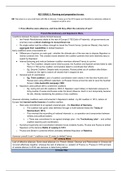
1. How effective were alliances, and how did they affect the outcome of war?
French Revolutionary and Napoleonic Wars.
Coalitions between European nations formed because
● the French Revolutionary ideals to the rest of Europe (1792 Edict of Fraternity - all governments are
enemies) were a direct challenge to monarchical rule.
● No single nation had the military strength to break the French forces (Levée en Masse); they had to
aggregate their capabilities to defeat Napoleon
Early coalitions were unsuccessful as:
● Differences of opinion on main goal - whether the ultimate aim of the war was to depose Napoleon or
merely constrain him. This created cracks between the coalition partners that were relatively easy to
exploit by Napoleon
● Internal bickering and mistrust between coalition members allowed France to survive:
○ Eg. First Coalition: despite some initial success, the Austrian and Spanish armies failed to take
Paris in 1794 as the coalition commanders failed to coordinate their efforts.
○ Eg. Second Coalition: Despite early successes, Russia pulled out of coalition after Britain
insisted on the right to search all vessels that it stopped at sea.
● General lack of coordination
○ Eg. Third coalition: Lack of coalition coordination seen clearly in the fact that Austria and
Russia were using different calendars, so Russian forces arrived too late to save the Austrian
forces in Ulm-Austerlitz campaign 1805
● Napoleon used political skill to undermine coalitions
○ Eg. during 3rd and 4th coalitions (1803-7) Napoleon used military or diplomatic pressure to
bring Austria, Prussia and Russia under his direct influence. Each in turn temporarily became
his ally, thereby weakening the potency of any coalitions.
However ultimately coalitions were instrumental in Napoleon's defeat - by 6th coalition in 1813, nations of
Europe had learned earlier lessons of coalition warfare
● there was commitment to an agreed universal goal – the liberation of Germany.
○ The coalition was given clear definition through a multi-national treaty (the Treaty of
Reichenbach 1813).
○ This involved the reconciling of national interests i.e. co-operation and compromise between
military and political leaders.
○ ⇒ There was commitment to an agreed strategic plan – the Trachenburg ‘plan’ – and unified
coalition planning and coordination.
● Numerical superiority and coordination between forces enabled Austria, Prussia and Russia to defeat
Napoleon at the decisive Battle of Leipzig in 1813
● Prussia and Britain's combined efforts ultimately defeated Napoleon at Waterloo.
However overall it took 7 coalitions over 22 years to defeat France
th
19 century Wars
Lack of effective alliances: Some weak alliances (i.e. French, British, Ottoman and Pietmontese in Crimea) did
not work effectively together, whereas the lack of alliances i.e. isolation of France vs. Prussia in 1870 and lack
of outside alliance in ACW was decisive in determining defeat.
Crimean War
NB: War plans is a very small topic with little to discuss. It came up in the 2018 paper and therefore is extremely unlikely to
reappear anytime soon
1. How effective were alliances, and how did they affect the outcome of war?
French Revolutionary and Napoleonic Wars.
Coalitions between European nations formed because
● the French Revolutionary ideals to the rest of Europe (1792 Edict of Fraternity - all governments are
enemies) were a direct challenge to monarchical rule.
● No single nation had the military strength to break the French forces (Levée en Masse); they had to
aggregate their capabilities to defeat Napoleon
Early coalitions were unsuccessful as:
● Differences of opinion on main goal - whether the ultimate aim of the war was to depose Napoleon or
merely constrain him. This created cracks between the coalition partners that were relatively easy to
exploit by Napoleon
● Internal bickering and mistrust between coalition members allowed France to survive:
○ Eg. First Coalition: despite some initial success, the Austrian and Spanish armies failed to take
Paris in 1794 as the coalition commanders failed to coordinate their efforts.
○ Eg. Second Coalition: Despite early successes, Russia pulled out of coalition after Britain
insisted on the right to search all vessels that it stopped at sea.
● General lack of coordination
○ Eg. Third coalition: Lack of coalition coordination seen clearly in the fact that Austria and
Russia were using different calendars, so Russian forces arrived too late to save the Austrian
forces in Ulm-Austerlitz campaign 1805
● Napoleon used political skill to undermine coalitions
○ Eg. during 3rd and 4th coalitions (1803-7) Napoleon used military or diplomatic pressure to
bring Austria, Prussia and Russia under his direct influence. Each in turn temporarily became
his ally, thereby weakening the potency of any coalitions.
However ultimately coalitions were instrumental in Napoleon's defeat - by 6th coalition in 1813, nations of
Europe had learned earlier lessons of coalition warfare
● there was commitment to an agreed universal goal – the liberation of Germany.
○ The coalition was given clear definition through a multi-national treaty (the Treaty of
Reichenbach 1813).
○ This involved the reconciling of national interests i.e. co-operation and compromise between
military and political leaders.
○ ⇒ There was commitment to an agreed strategic plan – the Trachenburg ‘plan’ – and unified
coalition planning and coordination.
● Numerical superiority and coordination between forces enabled Austria, Prussia and Russia to defeat
Napoleon at the decisive Battle of Leipzig in 1813
● Prussia and Britain's combined efforts ultimately defeated Napoleon at Waterloo.
However overall it took 7 coalitions over 22 years to defeat France
th
19 century Wars
Lack of effective alliances: Some weak alliances (i.e. French, British, Ottoman and Pietmontese in Crimea) did
not work effectively together, whereas the lack of alliances i.e. isolation of France vs. Prussia in 1870 and lack
of outside alliance in ACW was decisive in determining defeat.
Crimean War