Kinesiology
What is the brief history of Kinesiology?
384-322 B.C: Aristotle explored:
o the actions of muscles
o the complex process of walking
o the role of the center of gravity, the laws of motion and of leverage
131-201 B.C: Galen who tended to gladiators distinguished between:
o motor and sensory nerves
o agonist and antagonist muscles
o described muscle tone
1510: Leonardo da Vinci explored:
o the structure of the human body as related to performance
o the relationship between center of gravity and balance
o the application of resistance
1564-1643: Galileo:
o Showed space, time & velocity are most NB factors in study of human motion
o Thus, kinesiology is a science
What is Kinesiology?
Kinesiology → study of human movement
o combination of two Greek verbs:
o kinein: to move
o logos: to discourse
Study of kinesiology has its foundation in 3 major study areas:
o Biomechanics
o Musculoskeletal anatomy
o Neuromuscular physiology
What is the purpose of studying Kinesiology in OT?
Most forms of doing require some form of movement and skill
o Activities used in treatment: PCL; Leisure; Play (Learning); Work
OT requires the ability to analyze movements involved in activities to understand
underlying principles and make treatment more effective
o how has a movement occurred – normal / abnormal?
o what are the causes of the abnormality?
o what must be done to correct or improve movement abnormality?
Kinesiology is the key to OT fundamentals:
o Effective treatment plan
o Prevent deterioration
o Restoring function to maximum independence
Kinesiology helps to
o teach effective performance and perfect performance in both fundamental
and specialised motor skills
o contribute to successful participation in various physical activities
o improvement of the human structure through appropriate selection of
activities and the efficient use of the body
o Apply this knowledge to aid in the restoration of impaired function and
methods for compensating for lost function
o Analyze and understand movement
o Understand the effect of exercise on the body
o Apply mechanical principles to postural alignment
,The Musculoskeletal System
What are the 2 major parts of the skeleton?
axial skeleton → includes the skull, spinal column, sternum & ribs
appendicular skeleton → includes the bones of the upper & lower extremities
What are the types of bones?
Long bone:
o long shaft, cylindrical in cross-section, and (usually) expanded at either end.
o mostly composed of compact tissue
o contain spongy bone within their diaphyses
o act as levers for the skeletal muscles to act upon
→ humerus, radius, ulna, metacarpals, phalanges, femur, tibia, fibula, metatarsals
Short bone:
o generally equal in width and length
o mainly composed of spongy bone surrounded by a thin layer of compact bone
o allow small amounts of varied movement when articulated together
→ carpal and tarsal bones
Flat bone:
o smooth and thin bones comprising two thin and flat plates of compact bone,
between which lies a layer of spongy bone
o they protect the soft internal structures and provide attachment for muscles
→ sternum, scapula, parietal bone, occipital bone, temporal bone, frontal bone, ribs
Irregular bone:
o Elaborate in shape and cannot be classified into the above categories
→ sphenoid bone, ethmoid bone, hyoid bone, sacrum, coccyx and vertebra
Sesamoid bone:
o form within tendons of some muscles as these tendons pass over joints
o size and distribution can vary → often only measure a few millimeters
o act to protect the tendon and to increase its mechanical effect
→ patella and accessory bones of the foot
What are Articulations (joints)?
Rigid bones of the skeleton meet
Connective tissue organized to bind bones together and form joints
Configuration of bones & reinforcing ligaments determine & limit movements that the
involved segments can make
1. What are the types of joints based on particular connective tissue involved?
o Fibrous (synarthrodial)
o Cartilaginous (synarthrodial)
o Synovial (diarthrodial) → movement
2. What are the different synarthrodial connective tissue joints?
o Fibrous (synarthrodial)
Two bones connected by dense fibrous connective tissue
No synovial cavity present
Very little movement
Example: sutures in skull
o Cartilaginous (synarthrodial)
Two bones connected by hyaline cartilage
No synovial cavity present
Limited movement
, Example: costal cartilages and intervertebral discs
o Ligamentous joints (synarthrodial) → Example: mid-union of radius and ulna
3. What are the different diarthrodial connective tissue joints?
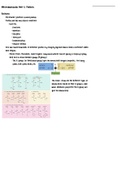
*See Table*
o Non axial: Diarthrodial
Gliding joints
Irregular articular surfaces slide over each other from side to side
Angle of bones does not significantly alter
Limited movement
Surfaces are irregular, flat or curved
o Uni-axial: Diarthrodial
Movement in 1 plane
Hinge joint:
movement restricted to one plane by
o shape of the opposing articular surfaces
o strong collateral ligaments along the sides of the joint
Only extension and flexion possible here
Example: elbow joint
Pivot joint:
Bony pivot or projection articulates with osteoligamentous ring
Function by rotating the bone around its own long axis
Example: superior radioulnar joint
o Bi-axial: Diarthrodial
Movement in 2 planes
Saddle joint:
Formed between bones with both concave & convex surfaces
Concave surface of one bone articulates with convex surface
of another
examples: carpometacarpal joint of the thumb
Condyloid joint:
Ellipsoidal joint
Formed by oval, convex condyle of one bone fitting into the
oval, concave depression of the opposing bone
Permit rotation around two axes
Allow angular movements
o i.e., flexion, extension, abduction, and adduction
example: metacarpal phalangeal joint (MCP) of the fingers
o Tri-axial: Diarthrodial
3 planes of movement
Ball-and-socket joint:
Most flexible & provide almost complete rotation on all axes &
planes
Consist of a hemispherical (or spherical) head that fits into a
cup- like depression in the opposing bone
example: glenohumeral joint (shoulder); hip joint
4. What are the functions of joints?
o provide a means by which bones can be moved.
o provide stability without interfering with the desired movement.
Not all joints have the same stability
E.g., hip and elbow more stable than shoulder and knee
More movement = less stability
What is the brief history of Kinesiology?
384-322 B.C: Aristotle explored:
o the actions of muscles
o the complex process of walking
o the role of the center of gravity, the laws of motion and of leverage
131-201 B.C: Galen who tended to gladiators distinguished between:
o motor and sensory nerves
o agonist and antagonist muscles
o described muscle tone
1510: Leonardo da Vinci explored:
o the structure of the human body as related to performance
o the relationship between center of gravity and balance
o the application of resistance
1564-1643: Galileo:
o Showed space, time & velocity are most NB factors in study of human motion
o Thus, kinesiology is a science
What is Kinesiology?
Kinesiology → study of human movement
o combination of two Greek verbs:
o kinein: to move
o logos: to discourse
Study of kinesiology has its foundation in 3 major study areas:
o Biomechanics
o Musculoskeletal anatomy
o Neuromuscular physiology
What is the purpose of studying Kinesiology in OT?
Most forms of doing require some form of movement and skill
o Activities used in treatment: PCL; Leisure; Play (Learning); Work
OT requires the ability to analyze movements involved in activities to understand
underlying principles and make treatment more effective
o how has a movement occurred – normal / abnormal?
o what are the causes of the abnormality?
o what must be done to correct or improve movement abnormality?
Kinesiology is the key to OT fundamentals:
o Effective treatment plan
o Prevent deterioration
o Restoring function to maximum independence
Kinesiology helps to
o teach effective performance and perfect performance in both fundamental
and specialised motor skills
o contribute to successful participation in various physical activities
o improvement of the human structure through appropriate selection of
activities and the efficient use of the body
o Apply this knowledge to aid in the restoration of impaired function and
methods for compensating for lost function
o Analyze and understand movement
o Understand the effect of exercise on the body
o Apply mechanical principles to postural alignment
,The Musculoskeletal System
What are the 2 major parts of the skeleton?
axial skeleton → includes the skull, spinal column, sternum & ribs
appendicular skeleton → includes the bones of the upper & lower extremities
What are the types of bones?
Long bone:
o long shaft, cylindrical in cross-section, and (usually) expanded at either end.
o mostly composed of compact tissue
o contain spongy bone within their diaphyses
o act as levers for the skeletal muscles to act upon
→ humerus, radius, ulna, metacarpals, phalanges, femur, tibia, fibula, metatarsals
Short bone:
o generally equal in width and length
o mainly composed of spongy bone surrounded by a thin layer of compact bone
o allow small amounts of varied movement when articulated together
→ carpal and tarsal bones
Flat bone:
o smooth and thin bones comprising two thin and flat plates of compact bone,
between which lies a layer of spongy bone
o they protect the soft internal structures and provide attachment for muscles
→ sternum, scapula, parietal bone, occipital bone, temporal bone, frontal bone, ribs
Irregular bone:
o Elaborate in shape and cannot be classified into the above categories
→ sphenoid bone, ethmoid bone, hyoid bone, sacrum, coccyx and vertebra
Sesamoid bone:
o form within tendons of some muscles as these tendons pass over joints
o size and distribution can vary → often only measure a few millimeters
o act to protect the tendon and to increase its mechanical effect
→ patella and accessory bones of the foot
What are Articulations (joints)?
Rigid bones of the skeleton meet
Connective tissue organized to bind bones together and form joints
Configuration of bones & reinforcing ligaments determine & limit movements that the
involved segments can make
1. What are the types of joints based on particular connective tissue involved?
o Fibrous (synarthrodial)
o Cartilaginous (synarthrodial)
o Synovial (diarthrodial) → movement
2. What are the different synarthrodial connective tissue joints?
o Fibrous (synarthrodial)
Two bones connected by dense fibrous connective tissue
No synovial cavity present
Very little movement
Example: sutures in skull
o Cartilaginous (synarthrodial)
Two bones connected by hyaline cartilage
No synovial cavity present
Limited movement
, Example: costal cartilages and intervertebral discs
o Ligamentous joints (synarthrodial) → Example: mid-union of radius and ulna
3. What are the different diarthrodial connective tissue joints?
*See Table*
o Non axial: Diarthrodial
Gliding joints
Irregular articular surfaces slide over each other from side to side
Angle of bones does not significantly alter
Limited movement
Surfaces are irregular, flat or curved
o Uni-axial: Diarthrodial
Movement in 1 plane
Hinge joint:
movement restricted to one plane by
o shape of the opposing articular surfaces
o strong collateral ligaments along the sides of the joint
Only extension and flexion possible here
Example: elbow joint
Pivot joint:
Bony pivot or projection articulates with osteoligamentous ring
Function by rotating the bone around its own long axis
Example: superior radioulnar joint
o Bi-axial: Diarthrodial
Movement in 2 planes
Saddle joint:
Formed between bones with both concave & convex surfaces
Concave surface of one bone articulates with convex surface
of another
examples: carpometacarpal joint of the thumb
Condyloid joint:
Ellipsoidal joint
Formed by oval, convex condyle of one bone fitting into the
oval, concave depression of the opposing bone
Permit rotation around two axes
Allow angular movements
o i.e., flexion, extension, abduction, and adduction
example: metacarpal phalangeal joint (MCP) of the fingers
o Tri-axial: Diarthrodial
3 planes of movement
Ball-and-socket joint:
Most flexible & provide almost complete rotation on all axes &
planes
Consist of a hemispherical (or spherical) head that fits into a
cup- like depression in the opposing bone
example: glenohumeral joint (shoulder); hip joint
4. What are the functions of joints?
o provide a means by which bones can be moved.
o provide stability without interfering with the desired movement.
Not all joints have the same stability
E.g., hip and elbow more stable than shoulder and knee
More movement = less stability