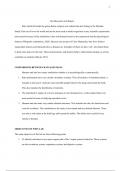
CALT Exam,.docx
coarticulation - correct answer the ability to overlap several phonemes anaphora - correct answer pronouns or articles used to refer to something already mentioned appositive - correct answer a noun or noun phrase placed after a noun to describe it more fully model involves two-way connection between context and meaning, and two way connections between orthography and phonology - correct answer Rumelhart and Seidenberg's Connectionist Theory meaning based and code-based strategies are taught together. First order skill are enciphering and deciphering. Second order skills are comprehension/composition. 1st and 2nd order skills are taught together - correct answer Farnham-Diggory Model trade-off of sub processes. Readers with poor word recognition are more reliant on context than good readers. Skill of reading as a developing process - correct answer Stanovich's Interactive-Compensatory Model 1. Letters are connected with phonemes. 2. Units of letters are connected with parts of spoken speech. 3. Printed word is connected to its meaning. Cipher Sight Reading (words are recognized quickly through Cipher strategy) - correct answer Ehri contributions 1. Alphabetic spelling precedes alphabetic reading 2. Dyslexics begin to fall behind in "Alphabetic Phase" - correct answer Firth's contributions 1. 1930 (John Dewey) whole word teaching 2. Language-experience text 3. Chall (1983) direct phonics instruction more successful 4. Adams-importance of connections between meaning "processors" and letter-sound "processors", effective phonics instruction must be linked with language based reading instruction - correct answer The Great Debate: Phonics vs. Whole Language 1. The Logographic Phase 2. The Phonetic-Cue Phase (Early Alphabetic) 3. The Cipher or Alphabetic Phase (Mature Alphabetic) 4. The Orthographic Phase - correct answer Ehri's Four Phases of Reading Strategy Development (Phases of Word Learning) Uta Firth-visual cue phase Pre-phonics lexicon-example (McD sign) many argue this stage does not exist - correct answer The Logographic Phase (Ehri) Linnea Ehri-Rudimentary alphabetic phase recall similar letters in words pre-alphabetic principle phase - correct answer The Phonetic-Cue Phase (Early Alphabetic) (Ehri) Early sight word meaning Phoneme-Grapheme correspondence Left to right sounding out letters Complete phoneme awareness Alphabetic principle Accuracy - correct answer The Cipher or Alphabetic Phase (Mature Alphabetic) (Ehri) Reading fluency by sound, syllable morphemes Whole words. Orthography in Greek means "perfect writing" Refers to spelling patterns Onset-rime use in spelling - correct answer The Orthographic Phase (Ehri) 1. Imitation 2. Graphic Presentation 3. Progressive Incorporation 4. Automatization 5. Elaboration Personalization-Diversification - correct answer Mel Levine's Developmental Stages of Learning Handwriting preschool-1st mimicking of actual writing motor problems may indicate at risk hand preference not fully established - correct answer Imitation (Mel Levine) 1st-2nd directionality and laterality reliance on proprioception - correct answer Graphic Presentation (Mel Levine) 2nd-4th aesthetic production cursive writing - correct answer Progressive Incorporation (Mel Levine) 4th-7th Increased writing rate and efficiency grammar usage - correct answer Automatization (Mel Levine) 7th-9th writing to establish viewpoint - correct answer Elaboration (Mel Levine) 9th-above Individual style and talent - correct answer Personalization-Diversification (Mel Levine) 1. words in sentence 2. syllables in words 3. phonemes in single words phonemic awareness - correct answer Liberman developmental hierarchy % of 4th graders that are not fluent - correct answer 44% (NAEP) acquired disorder in which ability to form letter shapes, letter sequences and motor patterns is impaired - correct answer specific agraphia motor feedback problem, fingers do not report location back to the brain - correct answer finger agnosia refers to the singular musical qualities of language, including intonation, expression, accent, pitch, juncture and rhythm - correct answer suprasegmental Dysrhthmic (when repeating syllables) - correct answer Peter Wolff poor word find
Escuela, estudio y materia
- Institución
- CALT
- Grado
- CALT
Información del documento
- Subido en
- 5 de mayo de 2024
- Número de páginas
- 8
- Escrito en
- 2023/2024
- Tipo
- Examen
- Contiene
- Preguntas y respuestas
Temas
-
calt examdocx