CALT Exam Prep_People.docx
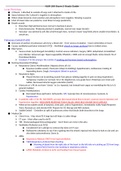
Rudolph Flesch - correct answer Started the issue of the great debate to the publics attention on how best to teach a child to read. This came about in his book. "Why Johnny Can't Read" (Mid 1950s) Kenneth Goodman and Frank Smith - correct answer Developed the Top-Down approach to reading instruction. Believed that reading should be taught through immersion in children's literature . Teaches reading without breaking it down into parts. Whole Language based, emphasis is on guessing at words rather than sounding them out. (1980s) G. Reid Lyon - correct answer Became the coordinator of the research for NICHD. (1985) Top-Down Theory - correct answer led by Kenneth Goodman and Frank Smith **strong meaning-based position **Goodman calls reading a "psycholinguistic guessing game" **rather than read every word, good readers select out on the essential textual information **only focus on individual words/sounds when text does not make sense, and the reader needs to go back and reread **this is Whole Language characteristic Bottom-Up Theory - correct answer emphasis on the subprocesses of the reading act and its contention that many of these subprocesses, such as letter and word identification, must become automatic in order for readers to be fluent. (Alphabetic Phonics) Interactive Theory - correct answer readers simultaneously initiate word identification and predict meaning----these are reciprocal events analytical approach - correct answer whole to part (Top-Down) put the whole word on the board/discover what's the same, how it can be broken down into component parts synthetic approach - correct answer part (letters) to whole words (bottom up) linguistics-based beginning reading approach - correct answer Learning to recognize word families (bat, cat, hat, ) D. Berlin (1887) - correct answer Coined the term "dys" -- meaning difficult, "lexia" -- meaning pertaining to words. James Hinshelwood (1917) - correct answer "word blindness" -- ophthalmologist from Scotland that discovered that the left hemisphere of the brain affected word storage Samuel Orton () - correct answer Neuropsychiatrist from Columbia University in New York who first recognized dyslexia students in America. He discovered that approximately 10% of students will not learn using the whole words method. Also coined the term "strephosymbolia" (twisted words), which replaced the former term word blindness. Dr. Madonald Critchley (1964) - correct answer Established term "developmental dyslexia" at the World Federation of Neurology meeting at the Scottish Rite Hospital. Marianne Frosig (1960) - correct answer Did visual tracking research. Findings show there is no relationship between dyslexia and vision acuity.
Escuela, estudio y materia
- Institución
- CALT
- Grado
- CALT
Información del documento
- Subido en
- 4 de mayo de 2024
- Número de páginas
- 4
- Escrito en
- 2023/2024
- Tipo
- Examen
- Contiene
- Preguntas y respuestas
Temas
-
calt exam preppeopledocx