Human Development Lecutre 5 – Fertilization
Stages;
• Pre-embryonic development; 2 weeks after fertilization
• Embryonic development; 2 months after feralization. Study of these =
embryology
• Fetal development; from 9th week to birth
• Postnatal development; commences (begint) at birth
• Maturity; aging process begins
Prenatal; Pre-embryonic + embryonic + fetal development
Fertilization (conception);
Spermatozoa undergo capacitation.
Muscle contractions of uterus and ciliary movement help
sperm to find way. <100 reach the ripe oocyte.
Fusion of 2 gamest occurs in female tract near ampulla-
isthmus within a day after ovulation.
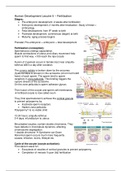
The corona radiate is broken down by the enzymes
(hyaluronidase & acrosin) in the acrosome (zit om het hoofd
heen) of each sperm. The sperm bind to sperm
receptors in zona pellucida. This binding triggers the
rupture (breuk) of the acrosome.
On the zone pellucida is sperm adhesion glycan.
Then fusion of the oocyte and sperm cell membranes.
→ fertilized oocyte is now called ovum
They (first spermatozoom) achieve the cortical granule
to prevent polyspermy by;
• Inactivate sperm receptors
• Harden zona pellucida
Polyspermy? Is no viable child
12-24 hours; ampulla-isthmus
3-4 days; infundibulum to uterus
Binucleated oocytes; contain double chromones. They
have defects in microtubule dynamics, affecting
chromosome segregation.
1 double chromone → Syndrome van Down
Abnormal sperm occurs much more frequently
causes; infection, toxins, lifestyle etc.
Cycle of the oocyte (oocyte activation);
First calcium wave for;
• Exocytosis of vasciles of cortical granules to prevent polyspermy
• Completion of meiosis II upon (bij) fertilization
Stages;
• Pre-embryonic development; 2 weeks after fertilization
• Embryonic development; 2 months after feralization. Study of these =
embryology
• Fetal development; from 9th week to birth
• Postnatal development; commences (begint) at birth
• Maturity; aging process begins
Prenatal; Pre-embryonic + embryonic + fetal development
Fertilization (conception);
Spermatozoa undergo capacitation.
Muscle contractions of uterus and ciliary movement help
sperm to find way. <100 reach the ripe oocyte.
Fusion of 2 gamest occurs in female tract near ampulla-
isthmus within a day after ovulation.
The corona radiate is broken down by the enzymes
(hyaluronidase & acrosin) in the acrosome (zit om het hoofd
heen) of each sperm. The sperm bind to sperm
receptors in zona pellucida. This binding triggers the
rupture (breuk) of the acrosome.
On the zone pellucida is sperm adhesion glycan.
Then fusion of the oocyte and sperm cell membranes.
→ fertilized oocyte is now called ovum
They (first spermatozoom) achieve the cortical granule
to prevent polyspermy by;
• Inactivate sperm receptors
• Harden zona pellucida
Polyspermy? Is no viable child
12-24 hours; ampulla-isthmus
3-4 days; infundibulum to uterus
Binucleated oocytes; contain double chromones. They
have defects in microtubule dynamics, affecting
chromosome segregation.
1 double chromone → Syndrome van Down
Abnormal sperm occurs much more frequently
causes; infection, toxins, lifestyle etc.
Cycle of the oocyte (oocyte activation);
First calcium wave for;
• Exocytosis of vasciles of cortical granules to prevent polyspermy
• Completion of meiosis II upon (bij) fertilization