Jean Watson's Theory of
Human Caring
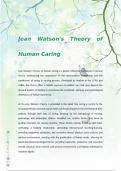
Jean Watson's Theory of Human Caring is a deeply influential framework in nursing
theory, emphasizing the importance of the nurse-patient relationship and the
significance of caring in nursing practice. Developed by Watson in the 1970s and
1980s, this theory offers a holistic approach to patient care that goes beyond the
physical aspects of healing to encompass the emotional, spiritual, and psychological
dimensions of human experience.
At its core, Watson's theory is grounded in the belief that caring is central to the
nursing profession and that nurses have a profound impact on the well-being of their
patients through their acts of caring. Drawing on her background in nursing,
psychology, and philosophy, Watson identified ten carative factors that serve as
guiding principles for nursing practice. These factors include fostering faith-hope,
cultivating a trusting relationship, promoting interpersonal teaching-learning,
providing supportive, protective, and corrective mental, physical, socio-cultural, and
spiritual environment, assisting with the gratification of human needs, allowing for
existential-phenomenological forces, providing supportive, protective, and corrective
mental, physical, socio-cultural, and spiritual environment, and helping individuals to
maintain dignity.
Human Caring
Jean Watson's Theory of Human Caring is a deeply influential framework in nursing
theory, emphasizing the importance of the nurse-patient relationship and the
significance of caring in nursing practice. Developed by Watson in the 1970s and
1980s, this theory offers a holistic approach to patient care that goes beyond the
physical aspects of healing to encompass the emotional, spiritual, and psychological
dimensions of human experience.
At its core, Watson's theory is grounded in the belief that caring is central to the
nursing profession and that nurses have a profound impact on the well-being of their
patients through their acts of caring. Drawing on her background in nursing,
psychology, and philosophy, Watson identified ten carative factors that serve as
guiding principles for nursing practice. These factors include fostering faith-hope,
cultivating a trusting relationship, promoting interpersonal teaching-learning,
providing supportive, protective, and corrective mental, physical, socio-cultural, and
spiritual environment, assisting with the gratification of human needs, allowing for
existential-phenomenological forces, providing supportive, protective, and corrective
mental, physical, socio-cultural, and spiritual environment, and helping individuals to
maintain dignity.