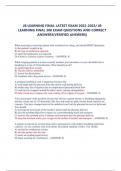
JB LEARNING FINAL LATEST EXAM / JB LEARNING FINAL 300 EXAM QUESTIONS AND CORRECT ANSWERS(VERIFIED ANSWERS)
JB LEARNING FINAL LATEST EXAM / JB LEARNING FINAL 300 EXAM QUESTIONS AND CORRECT ANSWERS(VERIFIED ANSWERS) When assessing a conscious patient who overdosed on a drug, you should FIRST determine: A) the patient's weight in kg. B) the type of medication ingested. C) when the medication was ingested. D) if there is a history of prior overdose. - ANSWER- B While triaging patients at a mass-casualty incident, you encounter a 4-year-old child who is breathing at a rate of 54 breaths/min. What should you do? A) Apply high-flow oxygen B) Tag the child as immediate C) Assess for distal pulses D) Ventilate with a bag-mask device - ANSWER- B A prolapsed umbilical cord is dangerous because the: A) cord might pull the placenta from the uterine wall during delivery. B) mother may die of hypoxia due to compromised placental blood flow. C) cord may be wrapped around the baby's neck, causing strangulation. D) baby's head may compress the cord, cutting off its supply of oxygen. - ANSWER- D Your assessment of the newborn reveals that she has a patent airway, is breathing adequately, and has a heart rate of 130 beats/min. Her face and trunk are pink, but her hands and feet are cyanotic. You have clamped and cut the umbilical cord, but the placenta has not yet delivered. You should: A) massage the lower part of the mother's uterus until the placenta delivers. B) give the newborn high-flow oxygen via a nonrebreathing mask and transport. C) reassess the newborn every 5 minutes and transport after the placenta delivers. D) keep the newborn warm, give oxygen to the mother if needed, and transport. - ANSWER- D A patient overdosed on several drugs and is unresponsive with shallow breathing and facial cyanosis. As you continue your assessment, the patient suddenly vomits. You should: A) suction his oropharynx at once. B) turn the patient onto his side. C) insert an oropharyngeal airway. D) begin assisting his ventilations. - ANSWER- B A known diabetic female is found unresponsive. Her respirations are rapid and shallow; her skin is cool, clammy, and pale; and her pulse is rapid and weak. Which of the following would BEST explain the likely cause of her condition? A) Insulin overdose B) Excessive eating C) High blood sugar D) Failure to take insulin - ANSWER- A A 29-year-old pregnant female complains of a severe headache, blurred vision, and swelling of her hands and feet. Which of the following additional assessment findings would the EMT MOST likely encounter? A) Hypertension B) Hyperglycemia C) Abdominal pain D) Vaginal bleeding - ANSWER- A In which position would you expect a patient with severe dyspnea to be found? A) Prone B) Supine C) Fowler's D) Lateral recumbent - ANSWER- C You are caring for a man with terminal cancer when his caretaker presents you with a Physician Order for Life-Sustaining Treatment (POLST) form. The purpose of this form is to: A) advise medical providers that resuscitation is not to be attempted. B) describe acceptable patient interventions in the form of medical orders. C) enable the caretaker to make healthcare decisions on the patient's behalf. D) limit the treatment provided to the patient to basic life support care. - ANSWER- B A 69-year-old man complains of dyspnea that began two days ago and has gotten worse. Which of the following assessments would give you the MOST information regarding the possible cause of his dyspnea? A) Lung sounds B) Mental status C) Oxygen saturation D) Pulse rate and quality - ANSWER- A A 73-year-old male presents with confusion; cool, pale, clammy skin; absent radial pulses; and a blood pressure of 70/40 mm Hg. The patient's wife tells you that he has had abdominal pain for a week and began vomiting a coffee-ground substance yesterday. His past medical history includes hypertension and gastric ulcer disease. Your MOST immediate concern should be that: A) his blood glucose level is probably too high. B) he is bleeding from his gastrointestinal tract. C) he is in shock and requires prompt transport. D) his condition requires surgery within 2 hours. - ANSWER- C
Información del documento
- Subido en
- 30 de abril de 2024
- Número de páginas
- 51
- Escrito en
- 2023/2024
- Tipo
- Examen
- Contiene
- Preguntas y respuestas