

Escrito por estudiantes que aprobaron Inmediatamente disponible después del pago Leer en línea o como PDF ¿Documento equivocado? Cámbialo gratis 4,6 TrustPilot
logo-home
Examen

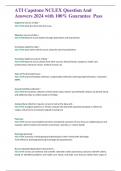
ATI Capstone NCLEX Question And Answers 2024 with 100% Guarantee Pass

Puntuación
-
Vendido
-
Páginas
17
Grado
A+
Subido en
26-04-2024
Escrito en
2023/2024

Provider-initiated/dependent interventions – SOLUTION interventions nurses initiate as a result of a provider's prescription (written, standing, or verbal) or the facility's protocol (blood administration procedures) Collaborative interventions – SOLUTION interventions nurses carry out in collaboration with other health care team professionals (ensuring that a client receives and eats their evening snack) Implementation – SOLUTION nurses base the care they provide based on assessment data, analysis, and the plan of care they developed in the previous steps of the nursing process. In this step they must use problem-solving, clinical judgment, and critical thinking to select and implement appropriate therapeutic interventions using nursing knowledge, priorities of care, and planned goals or outcomes to promote, maintain, or restore health. Evaluation – SOLUTION nurses evaluate clients' responses to nursing interventions and form a clinical judgment about the extent to which clients have met the goals and outcomes; nurses determine the effectiveness of the nursing care plan. They collect data based on the outcome criteria then compare what actually happened with the planned outcomes; clients' outcomes in specific, measurable terms are easier to evaluate Evaluate: Questions to Consider – SOLUTION "Did the client meet the planned outcomes?", "were the nursing interventions appropriate and effective?", "should I modify the outcomes or interventions?" Factors that can lead to lack of goal achievement during evaluation – SOLUTION an incomplete database, unrealistic client outcomes, nonspecific nursing interventions, and inadequate time for the client to achieve the outcomes 4 steps of Critical Thinking – SOLUTION a. Identify and analyze the problem; b. Recall info you need to resolve the problem; c. Evaluate each option; d. Select the correct or priority option Clients with diabetes mellitus should eat what when their blood glucose is low? – SOLUTION they should eat a snack of 10-15 grams of carbohydrates, such as 120 mL or 4 oz of fruit juice Infants and toddlers are at risk for injury due to – SOLUTION a tendency to put objects in their mouth and from hazards encountered while exploring their environment Preschool and school-aged children often face injury from – SOLUTION limited or underdeveloped motor coordination Adolescents’ risks for injury can stem from – SOLUTION increased desire to make independent decisions and relying on peers for guidance rather than family Preventing aspiration in infants and toddlers – SOLUTION keep all small objects out of reach; check toys and objects for loose or small parts and sharp edges; do not feed the infant hard candy, peanuts, popcorn, or whole or sliced pieces of hot dog; do not place the infant in the supine position while feeding or prop the infant's bottle; a pacifier (if used) should be constructed of one piece and never placed on a string or ribbon around the neck Antiemetics – SOLUTION used in the treatment and/or prevention of nausea and vomiting. Common classes of antiemetics – SOLUTION 5-HT3 receptor antagonists (serotonin antagonists); Dopamine antagonists; Antihistamines (H1 histamine receptor antagonists) 5-HT3 receptor antagonists (serotonin antagonists) – SOLUTION Dolasetron (Anzemet) Granisetron (Kytril, Sancuso) Ondansetron (Zofran) Tropisetron (Navoban) it’s 'Tron' to the rescue! Dopamine antagonists – SOLUTION Promethazine (Phenergan) Prochlorperazine (Compazine) Metoclopramide (Reglan): different in generic name because it can have extra-pyramidal side effects Antihistamines (H1 histamine receptor antagonists) – SOLUTION Diphenhydramine (Benadryl) Dimenhydrinate (Gravol, Dramamine) Meclizine (Bonine, Antivert) Proton Pump Inhibitors (PPIs) – SOLUTION decrease stomach acid by inhibiting those gastric proton pumps that make the acid - they stop the acid at the pump!; 'Zole' is very friendly (well-tolerated by most clients), but can cause vitamin B12 deficiency if he stays around too long (with long-term use). Common PPIs – SOLUTION Omeprazole (brand names: Prilosec, Zegerid, Omepral, Omez) Lansoprazole (brand names: Prevacid, Zoton, Inhibitol) Dexlansoprazole (brand name: Kapidex, Dexilant) Esomeprazole (brand names: Nexium, Esotrex) Pantoprazole (brand names: Protonix, Somac, Pantozol, Zentro) Erectile Dysfunction Agents – SOLUTION act by increasing nitric oxide which opens and relaxes the blood vessels of the penis causing increased blood flow (helping lead to getting and keeping an erection); side effects: flushing, back pain and muscle aches (with Levitra), temporary vision changes, (blue vision with Viagra); men who have heart problems, uncontrolled blood pressure problems, history of stroke, or a health problem that can cause priapism can't hang out with 'Fil.' common Erectile Dysfunction meds – SOLUTION Sildenafil (Viagra) Vardenafil (Levitra) Tadalafil (Cialis) Notice these end in 'fil'. 'Fil' helps the nitric oxide to 'fil' the penis. Antianemics – SOLUTION Instruct clients to take iron on an empty stomach such as 1 hr before meals to maximize absorption. Stomach acid increases absorption. Instruct clients to space doses at approximately equal intervals throughout day to most efficiently increase red blood cell production. Instruct clients to increase water and fiber intake (unless contraindicated), and to maintain an exercise program to counter the constipation effects. Encourage concurrent intake of appropriate quantities of foods high in iron (liver, egg yolks, muscle meats, yeast). drug administration interactions with iron – SOLUTION antacids or tetracycline's reduces absorption of iron. Separate use by at least 2 hr. Vitamin C increases absorption of iron, but also increases incidence of – SOLUTION GI complications. Avoid vitamin C intake when taking medication. Iron side effects – SOLUTION GI distress (nausea, constipation, heartburn). If intolerable, iron can be administered with food to increase compliance with therapy but this does reduce absorption; inform clients to anticipate a harmless dark green or black color of stool; Iron can cause teeth staining (liquid form), teach clients to dilute liquid iron with water or juice, drink with a straw, and rinse mouth after swallowing; iron can cause staining of skin and other tissues with IM injections. If IM route must be used, give IM doses deep IM using Z track technique. Statins (HMG-CoA Reductase Inhibitors) – SOLUTION treat primary hypercholesterolemia, for prevention of coronary events (primary and secondary), for protection against MI and stroke for clients with diabetes, and to help increase HDL levels in clients with primary hypercholesterolemia; You want your LOW (LDL) LOW and your HIGH (HDL) HIGH. Statins (HMG-CoA Reductase Inhibitors) common meds – SOLUTION Atorvastatin (Lipitor) Simvastatin (Zocor) Lovastatin (Mevacor) Pravastatin (Pravachol) Rosuvastatin (Crestor) Fluvastatin (Lescol) Statins (HMG-CoA Reductase Inhibitors) side effects – SOLUTION When you think 'statins' think that we need to protect the liver and muscles stat: there is a risk of hepatotoxicity. It is important to obtain a baseline liver function and to monitor liver function tests after 12 weeks and then every 6 months and to avoid alcohol. There is also a risk of myopathy and peripheral neuropathy. Clients should be told to report muscle weakness and/or aches, pain, tingling, and tenderness. CK levels will be monitored periodically during treatment as well. Anticoagulants – SOLUTION Anticoagulants prevent the formation of blood clots by interfering with the clotting cascade, thereby preventing coagulation. The use of this class of medications is contraindicated with active bleeding, such as with bleeding disorders, ulcers, or hemorrhagic brain injuries. Anticoagulant common meds – SOLUTION heparin, coumadin HEPARIN – SOLUTION HEPARIN H-eparin sodium prevents thrombin from converting fibrinogen to fibrin; it is administered IV or SQ. E-noxaparin (Lovenox) is a low-molecular weight heparin. It has the same action as heparin, but has a longer half-life. It is administered via subcutaneous injection. P-rotamine sulfate is the antidote for heparin. A -dminister heparin when there is the likelihood of clot formation, such as with myocardial infarction or deep-vein thrombosis. R-isk for bleeding is the major side effect that clients should be educated about. Clients should be educated to monitor for bleeding, including bleeding gums, bruises, hematuria, and petechiae. I-nstruct clients to avoid corticosteroid use, salicylates, NSAIDs, green leafy vegetables, and foods high in Vitamin K. N-ormal activated partial thromboplastin time (aPTT) is 20 to 36 seconds, but to maintain a therapeutic level of anticoagulation while on heparin, the aPTT should be 1.5 to 2 times the normal value (60 to 80 seconds). activated partial thromboplastin time (aPTT) – SOLUTION 20-36; to maintain a therapeutic level of anticoagulation while on heparin, the aPTT should be 1.5 to 2 times the normal value (60 to 80 seconds). COUMADIN – SOLUTION C-oumadin (generic name Warfarin sodium) interferes with coagulation factors by antagonizing vitamin K. O-ral administration is typically used. Clients may need continued heparin infusion via IV until therapeutic effect of Coumadin is experienced (may take 3-5 days). U-se is contraindicated in clients with low platelet counts or uncontrolled bleeding.

Mostrar más Leer menos
Institución
Grado

Vista previa del contenido

ATI Capstone NCLEX Question And
Answers 2024 with 100% Guarantee Pass
Subjective sources of data –
SOLUTION what the client tells the nurse


Objective sources of data –
SOLUTION Data the nurse obtains through observation and examination


Secondary subjective data –
SOLUTION what others tell the nurse; what the client had told them


Secondary objective sources of data –
SOLUTION Data the nurse collects from other sources; family,friends, caregivers, health care
professionals, literature review, medical records, etc.


Steps of the Nursing Process –
SOLUTION assessment/data collection, analysis/data collection, planning,implementation, evaluation;
ADPIE


Assessment/Data collection –
SOLUTION the systemic collection of information about clients' presenthealth statuses to identify needs
and additional data to collect based on findings


Analysis/data collection requires nurses to look at the data and: -
SOLUTION recognize patterns or trends; compare the data with expected standards or reference
ranges, and arrive to conclusions toguide nursing care


Planning –
SOLUTION nurses must establish priorities and optimal outcomes of acre they can readilymeasure and
evaluate, which include interventions to promote, maintain, or restore health


Discharge planning –
SOLUTION a process of anticipating and planning for client's needs after discharge.
To be effective, discharge planning must begin during admission


Nurse-initiated/independent interventions –
SOLUTION nurses use evidence and scientific rationale to take autonomous actions to benefit clients;
based on identified problems and health care needs, and make sure they are within their scope of

,ATI Capstone NCLEX Question And
Answers 2024 with 100% Guarantee Pass
practice. An example is repositioning a client at least every 2 hours to prevent skin breakdown

, ATI Capstone NCLEX Question And
Answers 2024 with 100% Guarantee Pass
Provider-initiated/dependent interventions –
SOLUTION interventions nurses initiate as a result of aprovider's prescription (written, standing, or verbal)
or the facility's protocol (blood administrationprocedures)


Collaborative interventions –
SOLUTION interventions nurses carry out in collaboration with other healthcare team professionals
(ensuring that a client receives and eats their evening snack)


Implementation –
SOLUTION nurses base the care they provide based on assessment data, analysis, andthe plan of care
they developed in the previous steps of the nursing process. In this step they must use problem-
solving, clinical judgment, and critical thinking to select and implement appropriate therapeutic
interventions using nursing knowledge, priorities of care, and planned goals or outcomes topromote,
maintain, or restore health.


Evaluation –
SOLUTION nurses evaluate clients' responses to nursing interventions and form a clinical judgment
about the extent to which clients have met the goals and outcomes; nurses determine the effectiveness
of the nursing care plan. They collect data based on the outcome criteria then compare what actually
happened with the planned outcomes; clients' outcomes in specific, measurable terms areeasier to
evaluate


Evaluate: Questions to Consider –
SOLUTION "Did the client meet the planned outcomes?", "were thenursing interventions appropriate and
effective?", "should I modify the outcomes or interventions?"


Factors that can lead to lack of goal achievement during evaluation –
SOLUTION an incomplete database,unrealistic client outcomes, nonspecific nursing interventions, and
inadequate time for the client to achieve the outcomes


4 steps of Critical Thinking –
SOLUTION a. Identify and analyze the problem; b. Recall info you need toresolve the problem; c. Evaluate
each option; d. Select the correct or priority option


Clients with diabetes mellitus should eat what when their blood glucose is low? –
SOLUTION they shouldeat a snack of 10-15 grams of carbohydrates, such as 120 mL or 4 oz of fruit juice

Escuela, estudio y materia

Grado

Información del documento

Subido en
26 de abril de 2024
Número de páginas
17
Escrito en
2023/2024
Tipo
Examen
Contiene
Preguntas y respuestas

Temas

$9.39
Accede al documento completo:

¿Documento equivocado? Cámbialo gratis Dentro de los 14 días posteriores a la compra y antes de descargarlo, puedes elegir otro documento. Puedes gastar el importe de nuevo.
Escrito por estudiantes que aprobaron
Inmediatamente disponible después del pago
Leer en línea o como PDF


Documento también disponible en un lote

Conoce al vendedor

Seller avatar
Los indicadores de reputación están sujetos a la cantidad de artículos vendidos por una tarifa y las reseñas que ha recibido por esos documentos. Hay tres niveles: Bronce, Plata y Oro. Cuanto mayor reputación, más podrás confiar en la calidad del trabajo del vendedor.
ApexExams jomo kenyatta University of agriculture and technology
Seguir Necesitas iniciar sesión para seguir a otros usuarios o asignaturas
Vendido
62
Miembro desde
2 año
Número de seguidores
0
Documentos
376
Última venta
2 semanas hace
APEX EXAMS Test banks and practice exam Graded A+

Need reliable, up-to-date materials to boost your exam prep? Look no further Apex Exam is here to support your academic journey. We provide a wide selection of resources, including practice tests, exam guides, study notes, and more all designed to help you study smarter and reach your academic goals with confidence. But that’s not all; we also offer assistance with assignments, research projects, dissertations, online exams, tutoring sessions, and more. Just send us a message, and we’ll get back to you as soon as possible. And always remember: Stay calm, do your best, and let the rest take care of itself SUCCESS

Lee mas Leer menos
3.7

6 reseñas

5
4
4
0
3
0
2
0
1
2

Por qué los estudiantes eligen Stuvia

Creado por compañeros estudiantes, verificado por reseñas

Calidad en la que puedes confiar: escrito por estudiantes que aprobaron y evaluado por otros que han usado estos resúmenes.

¿No estás satisfecho? Elige otro documento

¡No te preocupes! Puedes elegir directamente otro documento que se ajuste mejor a lo que buscas.

Paga como quieras, empieza a estudiar al instante

Sin suscripción, sin compromisos. Paga como estés acostumbrado con tarjeta de crédito y descarga tu documento PDF inmediatamente.

Student with book image

“Comprado, descargado y aprobado. Así de fácil puede ser.”

Alisha Student

Preguntas frecuentes
