

Foundations of Nursing Practice - Exam I
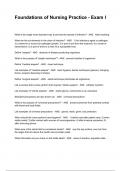
Foundations of Nursing Practice - Exam I What is the single most important way to prevent the spread of infection? - ANS Hand washing What are the six elements in the chain of infection? - ANS 1) An infectious agent or pathogen; 2) a reservoir or source for pathogen growth; 3) a port of exit from the reservoir; 4) a mode of transmission; 5) a port of entry to a host; 6) a susceptible host. Define "asepsis" - ANS absence of disease producing organisms What is the purpose of "aseptic technique"? - ANS prevent transfer of organisms Define "medical asepsis" - ANS clean technique List examples of "medical asepsis" - ANS hand hygiene; barrier techniques (gloves); changing linens; properly disposing of sharps Define "surgical asepsis" - ANS sterile technique (eliminates all organisms) List a process that nurses perform that requires "sterile asepsis" - ANS catheter insertion List examples of "sterile asepsis" - ANS sterile gloves, instruments in an autoclave Standard precautions are also known as: - ANS universal precautions What is the purpose of "universal precautions?" - ANS protect personnel from potential contact with blood and body fluids. List examples of universal precautions: - ANS gloves, mask, gown, eye protection When should the nurse perform hand hygiene? - ANS 1) before and after patient care; 2) when visibly soiled; 3) after contact with sources of microorganisms; 4) after invasive procedure; 5) after removing gloves. What area of the sterile field is considered sterile? - ANS only the top surface, one inch from the edges that are above the health care providers waist What information do you check on the bottle label? - ANS name of solution; expiration date How long is the bottle considered sterile once it has been opened? - ANS once opened it is NOT sterile. (may be used up to 24 hours if properly handled) If you open a new bottle and are going to leave it in the patient's room, what information do you write on the bottle? - ANS date, time and your initials If there is an opened bottle in the patient's room without the date it was opened written on it, what do you do with the bottle? - ANS throw it away When pouring fluid from the bottle, why do you place the label in the palm of your hand? - ANS to keep from smearing the print on the label with the solution if it accidentally drips down the side When removing contaminated gloves, why is it important to grab the palm pocket first? - ANS To minimize contamination of underlying skin and keep microorganisms inside gloves upon disposal Why do you always remove your gloves, dispose of them, and wash your hands before leaving the patients room? - ANS To reduce the risk of cross contamination with other patients Why is hand hygiene compliance poor? - ANS too busy; "my hands look clean;" takes too long What two methods may be used to provide hand hygiene? - ANS soap and water; foam handrub Define "isolation" - ANS the separation and restriction of movement of ill persons with contagious diseases. Describe "contact precautions:" - ANS used for direct and indirect contact with patients and their environments Describe "direct contact" - ANS care and handling of contaminated body fluids. (ex. blood) Describe "indirect contact" - ANS transfer of infections agents through a contaminated intermediate object (ex. contaminated instruments) Describe "droplet precautions" - ANS focuses on diseases that are transmitted by large droplets in the air that travel 3 to 6 feet from the patient. Precautions require wearing surgical masks. (ex. influenza) Describe "airborne precautions" - ANS focuses on diseases that are transmitted by smaller droplets in the air that remain in the air for longer periods of time. Precautions require a room with a 'negative air flow' Describe "protective environment" - ANS focuses on a very limited patient population. Precautions require a room with 'positive air flow'
Información del documento
- Subido en
- 25 de abril de 2024
- Número de páginas
- 3
- Escrito en
- 2023/2024
- Tipo
- Examen
- Contiene
- Preguntas y respuestas

