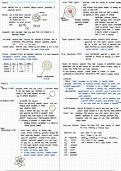
Chapter 6: Form Perception
Gestalt Psychology/Principles of Grouping: Explains how we report ○ Recognizing a geon involves recognizing the
seeing more than just the sensory info falling on the retina, we attempt features that define it (feature analysis) +
to organize visual information into simple groups, making it easier to recognizing the object as the pattern composed
interpret, “the whole is greater than the sum of its parts” (the whole from these pieces (prototype comparison)
has a perceptual reality of its own, that is different from the ○ Pros: People can typically recognize about 30,000
component parts), innate/ acquired very rapidly after birth objects with the use of only 36 different geons +
● Six Gestalt Principles: we can see objects from an unlimited possible
1. Figure-Ground Segregation: An object (figure) is viewpoint because different views of the same
perceived as separate from its background (objects object should still lead to the same set of geon
in ground fade away), process = difficult with recognition (view invariance)
reversible figures/images ○ Cons: Invariant features are difficult to extract in
2. Proximity: Things closer together are perceived as real images (ie slight variations in lighting can
being members of the same group completely change the unique features of a face
3. Closure: When we see an incomplete object/gaps used for individual identification) + geons are
in the contours of a shape, we tend to fill in the poor at representing many natural
gaps + perceive the object as whole objects/accounting for slight differences in shape
4. Similarity: Things that share similar visual + cannot account for brian damage where person
characteristics (ie. shape, texture, orientation) are is unable to recognize different types of fruit but
seen as belonging together can recognize different types of tools
5. Continuity: Points connected by straight/curving ● Template Theory: Proposes that incoming sensory
lines are seen in a way that follows the smoothest info/objects in environment = compared directly to
path (rather than seeing separate lines and angles, copies/exemplars stored in long-term memory due to our
lines are seen as belonging together, we perceive a past experiences and learning, need an exact match between
simple/continuous form rather than a combination object and template in order for recognition to occur,
of awkward forms, ie x = made up of 2 lines otherwise novel object is stored as another, new template
rather then 2 awkward vs) (diff from exemplar theory, not flexible)
6. Common Fate: Elements tend to be perceived as ○ Con: Does not work well with humans
grouped together if they move together/change in ○ Con: Assumes our recognition of objects requires
the same way a separate representation for each possible
Law of Pragnanz: States that we have a bias to organize things into the stimulus in every possible position, orientation,
simplest organization and size (would require an extraordinary number
● Ie. A ‘pyramid of triangles’ is a more simple organization of stored exemplars to recognize a single object)
than accounting for every single triangle ○ Con: Cannot account for how we recognize
Role of Expectation in Perception of Patterns and Objects: Vision is imperfect matches + how the brain would add
also the result of our expectations of what stimuli should be more exemplars to memory (an object would not
● Bottom-Up/Data-Driven Processing: When our be recognized if it does not make a perfect match
interpretation emerges from the data (info provided by the with an already existing exemplar) + does not
retina), features present in stimulus itself are compared to allow for alternate interpretations of the
memory and guide object recognition perception of the object within the context it is
● Top-Down/Prediction Processing: When our perception is presented in
influenced by sources beyond the images on the retina (ie ● Prototype Model: Proposes that new stimuli are compared
knowledge or experience), higher-level cognitive processing with an average/ideal stored in memory based on previous
is engaged to interpret the image experiences
● Bi-Directional Activation: When both types of processing ○ More flexible as perceived object does not need to
are involved (processing occurs in both directions at once) exactly match the prototype for object recognition
resulting in both the features of the object + our to occur (just need ‘family resemblance’ to
expectations guiding object recognition prototype)
Priming Experiments: Studies show that the processing of a word is ○ Con: Unable to account for our categorization of
more efficient/faster if the participant is primed beforehand to expect a unique/specific objects
certain category (told the next word is an animal = faster recognition Perceptual Constancy: The tendency of animals/humans to see
of animal words) familiar objects as having standard shape/size/colour/location
Theories of Object Recognition in Humans: Describe how the brain regardless of changes in the angle of perspective/distance/lighting,
organizes object representations + what the brain must do to recognize helps us recognize that all variations belong to the same object + make
objects sense of a flood of incoming visual info so that we can separate signal
● Recognition-by-Components/Geon Theory: Proposes that all from noise to organize and form perceptions of the world
objects can be made through combining 36 geons (3D ● Tends to conform to the object as it is/assumed to be, rather
shapes/simple geometric forms) than to the actual stimulus
○ Accounts for successful identification of objects ● 5 Perceptual Constancies:
despite changes in the size/orientation/moderate 1. Shape Constancy: The tendency to create a fixed
occlusion/degradation/novel examples representation of the shape of an object, despite
○ Geons = object ‘alphabet’ the retinal image of the shape changing change as
○ Unique combinations of geons = object ‘words’ your point of view changes or as the object
readily interpreted by the visual system changes position in space
Gestalt Psychology/Principles of Grouping: Explains how we report ○ Recognizing a geon involves recognizing the
seeing more than just the sensory info falling on the retina, we attempt features that define it (feature analysis) +
to organize visual information into simple groups, making it easier to recognizing the object as the pattern composed
interpret, “the whole is greater than the sum of its parts” (the whole from these pieces (prototype comparison)
has a perceptual reality of its own, that is different from the ○ Pros: People can typically recognize about 30,000
component parts), innate/ acquired very rapidly after birth objects with the use of only 36 different geons +
● Six Gestalt Principles: we can see objects from an unlimited possible
1. Figure-Ground Segregation: An object (figure) is viewpoint because different views of the same
perceived as separate from its background (objects object should still lead to the same set of geon
in ground fade away), process = difficult with recognition (view invariance)
reversible figures/images ○ Cons: Invariant features are difficult to extract in
2. Proximity: Things closer together are perceived as real images (ie slight variations in lighting can
being members of the same group completely change the unique features of a face
3. Closure: When we see an incomplete object/gaps used for individual identification) + geons are
in the contours of a shape, we tend to fill in the poor at representing many natural
gaps + perceive the object as whole objects/accounting for slight differences in shape
4. Similarity: Things that share similar visual + cannot account for brian damage where person
characteristics (ie. shape, texture, orientation) are is unable to recognize different types of fruit but
seen as belonging together can recognize different types of tools
5. Continuity: Points connected by straight/curving ● Template Theory: Proposes that incoming sensory
lines are seen in a way that follows the smoothest info/objects in environment = compared directly to
path (rather than seeing separate lines and angles, copies/exemplars stored in long-term memory due to our
lines are seen as belonging together, we perceive a past experiences and learning, need an exact match between
simple/continuous form rather than a combination object and template in order for recognition to occur,
of awkward forms, ie x = made up of 2 lines otherwise novel object is stored as another, new template
rather then 2 awkward vs) (diff from exemplar theory, not flexible)
6. Common Fate: Elements tend to be perceived as ○ Con: Does not work well with humans
grouped together if they move together/change in ○ Con: Assumes our recognition of objects requires
the same way a separate representation for each possible
Law of Pragnanz: States that we have a bias to organize things into the stimulus in every possible position, orientation,
simplest organization and size (would require an extraordinary number
● Ie. A ‘pyramid of triangles’ is a more simple organization of stored exemplars to recognize a single object)
than accounting for every single triangle ○ Con: Cannot account for how we recognize
Role of Expectation in Perception of Patterns and Objects: Vision is imperfect matches + how the brain would add
also the result of our expectations of what stimuli should be more exemplars to memory (an object would not
● Bottom-Up/Data-Driven Processing: When our be recognized if it does not make a perfect match
interpretation emerges from the data (info provided by the with an already existing exemplar) + does not
retina), features present in stimulus itself are compared to allow for alternate interpretations of the
memory and guide object recognition perception of the object within the context it is
● Top-Down/Prediction Processing: When our perception is presented in
influenced by sources beyond the images on the retina (ie ● Prototype Model: Proposes that new stimuli are compared
knowledge or experience), higher-level cognitive processing with an average/ideal stored in memory based on previous
is engaged to interpret the image experiences
● Bi-Directional Activation: When both types of processing ○ More flexible as perceived object does not need to
are involved (processing occurs in both directions at once) exactly match the prototype for object recognition
resulting in both the features of the object + our to occur (just need ‘family resemblance’ to
expectations guiding object recognition prototype)
Priming Experiments: Studies show that the processing of a word is ○ Con: Unable to account for our categorization of
more efficient/faster if the participant is primed beforehand to expect a unique/specific objects
certain category (told the next word is an animal = faster recognition Perceptual Constancy: The tendency of animals/humans to see
of animal words) familiar objects as having standard shape/size/colour/location
Theories of Object Recognition in Humans: Describe how the brain regardless of changes in the angle of perspective/distance/lighting,
organizes object representations + what the brain must do to recognize helps us recognize that all variations belong to the same object + make
objects sense of a flood of incoming visual info so that we can separate signal
● Recognition-by-Components/Geon Theory: Proposes that all from noise to organize and form perceptions of the world
objects can be made through combining 36 geons (3D ● Tends to conform to the object as it is/assumed to be, rather
shapes/simple geometric forms) than to the actual stimulus
○ Accounts for successful identification of objects ● 5 Perceptual Constancies:
despite changes in the size/orientation/moderate 1. Shape Constancy: The tendency to create a fixed
occlusion/degradation/novel examples representation of the shape of an object, despite
○ Geons = object ‘alphabet’ the retinal image of the shape changing change as
○ Unique combinations of geons = object ‘words’ your point of view changes or as the object
readily interpreted by the visual system changes position in space