GEOG 1111 - Unit 3 Questions And Answers Rated A+ New Update Assured Satisfaction
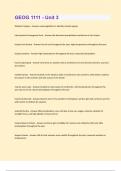
Wladimir Koppen - Answer-used vegetation to identify climate regions Intertropical Convergence Zone - Answer-the dominant precipitation mechanism in the tropics tropical rain forsest - Answer-lots of rain throughout the year; high temperatures throughout the year tropical savanna - Answer-high temperatures throughout the year; seasonal precipitation humid subtropical - Answer-tend to be on eastern side of continents; hot and humid summers; cool and dry winters mediterranean - Answer-located on the western sides of continents; hot summers; mild winters; distinct dry season in the summer and wet season in the winter marine west coast - Answer-located on west coasts of continents; mild temperatures throughout the year due to mP air; decent precipitation throughout the year humid continental - Answer-doesn't exist in the southern hemisphere; winters get cold; summers are hot and humid; no distinct dry seasons subartic/tundra - Answer-little precipitation; very cold due to low sun angles, extreme variation of sunlight hours, and high albedo of snow and ice tropical desert climate - Answer-summers get incredibly hot; winters are relatively mild; very little precipitation throughout the year steppe climate - Answer-still dry but receives some rainfall throughout the year; seasonal variation in temperaturemidlatitude desert - Answer-gets hot during the summer and cold in the winter; little precipitation throughout the year midlatitude steppe - Answer-good amount of seasonal variation; some precipitation throughout the year abatement - Answer-reducing emissions of radiatively active greenhouse gases to prevent global warming adaption - Answer-building sea walls around coastal cities and developing aquaducts to bring water to newly dry areas to adapt to global warming geo-engineering - Answer-engineering the earth's atmosphere and oceans to reduct climate change calving - Answer-the process through which pieces of a glacier break off and fall into the ocean crust - Answer-outermost, thinnest layer of the earth continental crust - Answer-made of granite; much thicker than oceanic crust oceanic crust - Answer-made of basalt; thinner and more dense than continental crust mantle - Answer-middle layer of earth; makes up 80% of earth's volume; made of olivine; mostly solid core - Answer-center of the earth; made of iron and nickel; inner core is solid; outer core is molten; creates our magnetic field lithosphere - Answer-made up of the crust and the uppermost mantle; solid asthenosphere - Answer-made up of the mantle beneath the lithosphere; plastic layer; can disturb crust and lead to tectonic activitymineral - Answer-inorganic substance with a specific chemical composition and atomic structure rock - Answer-a combination of one or more minerals igneous rocks - Answer-rocks that solidify from molten mineral matter sedimentary rocks - Answer-rocks that form from sediment that accumulates and is compacted and/or cemented metamorphic - Answer-rocks that form from igneous or sedimentary rocks that undergo intense heat and/or pressure, which deforms them and causes them to recrystallize
Escuela, estudio y materia
- Institución
- GEOG 1111 - Unit 3
- Grado
- GEOG 1111 - Unit 3
Información del documento
- Subido en
- 18 de abril de 2024
- Número de páginas
- 7
- Escrito en
- 2023/2024
- Tipo
- Examen
- Contiene
- Preguntas y respuestas
Temas
-
geog 1111 unit 3

Documento también disponible en un lote