

MRSO FINAL EXAM WITH QUESTIONS AND ANSWERS.
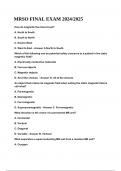
MRSO FINAL EXAM WITH QUESTIONS AND ANSWERS. How do magnetic flux lines travel? A. North to South B. South to North C. East to West D. West to East - Answer A North to South Which of the following can be potential safety concerns to a patient in the static magnetic field? A. Electrically conductive materials B. Ferrous objects C. Magnetic objects D. All of the choices. - Answer D. All of the choices An object that retains its magnetic field when exiting the static magnetic field is call what? A. Paramagnetic B. Diamagnetic C. Ferromagnetic D. Superparamagnetic - Answer C. Ferromagnetic What direction is the vector of a permanent MR unit? A. Horizontal B. Vertical C. Diagonal D. Variable - Answer B. Vertical What separates a superconducting MR unit from a resistive MR unit? A. Cryogen MRSO FINAL EXAM 2024/2025 B. Coils of wires C. Permanent magnets D. none of the choices - Answer A. Cryogen The increasing strength of magnetism as we move closer to the MR unit is called what? A. Ferromagnetism B. Spatial magnetic gradient field C. Vector D. B0 - Answer B. Spatial magnetic gradient field What is responsible for attracting ferrous objects into the MR unit? A. Spatial magnetic gradient fields B. Strong uniform magnetic fields C. Gradient coils D. Radiofrequency system - Answer A. Spatial magnetic gradient fields If we placed a small ferrous object at isocenter, what would we expect to happen? A. The object would experience no attraction. B. The object would immediately be attracted to the bore. C. The object would levitate. D. The object would be repulsed by the unit. - Answer A. The object would experience no attraction. Rotational force will be the strongest at what location? A. Isocenter B. Outside the MR room C. At the gantry opening D. At the 5 gauss line - Answer A. Isocenter Passive shielding uses which of the following? A. Coils of wires with electrical current running through them. B. Magnetically conductive materials C. Plastic D. Wood - Answer B. Magnetically conductive materials How can we reduce risks associated with Lenz's force? A. No risks are associated with Lenz's force. B. Use a cold compress to reduce heating. C. Move as quickly as possible to get the patient out of the scanner quickly. D. Advance patient into the scanner slowly. - Answer D. Advance Patient into the scanner slowly. An implant has a deflection of 23 degrees. In terms of static magnetic fields, is it safe for this patient to have an MRI? A. Yes B. Must call the manufacture to determine conditions. C. No D. Not enough information. - Answer A. Yes Which of the following stainless steels are non-ferrous? A. Ferritic B. Martensitic C. Austenitic D. All are ferrous - Answer C. Austenitic It is not safe for a patient to cross over the 5 gauss line. How many millitesla is this? A. 0.5mT B. 5mT C. 50mT D. 0.005mT - Answer A. 0.5mT A patient is placed in a magnetic field that changes over a distance from the MR unit. What do we need in order to meet the manufacture limits if a patient with an implant will be safe from the threats associated with the static magnetic field prior to their MRI. A. Spatial gradient map. B. Compression C. The MRSO sole approval. D. All of the choices. - Answer A. Spatial gradient map The spatial gradient of 1.5 T MR unit, not the maximum spatial gradient has a lower spatial gradient than a 3.0 T MR unit. A. True B. False - Answer B. False Which of the following are documented biological effects associated with the static magnetic field? A. Magnetophosphenes B. Magnetohydrodynamic Effect C. Headaches D. Difficulty breathing - Answer A. Magnetophosphenes, B. Magnetohydrodynamic Effect and C. Headaches. What is the purpose of the time-varying gradient magnetic field? A. To produce resonance in our hydrogen nuclei B. To change the precessional speeds of hydrogen C. To produce net magnetism D. To form an image. - Answer B. To change the precessional speeds of hydrogen.
Información del documento
- Subido en
- 17 de abril de 2024
- Número de páginas
- 36
- Escrito en
- 2023/2024
- Tipo
- Examen
- Contiene
- Preguntas y respuestas

