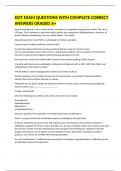
DOT EXAM QUESTIONS WITH COMPLETE CORRECT ANSWERS GRADED A+
DOT EXAM QUESTIONS WITH COMPLETE CORRECT ANSWERS GRADED A+ Upon examination of a 46 y/o male smoker, you detect an irregularly irregular heart rythm. The rate is 140 bpm. This is unknown to the driver and he denies any symptoms of lightheadedness, shortness of breath, dizziness, palpitations, nor any cardiac history. You would: Disqualify and refer to his PMD or cardiologist for further evaluation. Concerning the medical certificate, which is false? Provide the original to the driver being examined. Retain a copy for at least 3 years. You may not provide a copy to the current or prospective employer, they must get it from the driver. The driver must carry the original certificate during operation of a CMV. How soon may a driver be certified after coronary artery bypass grafting (CABG) surgery? 3 months with clearance by cardiologist, resting echocardiogram with an LVEF >40% after CABG, and asymptomatic status with no angina. FMCSA defines a severe hypoglycemic reaction as one that results in: Need of assistance from another person, loss of consciousness, any period of impaired cognitive function that occurs without warning, or seizure Medical fitness for duty includes the ability to perform strenuous labor and to have good judgment, impulse control, and _____________________. Problem solving skills All of the following may perform and certify vision test results except: A chiropractor Ophthalmologist Optometrist or Registered Nurse The grace period for the expiration of a Medical Examiner's Certification is There is no grace period, the certification expires at midnight on the date listed A 28 year old female presents for her CDL physical exam. She indicates she has been enrolled in a Methadone program for three months secondary to a previous substance abuse issue in the recent past. She presents a letter from the administrator of the program documenting her compliance with the program and absence of any history of prior violations of their agreement. According to medical guidance, can a driver be certified while taking methadone. No, since Methadone is a habit-forming narcotic that can produce drug dependence. Methadone is not an allowable drug for CMV operators. Arriving for a recertification exam, a 48 y/o male non-smoker is 5'4", 275lbs. His supervisor calls you ahead of time stating he recently went off the side of the road crashing into a guard rail. There were no injuries and the truck sustained only minor damage. When the medical assistant goes to bring him back, he is found asleep, snoring in the waiting room and she needs to wake him by gently shaking him by the shoulder. She reports this to you. When you arrive in the exam room the patient appears to be nodding off while sitting on the exam table. Upon further questioning, he admits that his wife frequently elbows him because of his snoring and that he gasps and snorts in his sleep. When asked, he denies nodding off while driving. His exam is notable for obesity, Mallampati 4 oropharynx, HTN controlled with 2 medications, otherwise normal. Appropriate next steps: Disqualify and refer to PMD for sleep study. You examine a 37 male driver with missing fingers on his left hand, you must evaluate and do all of the following, Document the effect that the deficit has on the ability of the driver to safely operate a CMV Provide a copy of the Medical Examination Report form and medical examiner's certificate for an SPE initial or renewal application Ensure that the driver with an existing SPE certificate is complying with medical requirements You examine a 37 male driver with missing fingers on his left hand, you must evaluate and obtained Obtain approval from the primary care doctor no When you perform a urinalysis (dip stick) test, you are to test for what? Specific gravity, protein (proteinuria), blood (hematuria) and glucose (glycosuria) Commercial drivers have a greater propensity to develop hypertension than their peers in other professions. true The percentage of drivers with hypertension increases with years of driving, from 29% in drivers with fewer than 10 years driving experience to 39% in drivers with over 20 years of experience. true Effective hypertension management reduces overall cardiac morbidity and mortality. true The rise in hypertension prevalence is unrelated to age, increase in body mass or physical inactivity. false The FMCSA Medical Examination Report includes: Health questionnaire and Physical examination For CMV drivers, "Medical fitness for duty" includes the ability to perform the specific tasks related to driving the vehicle and strenuous labor Drivers with hearing aids: May use hearing aids to undergo the forced whisper test. Vision acuity is measured in In each eye separately, and together and if corrective lens are worn, both with and without corrective lens Periodic monitoring can only be for either 3, 6 or 12 months. false You must write the reason for periodic monitoring on the certification section of the examination form.The expiration date is calculated from the original exam date, not any follow up exam dates. You are never required to certify for an interval longer than would be necessary to adequately monitor a driver's medical fitness for duty. true A 50 y/o male smoker had a percutaneous coronary intervention procedure 2 weeks ago after an abnormal stress test. He is asymptomatic, stage 2 HTN controlled on ramapril and labetolol. You determine: Certify six months. Advise to have ETT before 6 month follow up. If he remains stable with a normal ETT, certify for one year. Is kidney dialysis is disqualifying true Exercise stress tests after CABG should be obtained: In 5 years, then annually thereafter. Which of the following is true regarding the Medical Examination Certificate? The medical examiner completes the certificate and provides a copy to the driver and a copy to the employer. A driver with insulin dependent diabetes must do Obtain an assessment by his/her treating physician, who will complete form MCSA-58870. Produce a 3 month electronic report from their blood glucose device. The driver must not have the complication of severe non-proliferative diabetic retinopathy or proliferative diabetic retinopathy. regarding retinopathy Carcinoma-associated retinopathy is characterized by slow onset of blindness caused by retinal degeneration, usually of photoreceptors. The most common cause of retinopathy is diabetes mellitus. Guidelines for diabetics include an annual optometrist or ophthalmologist examination. EDS may also be a symptom of these underlying conditions Neurological disease, Depression and medication side effects prescription and OTC A 36 y/o non-smoker male driver with a history of asthma comes for a new certification. He has an albuterol inhaler which he uses only as needed. He states for the past two weeks he has had an upper respiratory infection with coughing, mild clear sputum production, and mild wheezing and shortness of breath. He has been using his inhaler 3-4 times a day and used it about an hour before this examination. Upon examination he is in NAD, afebrile, coughs occasionally. BP=136/84, P= 98, R=24. Chest examination reveals normal heart sounds and mild diffuse bilateral expiratory wheezing with slightly prolonged expiratory phase. Appropriate next steps would be: Order a pulmonary function test. If FEV1 <65%, order ABGs. If PaO2 <65%, disqualify. Upon examination for a recertification of an asymptomatic 64 y/o male smoker you note a pulsatile abdominal mass. Proper determination is: Disqualify pending cardiovascular consultation and abdominal CT/ultrasound results. Four of the 13 Federal Motor Carrier Regulations or Standards are non-discretionary, with objective criteria not requiring decision making by the examiner. Which are the 4 standards? Vision, Hearing, Diabetes Mellitus and Epilepsy A 48 y/o female smoker was discharged from the hospital two weeks prior to recertification examination with a diagnosis of DVT and is taking coumadin. She has not yet followed up with her physician. She brings no medical records with her. You would: Disqualify until 1 month waiting period, stable INR results. A commercial driver with a diagnosis of hypersensitivity pneumonitis: Should avoid transporting the causative agent. hypersensitivity pneumonitis: CXR shows interstitial disease. A 55 y/o male smoker for recertification has had chest pain on three occasions in the last 6 weeks, walking his dog in 23 degree weather, moving logs from his yard in to his fireplace in cold weather, and during intercourse. He saw the cardiologist who gave him a stress test. He wasn't sure of the results, but said the cardiologist thought he had angina, put him on NTG pills, told him he could drive but not do anything too strenuous and maybe wants him to have additional testing, but he had to get back on the road. He is asymptomatic, the last episode of chest pain having been 2 weeks ago. You request the ETT results from the cardiologist which was inconclusive. Your determination: The driver has unstable angina, disqualified pending additional testing.
Escuela, estudio y materia
- Institución
- DOT
- Grado
- DOT
Información del documento
- Subido en
- 17 de abril de 2024
- Número de páginas
- 12
- Escrito en
- 2023/2024
- Tipo
- Examen
- Contiene
- Preguntas y respuestas
Temas
-
dot exam questions with complete correct answers g

Documento también disponible en un lote