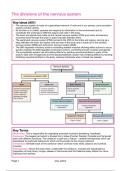
The divisions of the nervous system
Key Ideas (A01)
‣ The nervous system is made of a specialised network of cells and is our primary communication
system (control centre).
‣ Its function is to collect, process and respond to information in the environment and to
coordinate the workings of di erent organs and cells in the body.
‣ The brain and spinal cord make up the central nervous system (CNS) and motor and sensory
neurones travel through the brain to pass impulses between them.
‣ The peripheral nervous system (PNS) connects the CNS to the limbs and organs, serving as a
relay between the brain and spinal cord and rest of the body and is made up of the somatic
nervous system (SNS) and autonomic nervous system (ANS).
‣ The SNS regulates voluntary actions controlling skeletal muscles allowing re ex actions to occur
quickly whereas the ANS regulates involuntary actions, controlling smooth muscles and glands.
‣ The sympathetic system has stimulating e ects by sending neurotransmitters to parts of the
body to deal with emergencies and the parasympathetic system has inhibiting e ects by sending
inhibiting neurotransmitters to the body, relaxing individuals when a threat has passed.
Key Terms
Brain stem: This is responsible for regulating automatic functions (breathing, heartbeat)
Cerebrum: The largest part which is divided into 4 lobes (Frontal, Parietal, Occipital and Temporal)
each with di erent functions. The cerebrum is split into 2 halves - cerebral hemispheres which are
specialised for particular behaviours which communicate via the corpus callosum.
Cerebellum: Beneath back of the cerebrum which controls motor skills, balance and controls
muscles.
Diencephalon: Above the brain stem, underneath the cerebrum. Includes the hypothalamus
(regulation of body temp, hunger, release of hormones) and the thalamus (relay station for nerve
impulses from senses)
Page 1 Izzy Johns
ff ff ff fl ff
, Sensory, relay and motor neurons and synaptic
transmission
Key Ideas (A01)
‣ A sensory neuron has long dendrites in groups called ganglia and a short axon which carry
sensory information from receptors to the CNS, causing re ex actions.
‣ A relay neuron has short dendrites and axon which connect the sensory neurones to the
motor neurones or other relay neurones within the CNS and are responsible for
communication between di erent brain regions.
‣ A motor neuron has a large cell body with short dendrites and a long axon which carries
messages from the CNS to the e ectors such as muscles and glands causing them to relax
or contract.
‣ Synaptic transmission is when information is passed down the axon of the neuron as an
electrical impulse (action potential) once it reaches the terminal button, and then they release
their contents of neurotransmitters which carry the signal across the synaptic gap. These
bind to receptor sites on the post-synaptic cell, and return to electrical impulses.
‣ Excitation causes a post-synaptic neuron to increase its positive charge leading to an
excitatory post-synaptic potential (EPSP), making it more likely to re.
‣ Inhibition causes a post-synaptic neuron to increase its negative charge leading to an
inhibitory post-synaptic potential (IPSP), making it less likely to re
‣ Summation is the likelihood of a neuron ring, determined by adding up the overall potential.
Key Terms
Cell body: Has a nucleus which contains genetic material of a call. The control centre.
Dendrites: Branch-like structures which protrude from the cell body, they carry nerve impulses
from neurones or sensory receptors to the cell body.
Axon: Carries the impulse away from the cell body down the length of the neuron.
Myelin sheath: Fatty layer that protects the axon and speeds up synaptic transmission.
Node of Ranvier: Gaps in the myelin sheath that speed up transmission impulses by forcing it
to jump across the gaps.
Terminal buttons: At the end of the axon, communicate with the next neuron in the chain.
Synapse: A gap between pre-and post-synaptic neuron.
Page 2 Izzy Johns
ff ff fi fl fi fi
Key Ideas (A01)
‣ The nervous system is made of a specialised network of cells and is our primary communication
system (control centre).
‣ Its function is to collect, process and respond to information in the environment and to
coordinate the workings of di erent organs and cells in the body.
‣ The brain and spinal cord make up the central nervous system (CNS) and motor and sensory
neurones travel through the brain to pass impulses between them.
‣ The peripheral nervous system (PNS) connects the CNS to the limbs and organs, serving as a
relay between the brain and spinal cord and rest of the body and is made up of the somatic
nervous system (SNS) and autonomic nervous system (ANS).
‣ The SNS regulates voluntary actions controlling skeletal muscles allowing re ex actions to occur
quickly whereas the ANS regulates involuntary actions, controlling smooth muscles and glands.
‣ The sympathetic system has stimulating e ects by sending neurotransmitters to parts of the
body to deal with emergencies and the parasympathetic system has inhibiting e ects by sending
inhibiting neurotransmitters to the body, relaxing individuals when a threat has passed.
Key Terms
Brain stem: This is responsible for regulating automatic functions (breathing, heartbeat)
Cerebrum: The largest part which is divided into 4 lobes (Frontal, Parietal, Occipital and Temporal)
each with di erent functions. The cerebrum is split into 2 halves - cerebral hemispheres which are
specialised for particular behaviours which communicate via the corpus callosum.
Cerebellum: Beneath back of the cerebrum which controls motor skills, balance and controls
muscles.
Diencephalon: Above the brain stem, underneath the cerebrum. Includes the hypothalamus
(regulation of body temp, hunger, release of hormones) and the thalamus (relay station for nerve
impulses from senses)
Page 1 Izzy Johns
ff ff ff fl ff
, Sensory, relay and motor neurons and synaptic
transmission
Key Ideas (A01)
‣ A sensory neuron has long dendrites in groups called ganglia and a short axon which carry
sensory information from receptors to the CNS, causing re ex actions.
‣ A relay neuron has short dendrites and axon which connect the sensory neurones to the
motor neurones or other relay neurones within the CNS and are responsible for
communication between di erent brain regions.
‣ A motor neuron has a large cell body with short dendrites and a long axon which carries
messages from the CNS to the e ectors such as muscles and glands causing them to relax
or contract.
‣ Synaptic transmission is when information is passed down the axon of the neuron as an
electrical impulse (action potential) once it reaches the terminal button, and then they release
their contents of neurotransmitters which carry the signal across the synaptic gap. These
bind to receptor sites on the post-synaptic cell, and return to electrical impulses.
‣ Excitation causes a post-synaptic neuron to increase its positive charge leading to an
excitatory post-synaptic potential (EPSP), making it more likely to re.
‣ Inhibition causes a post-synaptic neuron to increase its negative charge leading to an
inhibitory post-synaptic potential (IPSP), making it less likely to re
‣ Summation is the likelihood of a neuron ring, determined by adding up the overall potential.
Key Terms
Cell body: Has a nucleus which contains genetic material of a call. The control centre.
Dendrites: Branch-like structures which protrude from the cell body, they carry nerve impulses
from neurones or sensory receptors to the cell body.
Axon: Carries the impulse away from the cell body down the length of the neuron.
Myelin sheath: Fatty layer that protects the axon and speeds up synaptic transmission.
Node of Ranvier: Gaps in the myelin sheath that speed up transmission impulses by forcing it
to jump across the gaps.
Terminal buttons: At the end of the axon, communicate with the next neuron in the chain.
Synapse: A gap between pre-and post-synaptic neuron.
Page 2 Izzy Johns
ff ff fi fl fi fi