Aromatic Chemistry
16 October 2017 18:02
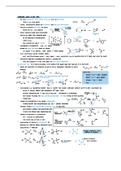
INTRODUCTION TO AROMATIC CHEMISTRY Nomenclature of aromatic systems: 1. Structure of benzene
1. Describe the structure of benzene • All carbon and hydrogen atoms are coplanar,
2. Rationalise the extra stability associated with aromatic compounds therefore the molecule as a whole is planar
3. State the conditions for aromaticity and apply these rules to a range of • All six carbons are equivalent and sp2-
molecules to predict whether or not they are aromatic or anti-aromatic hybridised
4. Rationalise the appearance of the 1H-NMR spectrum of benzene and
related aromatic compounds
2. Stability of aromatic compounds (R group drawn as such when it doesn't • Each carbon uses 3 sp2 hybrid orbitals to
π-molecular orbitals of benzene matter what position it is in) make σ-bonds to neighbouring atoms
• Planar π-system made up of overlapping 6 AO's to give 6 new MO's • Remaining p-orbital is orthogonal to the plane of the molecule -
• Can then accommodate the 6 electrons from the original p-orbitals these orbitals can overlap to form the π-system of the molecule
• The 6 electrons are then completely delocalised around the six
carbon atoms in the ring
• Although the Kekule structure of benzene is less correct than the hybrid structure, it helps to
understand chemical reactivity and aids drawing mechanisms.
3. Criteria for aromaticity
1. Cyclic - electrons can be delocalised around the whole ring
2. Planar - the p atomic orbitals must be able to overlap to form the π-system, requiring all
atoms to be in the same plane
3. Fully conjugated - allows the complete delocalisation around the ring
Cyclopentadienyl Anion 4. Hückel's rule - 4n+2 π-electrons (n = 0,1,2,3, etc) - estimation if a molecule will be aromatic
• As predicted by (based on quantum mechanical calculations by Erich Hückel in 1931 and can also be seen as
Hückel's rule, a quick estimation of drawing the MO diagram for a molecule)
the
cyclopentadienyl Cyclooctatetraene (COT)
anion is aromatic and so relatively stable, hence explaining the easy • There can be situations in which cyclic delocalisation of
deprotonation (and low pKa). This can also be seen from the MO electrons is destabilising, rather than stabilising.
diagram • These cyclic systems are said to be anti-aromatic and
• The π-molecular orbital diagrams for conjugated cyclic hydrocarbons Hückel's rule predicts that systems with 4n π-electrons
can be predicted relatively easily. If the energy level of the highest filled have these very unstable electronic arrangements.
MO relative is lower than the energy of p-orbital (dashed line) then • Can see from MO diagram that a particularly unstable
there will be aromatic stabilisation (if higher, not aromatic) bonding arrangement would result from the
For monocyclic delocalisation of the p-electrons around the ring.
compounds, MO • This is actually avoided as the system prevents the
diagrams look the delocalisation of the electrons by adopting a non-planar
same as the molecule conformation.
pointing down.
Cyclobutadiene Low energy form of cyclooctatetraene "tub-shaped" conformation
• Fleeting existence and dimerises at Which are aromatic?
35K (-238oC).
• The MO diagram for a square planar Molecule
molecule predicts it to be very
unstable and a diradical species with
unpaired electrons
• However cyclobutadiene is Cyclic? Y N Y Y Y Y
diamagnetic and to be rectangular in
shape, due to distortions that Planar? N N Y Y Y Y
reduce the orbital overlap, resulting Conjugated? N N Y Y Y Y
in a rectangular molecule that
Hückel? N N Y (6π, n= Y (14π, n=1) N (8π so 4n, Y (6π, n=1)
behaves more like it has 2 isolated
1) n=2)
double bonds.
Aromatic? Not Not aromatic Aromatic Aromatic Anti- Aromatic
aromatic aromatic
1H NMR spectra of arenes
• Aromatic protons are
Pyridine Aniline Pyrrole deshielded compared to
alkenic protons e.g.
cyclohexene vs benzene.
• N is sp2 hybridised • N is sp2 hybridised, allowing • N is sp2 hybridised, allowing full conjugation and • The delocalised π-electron
• N has a lone pair the lone pair on nitrogen to aromatic stabilisation. density above and below the
available to bond conjugate in to the ring (this • If the N was sp3 hybridised (as expected from looking plane of the ring sets up a ring
with H+ (so a weak reduces the availability of at the structure), would not be aromatic as not fully current when the molecule is
base) the lone pair) conjugated. placed in an applied magnetic
• pKa = 5.25 • Aniline is a weak base • Lone pair on N is involved in aromaticity (not available field
• pKa = 4.6 to bond with H+, pyrolle is weak base pKa = -3.8) • This results in protons outside
. the ring experiencing a
stronger local field and so are deshielded (results in a
downfield shift (higher ppm) from a typical sp2 shift).
• Protons above or
inside the ring (not
possible in
N has available lone Lone pair is involved in aromaticity, so protonation will benzene)
pair so protonation disrupt the π-electrons and protonated pyrrole is not experience a
does not disrupt π- aromatic. Protonation weaker local field,
Organic Chemistry I Page 1
16 October 2017 18:02
INTRODUCTION TO AROMATIC CHEMISTRY Nomenclature of aromatic systems: 1. Structure of benzene
1. Describe the structure of benzene • All carbon and hydrogen atoms are coplanar,
2. Rationalise the extra stability associated with aromatic compounds therefore the molecule as a whole is planar
3. State the conditions for aromaticity and apply these rules to a range of • All six carbons are equivalent and sp2-
molecules to predict whether or not they are aromatic or anti-aromatic hybridised
4. Rationalise the appearance of the 1H-NMR spectrum of benzene and
related aromatic compounds
2. Stability of aromatic compounds (R group drawn as such when it doesn't • Each carbon uses 3 sp2 hybrid orbitals to
π-molecular orbitals of benzene matter what position it is in) make σ-bonds to neighbouring atoms
• Planar π-system made up of overlapping 6 AO's to give 6 new MO's • Remaining p-orbital is orthogonal to the plane of the molecule -
• Can then accommodate the 6 electrons from the original p-orbitals these orbitals can overlap to form the π-system of the molecule
• The 6 electrons are then completely delocalised around the six
carbon atoms in the ring
• Although the Kekule structure of benzene is less correct than the hybrid structure, it helps to
understand chemical reactivity and aids drawing mechanisms.
3. Criteria for aromaticity
1. Cyclic - electrons can be delocalised around the whole ring
2. Planar - the p atomic orbitals must be able to overlap to form the π-system, requiring all
atoms to be in the same plane
3. Fully conjugated - allows the complete delocalisation around the ring
Cyclopentadienyl Anion 4. Hückel's rule - 4n+2 π-electrons (n = 0,1,2,3, etc) - estimation if a molecule will be aromatic
• As predicted by (based on quantum mechanical calculations by Erich Hückel in 1931 and can also be seen as
Hückel's rule, a quick estimation of drawing the MO diagram for a molecule)
the
cyclopentadienyl Cyclooctatetraene (COT)
anion is aromatic and so relatively stable, hence explaining the easy • There can be situations in which cyclic delocalisation of
deprotonation (and low pKa). This can also be seen from the MO electrons is destabilising, rather than stabilising.
diagram • These cyclic systems are said to be anti-aromatic and
• The π-molecular orbital diagrams for conjugated cyclic hydrocarbons Hückel's rule predicts that systems with 4n π-electrons
can be predicted relatively easily. If the energy level of the highest filled have these very unstable electronic arrangements.
MO relative is lower than the energy of p-orbital (dashed line) then • Can see from MO diagram that a particularly unstable
there will be aromatic stabilisation (if higher, not aromatic) bonding arrangement would result from the
For monocyclic delocalisation of the p-electrons around the ring.
compounds, MO • This is actually avoided as the system prevents the
diagrams look the delocalisation of the electrons by adopting a non-planar
same as the molecule conformation.
pointing down.
Cyclobutadiene Low energy form of cyclooctatetraene "tub-shaped" conformation
• Fleeting existence and dimerises at Which are aromatic?
35K (-238oC).
• The MO diagram for a square planar Molecule
molecule predicts it to be very
unstable and a diradical species with
unpaired electrons
• However cyclobutadiene is Cyclic? Y N Y Y Y Y
diamagnetic and to be rectangular in
shape, due to distortions that Planar? N N Y Y Y Y
reduce the orbital overlap, resulting Conjugated? N N Y Y Y Y
in a rectangular molecule that
Hückel? N N Y (6π, n= Y (14π, n=1) N (8π so 4n, Y (6π, n=1)
behaves more like it has 2 isolated
1) n=2)
double bonds.
Aromatic? Not Not aromatic Aromatic Aromatic Anti- Aromatic
aromatic aromatic
1H NMR spectra of arenes
• Aromatic protons are
Pyridine Aniline Pyrrole deshielded compared to
alkenic protons e.g.
cyclohexene vs benzene.
• N is sp2 hybridised • N is sp2 hybridised, allowing • N is sp2 hybridised, allowing full conjugation and • The delocalised π-electron
• N has a lone pair the lone pair on nitrogen to aromatic stabilisation. density above and below the
available to bond conjugate in to the ring (this • If the N was sp3 hybridised (as expected from looking plane of the ring sets up a ring
with H+ (so a weak reduces the availability of at the structure), would not be aromatic as not fully current when the molecule is
base) the lone pair) conjugated. placed in an applied magnetic
• pKa = 5.25 • Aniline is a weak base • Lone pair on N is involved in aromaticity (not available field
• pKa = 4.6 to bond with H+, pyrolle is weak base pKa = -3.8) • This results in protons outside
. the ring experiencing a
stronger local field and so are deshielded (results in a
downfield shift (higher ppm) from a typical sp2 shift).
• Protons above or
inside the ring (not
possible in
N has available lone Lone pair is involved in aromaticity, so protonation will benzene)
pair so protonation disrupt the π-electrons and protonated pyrrole is not experience a
does not disrupt π- aromatic. Protonation weaker local field,
Organic Chemistry I Page 1