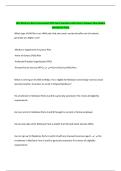
EAPS 106 Exam 1, Review Questions and answers, rated A+| LATEST EXAM UPDATES| 2024/25 |
EAPS 106 Exam 1, Review Questions and answers, rated A+ The earth's four layers and their thicknesses --crust: radius = 6371 km, thiccness = 35 km mantle: radius = 6336 km, thiccness = 2850 km outer core: radius = 3486 km, thiccness = 2270 km inner core: radius = 1216 km, thiccness = 1216 km How did Earth acquire its internal heat? --The process of planet accretion results from lots of collisions, each producing heat. Combined with heat from the decay radioactive elements, the interiors of all new planets become so hot inside that they melt. Earth will never lose its heat prior to the Sun going Red Giant stage Why is the interior of Earth layered? --When everything was melted, the dense elements like iron sank to the center forming an iron core, and the lighter elements like silicon and oxygen rise to form a rocky mantle and crust. Process is called differentiation. (spinning water bottle experiment) Why is the outer core a liquid and the inner core a solid? --The outer layer is the only layer that remains hotter than its melting temperature. The inner core is at a higher temperature, but the melting temperature is also higher due to the greater pressure at the increased depth. What are the lithosphere and asthenosphere? --Lithosphere is a strong outer shell of the Earth consisting of the cold crust and uppermost mantle. The breaking of the lithosphere into pieces or "plates" and the manner in which they move around the surface of the Earth gives rise to the term "plate tectonics". The asthenosphere underlies the lithosphere and is hot enough to flow like a fluid (even though it remains a solid). It is the weakness of the asthenosphere that allows tectonic plates to slide around the surface of the Earth. What evidence did Wegner use to suggest that the continents drift? --North and South America coastlines fit with Europe and Africa Identical volcanic flows appear on both sides of the Atlantic Fossils of non-swimmers found on both sides of the modern oceans How do we know that our magnetic field has reversed itself many times? --Crystals in lava record the direction to the magnetic poles at the time of each eruption, There are also magnetic lineations on the seafloor that show new oceanic plates are created at mid ocean ridges, giving mor| LATEST EXAM UPDATES| 2024/25 |
Escuela, estudio y materia
- Institución
- EAPS
- Grado
- EAPS
Información del documento
- Subido en
- 11 de abril de 2024
- Número de páginas
- 23
- Escrito en
- 2023/2024
- Tipo
- Examen
- Contiene
- Preguntas y respuestas
Temas
-
eaps 106 exam 1 review questions and answers ra

Documento también disponible en un lote