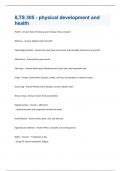
ILTS 305 - physical development and health Questions and Answers with complete solution
Health - Answer-State of being sound in body, mind, and spirit Wellness - Answer-Highest state of health Psychological health - Answer-You must have an accurate and Favorable impression of yourself Self esteem - Answer-Know your worth Vital signs - Answer-Body temp, blood pressure, pulse rate, and respiration rate Smog - Answer-Combination of gases, smoke, and Fog. Accumulates in industrial areas. Gray smog - Answer-Mainly sulfur dioxide, common Eastern USA Brown smog - Answer-Comes from automobiles Skeletal system - Answer-- 200 bones - create protective and supportive network for body Axial skeleton - Answer-Skull, spine, ribs, and sternum Appendicular skeleton - Answer-Pelvis, shoulder, arm and leg bones Water - Answer-- 7-10 glasses a day - losing 5% causes headaches, fatigueFat - Answer-Two categories saturated and unsaturated Saturated fat - Answer-Meat, lard, butter, coconut, and palm oil Unsaturated fat - Answer-Sunflower oil, corn oil, olive oil, and canola oil Monounsaturated fats - Answer-Good for body as lower cholesterol Trans fats - Answer-Most harmful, liquid veg oil Cholesterol and fat - Answer-Cholesterol - linked to heart disease, too much causes arteries to be blocked Fiber - Answer-Whole grains, fruits, and vegetables. Insoluble- speed digestion and reduce risk of colon cancer Soluble - lowers cholesterol and managed blood sugar Cancer - Answer-Feiffer the types of cancer. Carcinoma- most common type, starts inside organs or outside the body Sarcomas- develop in connective or supportive tissue Lymphomas- originate in the lymph system Complex carbs - Answer-Keep level of blood sugar stable Water - Answer-Important part of exercise. If dehydrated heart will hard hard time pumping Nicotine - Answer-Far more addictive than alcohol, 8 out of 10 smokers will become addicted.Avoiding alcohol abuse - Answer-Don't use as medicine, or escape from problems, eat whilst and after drinking Psychological dependence on drugs - Answer-Crave relieve from pain or anxiety, escape. Can lead to dependency. Physical dependency - Answer-Person needs increasing amount to get needed effect appetite - Answer-desire to eat Satiety - Answer-Point where body says it's full Digestive system - Answer-Convert food to energy. Immediate energy and future energy Muscular system - Answer-Muscles are attached to the skeleton. Muscles are stimulated by nerves that link them to the brain. Endocrine system - Answer-Creates and secretes the hormones to accomplish bodily tasks. Metabolism, growth. E.g. pituitary, thyroid, parathyroid, and adrenal gland. Circulatory system - Answer-Composed of heart, blood vessels, and blood. Moves blood through the body. Arteries - carry blood away from heart Veins - carry blood back to heart Capillaries - distribute blood to various body cells. Removes impurities in the bloody Hormone system - Answer-Chemicals that motivate the body to do certain things Hypothalamus - Answer-Area of brain about size of a pea. Sends messages to pituitary gladPituitary gland - Answer-Turns on and off hormones being released. Communicable diseases - Answer-Caused by microorganisms and can be transferred from one infected person to an uninflected person or animal. Infectious disease - Answer-Caused by virus, parasite, or bacteria Viruses - Answer-Smallest pathogens, most difficult to destroy Bacteria - Answer-Simple, once- called organism and are the most common microorganisms and pathogen. Most do not cause disease. Many are important to body processes. immune system - Answer-The cells and tissues that recognize and attack foreign substances in the body immune response - Answer-The body's defensive reaction to invasion by bacteria, viral agents, or other foreign substances. T cells - Answer-Cells created in the thymus that produce substances that attack infected cells in the body. Macrophages - Answer-Found within the lymph nodes, they are phagocytes that destroy bacteria, cancer cells, and other foreign matter in the lymphatic stream. B cells - Answer-produce antibodies lymph nodes - Answer-Bean-shaped filters that cluster along the lymphatic vessels of the body. They function as a cleanser of lymph as wells as a site of T and B cell activation USDA's My Plate - Answer-created in 2011lymphatic system - Answer-Composed of a network of vessels, ducts, nodes, and organs. Provides defense against infection. nervous system - Answer-the body's speedy, electrochemical communication network, consisting of all the nerve cells of the peripheral and central nervous systems
Escuela, estudio y materia
- Institución
- ILTS 305 - physical development and health
- Grado
- ILTS 305 - physical development and health
Información del documento
- Subido en
- 11 de abril de 2024
- Número de páginas
- 5
- Escrito en
- 2023/2024
- Tipo
- Examen
- Contiene
- Preguntas y respuestas
Temas
-
ilts 305 physical development and health

Documento también disponible en un lote