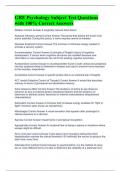
GRE Psychology Subject Test Questions with 100% Correct Answers
Ablation Correct Answer A surgically induced brain lesion. Absolute refractory period Correct Answer The period that follows the onset of an action potential. During this period, a nerve impulse cannot be initiated Absolute threshold Correct Answer The minimum of stimulus energy needed to activate a sensory system. Accommodation Correct Answer A principle of Piaget's theory of cognitive development. It occurs when cognitive structures are modified because new information or new experiences do not fit into existing cognitive structures. Acetylcholine Correct Answer A neurotransmitter found in both central and peripheral nervous systems linked to Alzheimer's disease and used to transmit nerve impulses to the muscles, respectively. Acrophobia Correct Answer A specific phobia that is an irrational fear of heights. ACT model (Adaptive Control of Thought) Correct Answer A model that describes memory in terms of procedural and declarative memory. Actor-observer effect Correct Answer The tendency of actors to see observer behavior as due to external factors (situational factors) and the tendency of observers to attribute actors' behaviors to internal characteristics (dispositional characteristics). Adrenaline Correct Answer A hormone that increases energy available for "fight or flight" reactions (also known as epinephrine). Afterimages Correct Answer A visual sensation that appears after prolonged or intense exposure to a stimulus. Agnosia Correct Answer Impairments in perceptual recognition. Agoraphobia Correct Answer An irrational fear of being in places or situations where escape might be difficult. All-or-none law Correct Answer A law about nerve impulses stating that when depolarization reaches the critical threshold (-50 millivolts) the neuron is going to fire, each time, every time. Alternate-form method Correct Answer In psychometrics, it is the method of using two or more different forms of a test to determine the reliability of a particular test. Altruism Correct Answer A form of helping behavior where the person's intent is to benefit someone else at some cost to him- or herself. Amnesia Correct Answer A dissociative disorder where individuals are unable to recall past experience, but this inability is not due to a neurological disorder. Analogy of inoculation Correct Answer McGuire's analogy that people can be psychologically inoculated against the "attack" of persuasive communications by first exposing them to a weakened attack. Analyses of Variance (anovas) Correct Answer A statistical method to compare the means of more than two groups by comparing the between-group variance to the within-group variance. Anchoring Correct Answer A cognitive term (a heuristic) that refers to the tendency of people to make decisions based on reference points, or standards used to make judgements. Anima (animus) Correct Answer An archetype from Jung's theory referring to the feminine behaviors in males, and the masculine behaviors in females. Anorexia nervosa Correct Answer An eating disorder characterized by a refusal to maintain a minimal normal body weight. Anterograde amnesia Correct Answer Memory loss for new information following brain injury. Anti-social personality disorder Correct Answer A personality disorder characterized by a pattern of disregard for, and violation of, the rights of others. Aphagia. Correct Answer An impairment in the ability to eat. Aphasias Correct Answer Language disorders, which are associated with Broca's and Wernicke's areas in the brain. Apparent motion Correct Answer An illusion that occurs when two dots flashed in different locations on a screen seconds apart are perceived as one moving dot. Apraxia Correct Answer An impairment in the organization of voluntary action. Archetypes Correct Answer The building blocks for the collective unconscious referred to in Jung's theory of personality. Assimilation Correct Answer A principle of Piaget's theory of cognitive development. It is the process of understanding new information in relation to prior knowledge, or existing schemata. Association area Correct Answer Areas in the brain that integrate information from different cortical regions
Escuela, estudio y materia
- Institución
- GRE Psychology
- Grado
- GRE Psychology
Información del documento
- Subido en
- 10 de abril de 2024
- Número de páginas
- 30
- Escrito en
- 2023/2024
- Tipo
- Examen
- Contiene
- Preguntas y respuestas
Temas
-
ablation

Documento también disponible en un lote