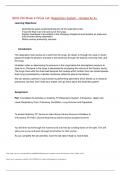
BIOS-255 Week 6 Virtual Lab: Respiratory System – Graded An A+
BIOS-255 Week 6 Virtual Lab: Respiratory System – Graded An A+ Learning Objectives: • Describe the gross anatomical features of the respiratory tract. • Trace the flow of air into and out o f the lungs. • Explain how Boyle’s law relates to the changing intrapleural and alveolar air pressures and volumes during respiration. • Define various pulmonary volumes. Introduction: The respiratory tract carries air to and from the lungs. Air drawn in through the nose or mouth passes through the pharynx and larynx and continues through the trachea, bronchial tree, and the lungs. Inhalation relies on decreasing the pressure in the lungs below the atmospheric pressure to draw air in. Pressure in the lungs is decreased by increasing the volume of the thoracic cavity; The lungs move with the chest wall because the cavities which contain them are closed spaces. Each lung is protected by a double membrane called the pleural membrane. We can assess a person’s lung function by performing spirometry which allows us to measure pulmonary volumes. Don’t hold your breath, let’s go learn about this essential system! Assignment: Part 1 Complete the activities in Anatomy.TV Respiratory System: Introduction, Upper and Lower Respiratory Tract, Pulmonary Ventilation, Lung Volumes and Capacities. To access Anatomy.TV: Resources tabLibraryLibrary Resources-Database A- ZAnatomy.TVTitles: Choose Respiratory systemchoose assigned sections You will then work through the material and activities by scrolling down on the right. This will allow you to see and work through all activities for that section. As you complete the lab activities, have the lab report ready to record data. Part 2 Complete the lab report. Respiratory Anatomy Lab Report A. Anatomy 1. Identify the following structures by indicating which letter is indicating the structure in the image below: (¼ point per identification; total 1 ½ points) Oropharynx (F) Nasopharynx (C) Palatine tonsil (E) Soft palate (D) Middle nasal conchae (A) Middle Meatuses (B) Trachea (G) Esophagus (H) 2. Label the following structures by indicating which letter they correspond to: (¼ point per identification; total 1 point) Trachea (B) Larynx (A) Diaphragm (E) Left primary bronchi (C) Bronchioles (D) 3. Label the following structures by indicating which letter they correspond to in this image of the larynx: thyroid cartilage (C) cricoid cartilage (D) epiglottis (A) (1/2 point per identification; 1 ½ point total) 4. Identify the following by indicating the letter that corresponds to the structure. (1/2 point per identification; 3 points total) Inferior lobe of the right lung (F) Apex of the right lung (A) Superior lobe of the right lung (B) Middle lobe of the right lung (E) Secondary (lobar) bronchi of the left lung (C) Tertiary (segmental) bronchi of the left lung (D) B. Pulmonary Ventilation 5. According to Boyle’s law, how are pressure and volume related, given a closed container? (1 point) • According to Boyle's law, the pressure inside a closed container is inversely proportional to its volume. Therefore, if the size of a closed container decreases, the pressure inside increases; on the other hand, if the size of the container increases, the pressure inside decreases. 6. a. What happens to the volume of the thoracic cavity when the diaphragm contracts/flattens? (1 point) • Intercostal and abdominal muscles contract. The contraction of the muscles reduces the volume of the abdominal muscle and thoracic cavity, causing the air to flow out more quickly. b. How does this volume change affect the pressure in the thoracic cavity, and the flow of air? (1 point) • Pressure increases causing the air to flow out quicker. 7. Describe the role of surfactant in the lungs. (1 point) • The surfactant quantity per alveolus is almost constant, so when deflated, each alveolus is filled with more surfactant and this concentration increases. Inhalation is therefore much easier as there is less effort to be exerted to inflate the lungs. C. Lung Volumes and Capacities 8. Define tidal volume and inspiratory reserve volume. (2 points) • Every respiratory cycle, the tidal volume indicates how much air is moving in and out of the lungs. The average for healthy adult is about 500mL. • When a person inhales forcefully after receiving a normal tidal volume of air, this is the inspiratory reserve volume. 9. Choose 4 of the blanks below to identify with the appropriate labels. (1/2 point per identification; 2 points total) A. Residual volume B. Expiratory reserve volume (ERV) C. Total lung capacity D. Vital capacity E. Functional residual capacity Grading Rubric for Lab Report Activity Deliverable Points Part 1 Complete lab activities 15 Part 2 Complete lab report 15 Total Complete all lab activities 30
Escuela, estudio y materia
- Institución
- Chamberlain College Nursing
- Grado
- BIOS 225
Información del documento
- Subido en
- 10 de abril de 2024
- Número de páginas
- 9
- Escrito en
- 2023/2024
- Tipo
- OTRO
- Personaje
- Desconocido
Temas
-
week6virtuallabrespiratorysystem
Documento también disponible en un lote