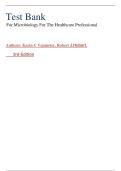
Test Bank For Organic Chemistry 9th Edition By John E. Mcmurry All Chapters 1-31 | Complete 2024/2025 | Verified.
Test Bank For Organic Chemistry 9th Edition By John E. Mcmurry All Chapters 1-31 | Complete 2024/2025 | Verified. Chapter 01 - Structure and Bonding 1. Give the ground-state electron configuration for carbon (atomic number 6). ANSWER: 1s 2 2s 2 2px 1 2py 1 or 1s 2 2s 2 2p 2 POINTS: 1 2. Give the ground-state electron configuration for fluorine (atomic number 9). ANSWER: 1s 2 2s 2 2px 2 2py 2 2pz 1 or 1s 2 2s 2 2p 5 POINTS: 1 3. Give the ground-state electron configuration for magnesium (atomic number 12). ANSWER: 1s 2 2s 2 2p 6 3s 2 POINTS: 1 4. How many electrons does silicon have in its valence shell? ANSWER: four POINTS: 1 Exhibit 1-1 Write valid Lewis (electron-dot) structures for each formula below. Show all electrons as dots and show all non-bonding electrons. 5. C2Cl4 tetrachloroethylene ANSWER: POINTS: 1 6. CO2 carbon dioxide ANSWER: POINTS: 1 7. CH4O methanol ANSWER: POINTS: 1 Exhibit 1-2 Consider the structure of urea, shown below, to answer the following question(s). 8. Refer to Exhibit 1-2. Fill in any non-bonding valence electrons that are missing from the line-bond structure. Cengage Learning Testing, Powered by Cognero Page 1 Chapter 01 - Structure and Bonding ANSWER: POINTS: 1 9. Refer to Exhibit 1-2. The carbon atom in urea is: a. sp 3 hybridized b. sp 2 hybridized c. sp hybridized d. not hybridized ANSWER: b POINTS: 1 10. Refer to Exhibit 1-2. The predicted NH2−C=O bond angle in urea is: a. 109.5° b. 120° c. 180° d. not predictable ANSWER: b POINTS: 1 Exhibit 1-3 Determine the hybridization for the indicated atoms in each structure below. 11. Refer to Exhibit 1-3. The hybridization of this oxygen atom (A) is ______. ANSWER: sp 2 POINTS: 1 12. Refer to Exhibit 1-3. The hybridization of this oxygen atom (B) is ______. ANSWER: sp 3 POINTS: 1 13. Refer to Exhibit 1-3. The hybridization of this carbon atom (C) is ______. ANSWER: sp 3 POINTS: 1 14. Refer to Exhibit 1-3. The hybridization of this carbon atom (D) is ______. ANSWER: sp POINTS: 1 Cengage Learning Testing, Powered by Cognero Page 2 Chapter 01 - Structure and Bonding 15. The molecular formula C2H4O can be converted into three-line bond (Kekulé) structures that are consistent with valence rules. a. b. c. d. a. Which one of the Kekulé structures is not consistent with valence rules? b. Explain why the structure you chose in part a is not consistent with valence rules. ANSWER: a. d b. The carbon bonded to the oxygen atom in structure d is pentavalent; it has 10 valence electrons. Carbon can only have eight valence electrons. In addition, the other carbon has only six valence electrons when it would prefer to have eight. POINTS: 1 16. The original question was combined with #15. This placeholder question is here to maintain the integrity of the numbering system between the printed copy and ExamView. Therefore, it has been marked "do not use on test" in ExamView's question information dialog. As a result, this placeholder question is automatically prevented from being chosen as a test question. ANSWER: Answer not provided. POINTS: 1 17. Convert the following structure to a skeletal drawing and give its molecular formula. ANSWER: Molecular formula: C5H7Br POINTS: 1 18. Draw an orbital picture for acetylene, C2H2. Clearly label each bond type and indicate the type of orbitals involved in each bond. Cengage Learning Testing, Powered by Cognero Page 3 Chapter 01 - Structure and Bonding ANSWER: POINTS: 1 Exhibit 1-4 Propose possible structures for a molecule that meets each of the following descriptions. 19. Refer to Exhibit 1-4. Contains two sp 3 hybridized carbons and two sp hybridized carbons. ANSWER: POINTS: 1 20. Refer to Exhibit 1-4. Contains one sp 3 hybridized carbon and two sp 2 hybridized carbons. ANSWER: POINTS: 1 21. Convert the following molecular model into a condensed structure and a skeletal structure. ANSWER: POINTS: 1 22. Convert the following molecular model into a condensed structure and a skeletal structure. Cengage Learning Testing, Powered by Cognero Page 4 Chapter 01 - Structure and Bonding ANSWER: POINTS: 1 23. Convert the following molecular model into a condensed structure and a skeletal structure. ANSWER: or more specifically; POINTS: 1 24. Indicate the hybridization on each of the carbon atoms indicated with a number in the molecular model shown. ANSWER: Carbon 1: sp 3 Carbon 2: sp 2 POINTS: 1 25. Draw the orbital diagram showing the ground-state electron configuration of sulfur. Cengage Learning Testing, Powered by Cognero Page 5 Chapter 01 - Structure and Bonding ANSWER: POINTS: 1 26. Fill in any nonbonding valence electrons that are missing from the following structural representation of the amino acid cysteine. ANSWER: POINTS: 1 27. There are two substances with the molecular formula C2H7N. Draw them and describe how they differ. ANSWER: The two structures differ in the number of hydrogen atoms and carbon atoms bonded to the nitrogen atom. The first structure contains the carbon atoms bonded in a two carbon chain while in the second structure the two carbons atoms are isolated from each other by the nitrogen atom. POINTS: 1 28. Overlap of the two atomic orbitals shown could result in a: a. σ bond b. π bond c. σ or π depending on the direction of the overlap. Cengage Learning Testing, Powered by Cognero Page 6 Chapter 01 - Structure and Bonding ANSWER: c POINTS: 1 29. Hybridization of the atomic orbitals shown would result in: a. sp 3 hybridization b. sp 2 hybridization c. sp hybridization ANSWER: b POINTS: 1 30. Which of the following represents a hybrid orbital? a. b. c. d. ANSWER: d POINTS: 1 31. What type of hybridization is exhibited by carbon in the following substance?: a. sp 3 hybridization Cengage Learning Testing, Powered by Cognero Page 7 Chapter 01 - Structure and Bonding b. sp 2 hybridization c. sp hybridization ANSWER: b POINTS: 1 32. What type of hybridization is exhibited by carbon in the following substance?: a. sp 3 hybridization b. sp 2 hybridization c. sp hybridization ANSWER: c POINTS: 1 33. What type of hybridization is exhibited by the nitrogen atom in the following substance and how many lone pairs are present on the nitrogen?: a. sp 3 hybridization and 1 lone pair b. sp 2 hybridization and l lone pair c. sp hybridization and 1 lone pair d. sp 3 hybridization and 2 lone pairs e. sp 2 hybridization and 2 lone pairs f. sp hybridization and 2 lone pairs ANSWER: a POINTS: 1 34. If all the missing bonds in the following structure are sigma bonds to hydrogen atoms, how many hydrogen atoms are missing from this structure? Atoms other than carbon are labeled. a. 7 Cengage Learning Testing, Powered by Cognero Page 8 Chapter 01 - Structure and Bonding b. 10 c. 12 d. 14 e. None of these is the correct number
Libro relacionado
- 2015
- 9781305686465
- Desconocido
Escuela, estudio y materia
- Institución
- Organic Chemistry 9th Edition
- Grado
- Organic Chemistry 9th Edition
Información del documento
- Subido en
- 6 de abril de 2024
- Número de páginas
- 570
- Escrito en
- 2023/2024
- Tipo
- Examen
- Contiene
- Preguntas y respuestas
Temas
-
by john e mcmurry
-
all chapters 1 31
-
omplete 2024
-
verified
-
organic chemistry 9th edition
-
test bank for organic chemistry 9th edition

Documento también disponible en un lote