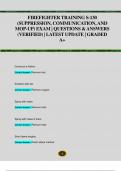
FIREFIGHTER TRAINING S-130
(SUPPRESSION, COMMUNICATION, AND
MOP-UP) EXAM | QUESTIONS & ANSWERS
(VERIFIED) | LATEST UPDATE | GRADED
A+
Construct a fireline.
Correct Answer: Remove fuel.
Smother with dirt.
Correct Answer: Remove oxygen.
Spray with water.
Correct Answer: Remove heat.
Spray with Class A foam.
Correct Answer: Remove heat.
Short flame lengths.
Correct Answer: Direct attack method.
1
,Smothering.
Correct Answer: Direct attack method.
Long flame lengths.
Correct Answer: Indirect attack method.
Line construction far from the fire edge.
Correct Answer: Indirect attack method.
Moderately intense fire moving at moderate ROS.
Correct Answer: Flank attack method.
Encircling spot fires.
Correct Answer: Parallel attack method.
Keeps burning debris from rolling across control line.
Correct Answer: Cup trenching.
Prevents fuel outside the control line from burning.
Correct Answer: Fireproofing fuel.
Eliminates fuel between fire edge and control line.
2
, Correct Answer: Firing Operations.
Attack parts of a fire threatening life or property.
Correct Answer: Hotspotting.
Creates emergency control line, especially in light fuels.
Correct Answer: Creating a scratch line.
Finds hotspots along a partly dead fire edge.
Correct Answer: Cold trailing.
Identify THREE true statements about control lines.
- Anchor points are required only in medium or heavy fuels.
- The control line should be at least 1 1/2 times the height of the fuels.
- One factor in control line position is whether offensive or defensive strategy is used.
- The control line should be uniform width all around a fire's perimeter.
- The control line should be kept as short and straight as possible.
Correct Answer: - The control line should be at least 1 1/2 times the height of the fuels.
- One factor in control line position is whether offensive of defensive strategy is used.
- The control line should be kept as short ans straight as possible.
Broken up and scattered in the green.
3
(SUPPRESSION, COMMUNICATION, AND
MOP-UP) EXAM | QUESTIONS & ANSWERS
(VERIFIED) | LATEST UPDATE | GRADED
A+
Construct a fireline.
Correct Answer: Remove fuel.
Smother with dirt.
Correct Answer: Remove oxygen.
Spray with water.
Correct Answer: Remove heat.
Spray with Class A foam.
Correct Answer: Remove heat.
Short flame lengths.
Correct Answer: Direct attack method.
1
,Smothering.
Correct Answer: Direct attack method.
Long flame lengths.
Correct Answer: Indirect attack method.
Line construction far from the fire edge.
Correct Answer: Indirect attack method.
Moderately intense fire moving at moderate ROS.
Correct Answer: Flank attack method.
Encircling spot fires.
Correct Answer: Parallel attack method.
Keeps burning debris from rolling across control line.
Correct Answer: Cup trenching.
Prevents fuel outside the control line from burning.
Correct Answer: Fireproofing fuel.
Eliminates fuel between fire edge and control line.
2
, Correct Answer: Firing Operations.
Attack parts of a fire threatening life or property.
Correct Answer: Hotspotting.
Creates emergency control line, especially in light fuels.
Correct Answer: Creating a scratch line.
Finds hotspots along a partly dead fire edge.
Correct Answer: Cold trailing.
Identify THREE true statements about control lines.
- Anchor points are required only in medium or heavy fuels.
- The control line should be at least 1 1/2 times the height of the fuels.
- One factor in control line position is whether offensive or defensive strategy is used.
- The control line should be uniform width all around a fire's perimeter.
- The control line should be kept as short and straight as possible.
Correct Answer: - The control line should be at least 1 1/2 times the height of the fuels.
- One factor in control line position is whether offensive of defensive strategy is used.
- The control line should be kept as short ans straight as possible.
Broken up and scattered in the green.
3