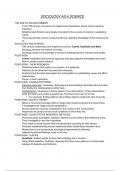
SOCIOLOGY AS A SCIENCE
THE AGE OF ENLIGHTENMENT:
- In the 18th century, the period of enlightenment developed, where science became
important.
- Enlightenment thinkers were deeply interested in the success of science in explaining
nature.
- They believed that science would provide true, objective knowledge of the world around
us.
SOCIOLOGY AND SCIENCE:
- 19th century modernists were inspired by science: Comte, Durkheim and Marx.
- Sociology became the science of society.
- Sociology seeks true knowledge of society to eradicate poverty, injustice and conflict.
POSITIVISM:
- Comte: established the positivist approach that uses objective knowledge and social
facts to conduct social research.
POSITIVISM - THEIR RESEARCH:
- Positivists believe that reality is not random, it is patterned.
- Patterns can be observed, recorded and measured.
- Positivists find the facts that explain the social pattern by establishing cause and effect
relationships.
- Favour a macro approach.
POSITIVISM - FINDING PATTERNS:
- Inductive reasoning: measuring, observing and accumulating information about society,
then finding the trends/patterns within them.
- Verificationism: developing a theory based on the observations. These observations
verify the theory and create a general law. The theory is proven to be true.
+ For example, finding patterns about falling objects created the laws of gravity.
POSITIVISM - MACRO THEORY:
- Macro or structural sociology refers to large scale social processes and phenomena.
- It investigates the ‘bigger picture’ perspective.
- Human behaviour must be understood in the context of the social system.
- People are the product of the social conditions in which they live.
POSITIVISM - QUANTITATIVE RESEARCH METHODS:
- Positivists prefer quantitative research methods as they believe that objectivity is key.
- They investigate to test their hypothesis.
- They observe causal factors while simultaneously excluding all other factors.
- Produces mathematically precise statements about relationships between facts.
- Researchers could contaminate sociological experiments by allowing
subjectivity/opinions/feelings to get in the way.
POSITIVISM - SUICIDE:
- Durkheim: studied suicide to show that sociology was a science.
- Using official statistics, Durkheim observed that there were patterns in suicide rates
between Protestants and Catholics.
, - He concluded that these patterns created social facts, not the individual motives of
people.
- Social facts were the levels of integration and regulation influencing the suicide rates.
INTERPRETIVISM:
- Believe that sociology is not a science, because science only deals with cause and
effect, not human meanings.
- They reject scientific methods and claim that positivism is inadequate and unsuited for
the study of humans.
- They study the behaviour of individuals to see how they shape society.
INTERPRETIVISM - SUBJECT MATTER OF SOCIOLOGY:
- Natural sciences: behaviour is a straightforward reaction to stimuli, studies matter with
no consciousness, actions can only be understood in terms of meanings.
- Sociology: studies people with consciousness, meanings are ideas or constructs, people
construct and make sense of their world by attaching meanings.
- G.H. Mead: people have free will and choice. Humans interpret stimulus and choose
how to respond to it (e.g: criminal behaviour).
- Individuals are not manipulated by external facts.
- The world is constructed through meanings, and it is the job of the sociologist to uncover
the meanings.
INTERPRETIVISM - VERSTEHEN AND QUALITATIVE RESEARCH:
- Weber: must use verstehen (empathetic understanding) to understand meanings.
- Favoured research methods:
+ Participant observation.
+ Unstructured interviews.
+ Personal documents.
INTERPRETIVISM - TYPES OF INTERPRETIVISM:
- Interactionism:
+ Causal explanations are possible.
+ Glaser and Strauss: having a hypothesis before starting research can risk
imposing your own view rather than taking an actor’s viewpoint, which risks a
distortion of reality.
+ Bottom up approach is favoured. Ideas emerge gradually from observations
during a study. They are later used for hypothesis testing.
- Phenomenologists and ethnomethodologists:
+ No possible causal explanations.
+ Garfinkel: anti-structuralist view, argues that society is a social construct and that
social reality is simply the shared meanings of knowledge of its members.
Society is not an external force, it exists only in people’s consciousness.
+ Sociology can only use interpretation, because there is no possibility for cause
and effect.
INTERPRETIVISM - SUICIDE:
- Douglas: rejected Durkehim’s study on suicide. Proposed the use of qualitative methods
to understand actors’ meanings and real rate of suicide.
THE AGE OF ENLIGHTENMENT:
- In the 18th century, the period of enlightenment developed, where science became
important.
- Enlightenment thinkers were deeply interested in the success of science in explaining
nature.
- They believed that science would provide true, objective knowledge of the world around
us.
SOCIOLOGY AND SCIENCE:
- 19th century modernists were inspired by science: Comte, Durkheim and Marx.
- Sociology became the science of society.
- Sociology seeks true knowledge of society to eradicate poverty, injustice and conflict.
POSITIVISM:
- Comte: established the positivist approach that uses objective knowledge and social
facts to conduct social research.
POSITIVISM - THEIR RESEARCH:
- Positivists believe that reality is not random, it is patterned.
- Patterns can be observed, recorded and measured.
- Positivists find the facts that explain the social pattern by establishing cause and effect
relationships.
- Favour a macro approach.
POSITIVISM - FINDING PATTERNS:
- Inductive reasoning: measuring, observing and accumulating information about society,
then finding the trends/patterns within them.
- Verificationism: developing a theory based on the observations. These observations
verify the theory and create a general law. The theory is proven to be true.
+ For example, finding patterns about falling objects created the laws of gravity.
POSITIVISM - MACRO THEORY:
- Macro or structural sociology refers to large scale social processes and phenomena.
- It investigates the ‘bigger picture’ perspective.
- Human behaviour must be understood in the context of the social system.
- People are the product of the social conditions in which they live.
POSITIVISM - QUANTITATIVE RESEARCH METHODS:
- Positivists prefer quantitative research methods as they believe that objectivity is key.
- They investigate to test their hypothesis.
- They observe causal factors while simultaneously excluding all other factors.
- Produces mathematically precise statements about relationships between facts.
- Researchers could contaminate sociological experiments by allowing
subjectivity/opinions/feelings to get in the way.
POSITIVISM - SUICIDE:
- Durkheim: studied suicide to show that sociology was a science.
- Using official statistics, Durkheim observed that there were patterns in suicide rates
between Protestants and Catholics.
, - He concluded that these patterns created social facts, not the individual motives of
people.
- Social facts were the levels of integration and regulation influencing the suicide rates.
INTERPRETIVISM:
- Believe that sociology is not a science, because science only deals with cause and
effect, not human meanings.
- They reject scientific methods and claim that positivism is inadequate and unsuited for
the study of humans.
- They study the behaviour of individuals to see how they shape society.
INTERPRETIVISM - SUBJECT MATTER OF SOCIOLOGY:
- Natural sciences: behaviour is a straightforward reaction to stimuli, studies matter with
no consciousness, actions can only be understood in terms of meanings.
- Sociology: studies people with consciousness, meanings are ideas or constructs, people
construct and make sense of their world by attaching meanings.
- G.H. Mead: people have free will and choice. Humans interpret stimulus and choose
how to respond to it (e.g: criminal behaviour).
- Individuals are not manipulated by external facts.
- The world is constructed through meanings, and it is the job of the sociologist to uncover
the meanings.
INTERPRETIVISM - VERSTEHEN AND QUALITATIVE RESEARCH:
- Weber: must use verstehen (empathetic understanding) to understand meanings.
- Favoured research methods:
+ Participant observation.
+ Unstructured interviews.
+ Personal documents.
INTERPRETIVISM - TYPES OF INTERPRETIVISM:
- Interactionism:
+ Causal explanations are possible.
+ Glaser and Strauss: having a hypothesis before starting research can risk
imposing your own view rather than taking an actor’s viewpoint, which risks a
distortion of reality.
+ Bottom up approach is favoured. Ideas emerge gradually from observations
during a study. They are later used for hypothesis testing.
- Phenomenologists and ethnomethodologists:
+ No possible causal explanations.
+ Garfinkel: anti-structuralist view, argues that society is a social construct and that
social reality is simply the shared meanings of knowledge of its members.
Society is not an external force, it exists only in people’s consciousness.
+ Sociology can only use interpretation, because there is no possibility for cause
and effect.
INTERPRETIVISM - SUICIDE:
- Douglas: rejected Durkehim’s study on suicide. Proposed the use of qualitative methods
to understand actors’ meanings and real rate of suicide.