Question 1
● Mom’s who smoke while pregnant tends to have smaller babies
● Male babies tend to be bigger than female babies
● Could the observed association between maternal smoking during pregnancy and infant
birth weight be confounded by infant gender
ANS) It is unlikely that a mothers decision to smoke depends on infant gender . Consequently
the observed association between maternal smoking and infant birth weights is unlikely to be
confounded by infant gender. Recall that a confounder(infant gender) must be predictive of
outcome(birth weight)and be associated with exposure (maternal smoking)
Question 2
Exposure measurement error in prospective cohort studies is usually non differential with
respect ot disease
● Why is this statement likely true?
○ This statement is likely true science exposure is measured at study entry at
which point all subjects are free of disease. The measurement of exposure
cannot thus depend on an event which has not yet occurred
● That is, the relationship between reported and true exposure is the same/different for
cased and controls
○ Same for cases and control
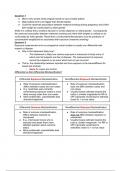
Differential vs.Non Differential Misclassification?
Differential Exposure Misclassification Nondifferential Exposure Misclassification
● Rate of exposure misclassification ● Rate of exposure misclassification
differs between cases and non-cases does not differ between cases and
● E.g. recall bias were correctly non-cases
remembering exposure status is more ● Usually biases estimate towards the
likely among cases than non-cases null(o.e.,smaller magnitude-for RR or
● More problematic, unpredictable bias OR it generally would lead to estimate
direction/magnitude closer to 1 vs true value
Differential Outcome Misclassification Nondifferential Outcome Misclassification
● Rate of outcome misclassification ● Rate of outcome misclassification
differs between exposed vs. does not differ between exposed vs.
unexposed unexposed
● E.g., interviewer knows who is ● Usually biases estimate towards the
exposed and akses them more null(i.e, smaller magnitude - for RR or
detailed question about outcome OR it generally would lead to
status estimates closer to 1 vs true value
● More problematic unpredictable bias
direction/magnitude.
● Mom’s who smoke while pregnant tends to have smaller babies
● Male babies tend to be bigger than female babies
● Could the observed association between maternal smoking during pregnancy and infant
birth weight be confounded by infant gender
ANS) It is unlikely that a mothers decision to smoke depends on infant gender . Consequently
the observed association between maternal smoking and infant birth weights is unlikely to be
confounded by infant gender. Recall that a confounder(infant gender) must be predictive of
outcome(birth weight)and be associated with exposure (maternal smoking)
Question 2
Exposure measurement error in prospective cohort studies is usually non differential with
respect ot disease
● Why is this statement likely true?
○ This statement is likely true science exposure is measured at study entry at
which point all subjects are free of disease. The measurement of exposure
cannot thus depend on an event which has not yet occurred
● That is, the relationship between reported and true exposure is the same/different for
cased and controls
○ Same for cases and control
Differential vs.Non Differential Misclassification?
Differential Exposure Misclassification Nondifferential Exposure Misclassification
● Rate of exposure misclassification ● Rate of exposure misclassification
differs between cases and non-cases does not differ between cases and
● E.g. recall bias were correctly non-cases
remembering exposure status is more ● Usually biases estimate towards the
likely among cases than non-cases null(o.e.,smaller magnitude-for RR or
● More problematic, unpredictable bias OR it generally would lead to estimate
direction/magnitude closer to 1 vs true value
Differential Outcome Misclassification Nondifferential Outcome Misclassification
● Rate of outcome misclassification ● Rate of outcome misclassification
differs between exposed vs. does not differ between exposed vs.
unexposed unexposed
● E.g., interviewer knows who is ● Usually biases estimate towards the
exposed and akses them more null(i.e, smaller magnitude - for RR or
detailed question about outcome OR it generally would lead to
status estimates closer to 1 vs true value
● More problematic unpredictable bias
direction/magnitude.