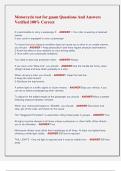
Newborn Assessment: NCLEX questions With 100% Correct Answers
Newborn Assessment: NCLEX questions With 100% Correct Answers The nurse assisted with the delivery of a newborn. Which nursing action is most effective in preventing heat loss by evaporation? 1.Warming the crib pad 2.Closing the doors to the room 3.Drying the infant with a warm blanket 4.Turning on the overhead radiant warmer - answer3 Evaporation of moisture from a wet body dissipates heat along with the moisture. Keeping the newborn dry by drying the wet newborn at birth prevents hypothermia via evaporation. Hypothermia caused by conduction occurs when the newborn is on a cold surface, such as a cold pad or mattress, and heat from the newborn's body is transferred to the colder object (direct contact). Warming the crib pad assists in preventing hypothermia by conduction. Convection occurs as air moves across the newborn's skin from an open door and heat is transferred to the air. Radiation occurs when heat from the newborn radiates to a colder surface (indirect contact). The mother of a newborn calls the clinic and reports that when cleaning the umbilical cord, she noticed that the cord was moist and that discharge was present. What is the most appropriate nursing instruction for this mother? 1.Bring the infant to the clinic. 2.This is a normal occurrence. 3.Increase the number of times that the cord is cleaned per day. 4.Monitor the cord for another 24 to 48 hours and call the clinic if the discharge continues. - answer1 Symptoms of umbilical cord infection are moistness, oozing, discharge, and a reddened base around the cord. If symptoms of infection occur, the client should be instructed to notify a health care provider (HCP). If these symptoms occur, antibiotics may be necessary. Options 2, 3, and 4 are inappropriate nursing interventions for the description given in the question. The nurse is assessing a newborn after circumcision and notes that the circumcised area is red with a small amount of bloody drainage. Which nursing action is most appropriate? 1.Apply gentle pressure. 2.Reinforce the dressing. 3.Document the findings. 4.Contact the health care provider (HCP). - answer3 The penis is normally red during the healing process after circumcision. A yellow exudate may be noted in 24 hours, and this is part of normal healing. The nurse would expect that the area would be red with a small amount of bloody drainage. Only if the bleeding were excessive would the nurse apply gentle pressure with a sterile gauze. If bleeding cannot be controlled, the blood vessel may need to be ligated, and the nurse would notify the health care provider. Because the findings identified in the question are normal, the nurse would document the assessment findings. The nurse in a newborn nursery is monitoring a preterm newborn for respiratory distress syndrome. Which assessment findings would alert the nurse to the possibility of this syndrome? 1.Tachypnea and retractions 2.Acrocyanosis and grunting 3.Hypotension and bradycardia 4.Presence of a barrel chest and acrocyanosis - answer1 A newborn infant with respiratory distress syndrome may present with clinical signs of cyanosis, tachypnea or apnea, nasal flaring, chest wall retractions, or audible grunts. Acrocyanosis, a bluish discoloration of the hands and feet, is associated with immature peripheral circulation, and is common in the first few hours of life. Options 2, 3, and 4 do not indicate clinical signs of respiratory distress syndrome. The postpartum nurse is providing instructions to the mother of a newborn with hyperbilirubinemia who is being breast-fed. The nurse should provide which most appropriate instruction to the mother? 1.Feed the newborn less frequently 2.Continue to breast-feed every 2 to 4 hours. 3.Switch to bottle-feeding the infant for 2 weeks. 4.Stop breast-feeding and switch to bottle-feeding permanently. - answer2 Hyperbilirubinemia is an elevated serum bilirubin level. At any serum bilirubin level, the appearance of jaundice during the first day of life indicates a pathological process. Early and frequent feeding hastens the excretion of bilirubin. Breast-feeding should be initiated within 2 hours after birth and every 2 to 4 hours thereafter. The infant should not be fed less frequently. Switching to bottle-feeding for 2 weeks or stopping breast-feeding permanently is unnecessary. The nurse is assessing a newborn who was born to a mother who is addicted to drugs. Which assessment finding would the nurse expect to note during the assessment of this newborn? 1.Lethargy 2.Sleepiness 3.Constant crying 4.Cuddles when being held - answer3 A newborn of a woman using drugs is irritable. The infant is overloaded easily by sensory stimulation. The infant may cry incessantly and be difficult to console. The infant would hyperextend and posture rather than cuddle when being held. The nurse notes hypotonia, irritability, and a poor sucking reflex in a full-term newborn on admission to the nursery. The nurse suspects fetal alcohol syndrome and is aware that which additional sign would be consistent with this syndrome? 1.Length of 19 inches 2.Abnormal palmar creases 3.Birth weight of 6 lb, 14 oz 4.Head circumference appropriate for gestational age - answer2 Fetal alcohol syndrome is caused by maternal alcohol use during pregnancy. Features of newborns diagnosed with fetal alcohol syndrome include craniofacial abnormalities, intrauterine growth restriction, cardiac abnormalities, abnormal palmar creases, and respiratory distress. Options 1, 3, and 4 are normal assessment findings in the full-term newborn infant. The nurse is preparing a plan of care for a newborn with fetal alcohol syndrome. The nurse should include which priority intervention in the plan of care? 1.Allow the newborn to establish own sleep-rest pattern. 2.Maintain the newborn in a brightly lighted area of the nursery. 3.Encourage frequent handling of the newborn by staff and parents. 4.Monitor the newborn's response to feedings and weight gain pattern. - answer4 Fetal alcohol syndrome is caused by maternal alcohol use during pregnancy. A primary nursing goal for the newborn diagnosed with fetal alcohol syndrome is to establish nutritional balance after delivery. These newborns may exhibit hyperirritability, vomiting, diarrhea, or an uncoordinated sucking and swallowing ability. A quiet environment with minimal stimuli and handling would help establish appropriate sleep-rest cycles in the newborn as well. Options 1, 2, and 3 are inappropriate interventions. The nurse administers erythromycin ointment (0.5%) to the eyes of a newborn and the mother asks the nurse why this is performed. Which explanation is best for the nurse to provide about neonatal eye prophylaxis? 1.Protects the newborn's eyes from possible infections acquired while hospitalized. 2.Prevents cataracts in the newborn born to a woman who is susceptible to rubella. 3.Minimizes the spread of microorganisms to the newborn from invasive procedures during labor. 4.Prevents an infection called ophthalmia neonatorum from occurring after delivery in a newborn born to a woman with an untreated gonococcal infection. - answer4 Erythromycin ophthalmic ointment 0.5% is used as a prophylactic treatment for ophthalmia neonatorum, which is caused by the bacterium Neisseria gonorrhoeae. Preventive treatment of gonorrhea is required by law. Options 1, 2, and 3 are not the purposes for administering this medication to a newborn infant. The nurse is preparing to care for a newborn receiving phototherapy. Which interventions should be included in the plan of care? Select all that apply. 1.Avoid stimulation. 2.Decrease fluid intake. 3.Expose all of the newborn's skin. 4.Monitor skin temperature closely. 5.Reposition the newborn every 2 hours. 6.Cover the newborn's eyes with eye shields or patches. - answer4, 5, 6 Phototherapy is the use of intense fluorescent lights to reduce serum bilirubin levels in the newborn. Adverse effects from treatment, such as eye damage, dehydration, or sensory deprivation, can occur. Interventions include exposing as much of the newborn's skin as possible; however, the genital area is covered. The newborn's eyes are also covered with eye shields or patches, ensuring that the eyelids are closed when shields or patches are applied. The shields or patches are removed at least once per shift to inspect the eyes for infection or irritation and to allow eye contact. The nurse measures the lamp energy output to ensure efficacy of the treatment (done with a special device known as a photometer), monitors skin temperature closely, and increases fluids to compensate for water loss. The newborn will have loose green stools and green-colored urine. The newborn's skin color is monitored with the fluorescent light turned off every 4 to 8 hours and is monitored for bronze baby syndrome, a grayish brown discoloration of the skin. The newborn is repositioned every 2 hours, and stimulation is provided. After treatment, the newborn is monitored for signs of hyperbilirubinemia because rebound elevations can occur after therapy is discontinued. The nurse develops a plan of care for a woman with human immunodeficiency virus infection and her newborn. The nurse should include which intervention in the plan of care? 1.Monitoring the newborn's vital signs routinely 2.Maintaining standard precautions at all times while caring for the newborn 3.Initiating referral to evaluate for blindness, deafness, learning problems, or behavioral problems 4.Instructing the breast-feeding mother regarding the treatment of the nipples with nystatin ointment - answer2 An infant born to a mother infected with human immunodeficiency virus (HIV) must be cared for with strict attention to standard precautions. This prevents the transmission of HIV from the newborn, if infected, to others and prevents transmission of other infectious agents to the possibly immunocompromised newborn. Mothers infected with HIV should not breast-feed. Options 1 and 3 are not associated specifically with the care of a potentially HIV-infected newborn. The nurse is planning care for a newborn of a mother with diabetes mellitus. What is the priority nursing consideration for this newborn? 1.Developmental delays because of excessive size 2.Maintaining safety because of low blood glucose levels 3.Choking because of impaired suck and swallow reflexes 4.Elevated body temperature because of excess fat and glycogen - answer2
Escuela, estudio y materia
- Institución
- Newborn Assessment: NCLEX
- Grado
- Newborn Assessment: NCLEX
Información del documento
- Subido en
- 1 de abril de 2024
- Número de páginas
- 30
- Escrito en
- 2023/2024
- Tipo
- Examen
- Contiene
- Preguntas y respuestas
Temas
-
newborn assessment nclex questions with 100 corr