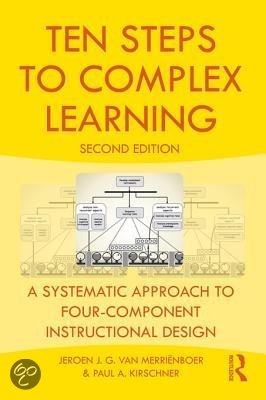
Ten steps to complex learning
Chapter 1: a new approach to instruction
1.1 Complex learning
Complex learning involves integrating knowledge, skills, and attitudes; coordinating qualitatively
different constituent skills; and often transferring what is learned in school or training settings to daily
life and work settings
Share focus on learning tasks based on real-life authentic tasks as the driving force for teaching,
training and learning
New demands from society -> adaptive expertise
Design theory must support the development of training programs for learners who need to learn
and transfer professional competencies or complex skills acquired in their study to an increasingly
varied set of real-world contexts and settings
- A holistic approach to instructional design is necessary to reach this goal
1.2 A holistic design approach
Holistic design approaches attempt to deal with complexity without losing sight of the
interrelationships between the elements taught
- Can offer a solution for three persistent problems in the field of education:
o Compartmentalization:
The separation of a whole into distinct parts or categories
Holistic design models integrate declarative, procedural and affective learning
-> facilitate development of integrated knowledge -> increase chance of
transfer of learning
o Fragmentation:
The act of process of breaking something into small, incomplete or isolated
parts
The learner is taught only one or a very limited number of constituent skills
at the time -> almost no opportunity to practice the whole complex skill
Problem: most complex skills or professional competencies are characterized
by numerous interactions between the different aspects of task performance,
with very high demands on their coordination
Learners are not capable of integrating and coordinating the separate
elements in transfer situations with fragmentation
Holistic design models focus on reaching highly integrated sets of objectives
and the coordinated attainment of those objectives in real-life task
performance
o The transfer paradox
A ‘random’ practice schedule is less efficient but in the long run it yields
much higher transfer of learning
Random schedule invites learners to compare and contrast the
different errors with each other and thus construct knowledge that is
general and abstract
, Transfer paradox: the methods that work the best for isolated, specific
objectives are often not the methods that work best for reaching integrated
objectives and increasing transfer of learning
A holistic design approach takes the transfer paradox into account and is
always directed toward more general objectives that go beyond a limited list
of highly specific objectives
A holistic approach offers alternative ways for dealing with complexity
- Modeling: simple to complex models, models these models from a pedagogical perspective
to ensure that they are presented in such a way that learners can actually learn from them
o Instruction should begin with a simplified but ‘whole’ model of reality
1.3 Four components and ten steps
Practical modified and simplified version of the 4C/ID model
The ten steps is mainly prescriptive and aims to provide a version of the model that is practicable for
teachers, domain experts involved in training design and instructional designers
- Focus on design
- Model will be typically used to develop training programs
- Basic assumption of educational programs for complex learning:
o Learning tasks
(case study, project, problem solving)
o Supportive information
Helps learners perform nonroutine aspects of learning tasks (problem solving
decision making, reasoning)
o Procedural information
Enables learners to perform the routine aspects of learning tasks (those
aspects are always performed the same way)
o Part-task practice
Pertains to additional practice of routine aspects in order to help learners
develop a very high level of automaticity of these aspects and so improve
their whole-task performance
- Steps corresponding with four design steps (1,4,7,10), the rest is performed when necessary
- In real-life designs projects are never a straightforward progression form step 1 to step 10
o Zigzagging between steps is common
Chapter 2: Four blueprint components
2.1 Training blueprints
, - Learning tasks: authentic whole-task experiences based on real-life tasks and situations that
aim at integrating knowledge, skills and attitudes
o High variability, organized simple-hard, learner support and guidance
- Supportive information: information helpful for learning and performing the problem-solving,
reasoning and decision-making aspects of learning, explaining how a domain is organized and
how problems in that domain are approached
o Specified per task and always available for learners, bridge between what learners
know and what they need to know to successfully carry out learning tasks
- Procedural information: information prerequisite for learning and performing routine aspects
of learning tasks
o Is best presented just-in-time, it is quickly faded as learners gain more expertise
- Part-task practice: practice items provided to help learners reach a very high level of
automatically for selected routine aspects of a task
o Repetitive practices, starts after the routine aspect has been introduced in the
context of a whole, meaningful learning task
2.2 Preventing compartmentalization:
- Constituent skills that are horizontally adjacent to each other can be performed sequentially
or simultaneously
- Constituent skills at a lower level on the vertical dimension enable the learning and
performance of skills higher in the hierarchy
- Many constituent skills can only be performed if the learner has the necessary knowledge
about the task domain and if the learner exhibits particular attitudes required to perform the
skills in an acceptable fashion
Learning tasks:
- Inductive learning: induce new knowledge form concrete experiences -> helps develop an
integrated knowledge
- Therefore, each learning tasks should offer whole-task practice that confronts the learner
with a set of constituent skills allowing for real-life task performance, together with their
associated knowledge and attitudes
- A sequence of learning tasks provides the backbone of a training program for complex
learning
Variability of practice:
, - It is important that all learning tasks differ from each other on all dimensions on which tasks
also differ in the real world
- The variation allows learners to generalize and abstract away from the details of each single
task -> important for transfer of learning
- Variability is indicated by little triangles
2.3 Avoiding fragmentation
- Complex learning: learning to coordinate constituent skills that make up real-life task
performance
- Constituent skills often need to be controlled by higher-level strategies because they make
little sense without taking their related constituent skill and associated knowledge into
account -> constituent skills are seen as aspects rather than parts of a complex skill
- It is necessary to simplify the tasks and give learners sufficient support and guidance
Task classes:
- The number of elements inherent to a task along with the degree of interaction between
those elements determines the task’s complexity
- A complex task can be easy for someone with high prior knowledge
- From relatively simple but whole learning with only a part of all constituent skills -> more
complex whole tasks that make an appeal to more constituent skills and require more
coordination
- Task classes: categories of learning tasks, each representing a version of the task with a
particular level of complexity
- Learning tasks within a particular task can be performed based on the same body of
knowledge (equivalent)
Support and guidance:
- Support and guidance is essential for coordinating the different aspects of their performance
- Support focuses on providing learners with assistance with the task elements involved in the
training
- Guidance focuses on providing learners with assistance with the processes inherent to finding
a solution
- In scaffolding support and guidance diminish
- Completion strategy or fading guidance: from more to less guidance -> highly effective
2.4 Dealing with the transfer paradox:
- Constituent skills are controlled, schema-based processes - involve the different use of the
same knowledge in a new task situation
- Constituent skills lover in the hierarchy may be rule-based processes – same use of the same
knowledge in a new problem situation
- Experts may reach a level where they operate the skill fully automatically – conscious control
is no longer needed here and they can focus their attention on other things
- Schema-based
Chapter 1: a new approach to instruction
1.1 Complex learning
Complex learning involves integrating knowledge, skills, and attitudes; coordinating qualitatively
different constituent skills; and often transferring what is learned in school or training settings to daily
life and work settings
Share focus on learning tasks based on real-life authentic tasks as the driving force for teaching,
training and learning
New demands from society -> adaptive expertise
Design theory must support the development of training programs for learners who need to learn
and transfer professional competencies or complex skills acquired in their study to an increasingly
varied set of real-world contexts and settings
- A holistic approach to instructional design is necessary to reach this goal
1.2 A holistic design approach
Holistic design approaches attempt to deal with complexity without losing sight of the
interrelationships between the elements taught
- Can offer a solution for three persistent problems in the field of education:
o Compartmentalization:
The separation of a whole into distinct parts or categories
Holistic design models integrate declarative, procedural and affective learning
-> facilitate development of integrated knowledge -> increase chance of
transfer of learning
o Fragmentation:
The act of process of breaking something into small, incomplete or isolated
parts
The learner is taught only one or a very limited number of constituent skills
at the time -> almost no opportunity to practice the whole complex skill
Problem: most complex skills or professional competencies are characterized
by numerous interactions between the different aspects of task performance,
with very high demands on their coordination
Learners are not capable of integrating and coordinating the separate
elements in transfer situations with fragmentation
Holistic design models focus on reaching highly integrated sets of objectives
and the coordinated attainment of those objectives in real-life task
performance
o The transfer paradox
A ‘random’ practice schedule is less efficient but in the long run it yields
much higher transfer of learning
Random schedule invites learners to compare and contrast the
different errors with each other and thus construct knowledge that is
general and abstract
, Transfer paradox: the methods that work the best for isolated, specific
objectives are often not the methods that work best for reaching integrated
objectives and increasing transfer of learning
A holistic design approach takes the transfer paradox into account and is
always directed toward more general objectives that go beyond a limited list
of highly specific objectives
A holistic approach offers alternative ways for dealing with complexity
- Modeling: simple to complex models, models these models from a pedagogical perspective
to ensure that they are presented in such a way that learners can actually learn from them
o Instruction should begin with a simplified but ‘whole’ model of reality
1.3 Four components and ten steps
Practical modified and simplified version of the 4C/ID model
The ten steps is mainly prescriptive and aims to provide a version of the model that is practicable for
teachers, domain experts involved in training design and instructional designers
- Focus on design
- Model will be typically used to develop training programs
- Basic assumption of educational programs for complex learning:
o Learning tasks
(case study, project, problem solving)
o Supportive information
Helps learners perform nonroutine aspects of learning tasks (problem solving
decision making, reasoning)
o Procedural information
Enables learners to perform the routine aspects of learning tasks (those
aspects are always performed the same way)
o Part-task practice
Pertains to additional practice of routine aspects in order to help learners
develop a very high level of automaticity of these aspects and so improve
their whole-task performance
- Steps corresponding with four design steps (1,4,7,10), the rest is performed when necessary
- In real-life designs projects are never a straightforward progression form step 1 to step 10
o Zigzagging between steps is common
Chapter 2: Four blueprint components
2.1 Training blueprints
, - Learning tasks: authentic whole-task experiences based on real-life tasks and situations that
aim at integrating knowledge, skills and attitudes
o High variability, organized simple-hard, learner support and guidance
- Supportive information: information helpful for learning and performing the problem-solving,
reasoning and decision-making aspects of learning, explaining how a domain is organized and
how problems in that domain are approached
o Specified per task and always available for learners, bridge between what learners
know and what they need to know to successfully carry out learning tasks
- Procedural information: information prerequisite for learning and performing routine aspects
of learning tasks
o Is best presented just-in-time, it is quickly faded as learners gain more expertise
- Part-task practice: practice items provided to help learners reach a very high level of
automatically for selected routine aspects of a task
o Repetitive practices, starts after the routine aspect has been introduced in the
context of a whole, meaningful learning task
2.2 Preventing compartmentalization:
- Constituent skills that are horizontally adjacent to each other can be performed sequentially
or simultaneously
- Constituent skills at a lower level on the vertical dimension enable the learning and
performance of skills higher in the hierarchy
- Many constituent skills can only be performed if the learner has the necessary knowledge
about the task domain and if the learner exhibits particular attitudes required to perform the
skills in an acceptable fashion
Learning tasks:
- Inductive learning: induce new knowledge form concrete experiences -> helps develop an
integrated knowledge
- Therefore, each learning tasks should offer whole-task practice that confronts the learner
with a set of constituent skills allowing for real-life task performance, together with their
associated knowledge and attitudes
- A sequence of learning tasks provides the backbone of a training program for complex
learning
Variability of practice:
, - It is important that all learning tasks differ from each other on all dimensions on which tasks
also differ in the real world
- The variation allows learners to generalize and abstract away from the details of each single
task -> important for transfer of learning
- Variability is indicated by little triangles
2.3 Avoiding fragmentation
- Complex learning: learning to coordinate constituent skills that make up real-life task
performance
- Constituent skills often need to be controlled by higher-level strategies because they make
little sense without taking their related constituent skill and associated knowledge into
account -> constituent skills are seen as aspects rather than parts of a complex skill
- It is necessary to simplify the tasks and give learners sufficient support and guidance
Task classes:
- The number of elements inherent to a task along with the degree of interaction between
those elements determines the task’s complexity
- A complex task can be easy for someone with high prior knowledge
- From relatively simple but whole learning with only a part of all constituent skills -> more
complex whole tasks that make an appeal to more constituent skills and require more
coordination
- Task classes: categories of learning tasks, each representing a version of the task with a
particular level of complexity
- Learning tasks within a particular task can be performed based on the same body of
knowledge (equivalent)
Support and guidance:
- Support and guidance is essential for coordinating the different aspects of their performance
- Support focuses on providing learners with assistance with the task elements involved in the
training
- Guidance focuses on providing learners with assistance with the processes inherent to finding
a solution
- In scaffolding support and guidance diminish
- Completion strategy or fading guidance: from more to less guidance -> highly effective
2.4 Dealing with the transfer paradox:
- Constituent skills are controlled, schema-based processes - involve the different use of the
same knowledge in a new task situation
- Constituent skills lover in the hierarchy may be rule-based processes – same use of the same
knowledge in a new problem situation
- Experts may reach a level where they operate the skill fully automatically – conscious control
is no longer needed here and they can focus their attention on other things
- Schema-based