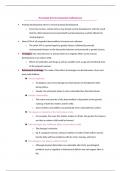
Prenatal Environmental Influences
Prenatal development refers to normal prenatal development.
o From time to time, certain factors may disrupt normal development, with the result
that the child’s physical and mental health and development could be affected to
varying degrees.
About 50% of all congenital abnormalities in humans are unknown.
o The other 50% is caused largely by genetic factors, followed by prenatal
environmental factors or the interaction between environmental or genetic factors.
Teratogen: Any external factor or process that has a negative effect on the normal
development of an unborn child.
o Effects of medication and drugs as well as variables such as age and emotional state
of the pregnant woman.
Behavioural teratology: The study of the effect of teratogens on the behaviour of pre and
post-natal children.
è Time of exposure.
o Teratogens cause more damage at certain phases of development than
during others.
o Usually, the embryonic phase is more vulnerable than the foetal phase.
è Genetic vulnerability.
o The nature and severity of the abnormalities is dependent on the genetic
makeup of both the mother and the child.
o Some mothers and children are genetically more vulnerable than others.
è The degree or intensity of the factor plays a role.
o For example, the more the mother smokes or drinks, the greater the chances
are that an unborn child could be harmed.
è Each teratogen has a different effect on the unborn child.
o The damage is selective.
o Eg. If a pregnant woman contracts rubella, her baby’s limbs will be normal,
but the baby will have problems with its vision, hearing, and heart.
è The damage is not always evident at birth.
o Although physical deformities are noticeable after birth, psychological
problems such as cognitive or behavioural deficits may only appear later in
life.
, Eg. Learning problems or hyperactivity.
The following prenatal environmental factors could affect the development of the child
negatively:
The Age of the Parents
Mothers younger than 20 and 35 or older run a greater risk of giving birth to a child with
mental and physical defects.
Teenage mothers are more susceptible to premature births, stillbirths, and pregnancy
complications. (15 and younger)
o Eg. High blood pressure and anaemia.
Women older than 35 who become pregnant for the first time and women older than 40
who have been pregnant previously tend to have a longer and more difficult birth process.
o Stillbirths and problems during pregnancy are common.
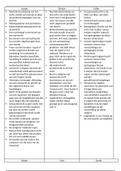
o The risk of having a Down syndrome child increases as she gets older.
Down Syndrome: Characterised by low intellectual ability and characteristic physical
features.
o The high frequency of Down syndrome babies from older mothers is probably
because older eggs have a greater risk of defective chromosome division.
Maternal Incidence of Maternal age Incidence of Maternal Incidence of
Age 20- down syndrome 30-39 down syndrome Age 40-49 down syndrome
29
20 2 in 2 000 30 1 in 900 40 1 in 100
21 1 in 1 700 31 1 in 800 41 1 in 80
22 1 in 1 500 32 1 in 720 42 1 in 70
23 1 in 1 400 33 1 in 600 43 1 in 50
24 1 in 1 300 34 1 in 450 44 1 in 40
25 1 in 1 200 35 1 in 350 45 1 in 30
26 1 in 1 100 36 1 in 300 46 1 in 25
27 1 in 1 050 37 1 in 250 47 1 in 20
28 1 in 1 000 38 1 in 200 48 1 in 15
29 1 in 950 39 1 in 150 49 1 in 10
Women who are older than 35 are often in good physical condition and are more financially
stable thus are more able to care for a child.
Prenatal development refers to normal prenatal development.
o From time to time, certain factors may disrupt normal development, with the result
that the child’s physical and mental health and development could be affected to
varying degrees.
About 50% of all congenital abnormalities in humans are unknown.
o The other 50% is caused largely by genetic factors, followed by prenatal
environmental factors or the interaction between environmental or genetic factors.
Teratogen: Any external factor or process that has a negative effect on the normal
development of an unborn child.
o Effects of medication and drugs as well as variables such as age and emotional state
of the pregnant woman.
Behavioural teratology: The study of the effect of teratogens on the behaviour of pre and
post-natal children.
è Time of exposure.
o Teratogens cause more damage at certain phases of development than
during others.
o Usually, the embryonic phase is more vulnerable than the foetal phase.
è Genetic vulnerability.
o The nature and severity of the abnormalities is dependent on the genetic
makeup of both the mother and the child.
o Some mothers and children are genetically more vulnerable than others.
è The degree or intensity of the factor plays a role.
o For example, the more the mother smokes or drinks, the greater the chances
are that an unborn child could be harmed.
è Each teratogen has a different effect on the unborn child.
o The damage is selective.
o Eg. If a pregnant woman contracts rubella, her baby’s limbs will be normal,
but the baby will have problems with its vision, hearing, and heart.
è The damage is not always evident at birth.
o Although physical deformities are noticeable after birth, psychological
problems such as cognitive or behavioural deficits may only appear later in
life.
, Eg. Learning problems or hyperactivity.
The following prenatal environmental factors could affect the development of the child
negatively:
The Age of the Parents
Mothers younger than 20 and 35 or older run a greater risk of giving birth to a child with
mental and physical defects.
Teenage mothers are more susceptible to premature births, stillbirths, and pregnancy
complications. (15 and younger)
o Eg. High blood pressure and anaemia.
Women older than 35 who become pregnant for the first time and women older than 40
who have been pregnant previously tend to have a longer and more difficult birth process.
o Stillbirths and problems during pregnancy are common.
o The risk of having a Down syndrome child increases as she gets older.
Down Syndrome: Characterised by low intellectual ability and characteristic physical
features.
o The high frequency of Down syndrome babies from older mothers is probably
because older eggs have a greater risk of defective chromosome division.
Maternal Incidence of Maternal age Incidence of Maternal Incidence of
Age 20- down syndrome 30-39 down syndrome Age 40-49 down syndrome
29
20 2 in 2 000 30 1 in 900 40 1 in 100
21 1 in 1 700 31 1 in 800 41 1 in 80
22 1 in 1 500 32 1 in 720 42 1 in 70
23 1 in 1 400 33 1 in 600 43 1 in 50
24 1 in 1 300 34 1 in 450 44 1 in 40
25 1 in 1 200 35 1 in 350 45 1 in 30
26 1 in 1 100 36 1 in 300 46 1 in 25
27 1 in 1 050 37 1 in 250 47 1 in 20
28 1 in 1 000 38 1 in 200 48 1 in 15
29 1 in 950 39 1 in 150 49 1 in 10
Women who are older than 35 are often in good physical condition and are more financially
stable thus are more able to care for a child.