CERTIFIED AMBULATORY CARE NURSE PRACTICE EXAMS
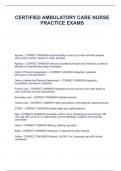
CERTIFIED AMBULATORY CARE NURSE PRACTICE EXAMS Apraxia - CORRECT ANSWER-impaired ability to carry out motor activities despite intact motor function; decline in motor activities Aphasia - CORRECT ANSWER-Difficulty expressing thought and emotions, as well as difficulty in understanding verbal messages Order of Physical Assessment - CORRECT ANSWER-Inspection, palpation, percussion, and auscultation Order of Abdominal Physical Assessment - CORRECT ANSWER-inspection, auscultation, percussion, palpation Primary care - CORRECT ANSWER-Integrates primary services with other levels of care, continuity is a key characteristic Secondary care - CORRECT ANSWER-Hospital services Tertiary care - CORRECT ANSWER-Highly specialized, technological hospital services START - CORRECT ANSWER-Simple triage and rapid treatment Red - CORRECT ANSWER-Immediate, within 1 hour. Breathing by unconscious, RR >30, cap refill >2 sec or no radial pulse (control bleeding), unable to follow simple commands Green - CORRECT ANSWER-Moving, walking, wounded Black - CORRECT ANSWER-Diseased, no respirations after head tilt Yellow - CORRECT ANSWER-Delayed, >30 RR, 0 to 2 seconds cap refill, follows commands Primary prevention - CORRECT ANSWER-Health promotion (nutrition and sex education), specific protection (use of seat belts, avoidance of allergens, and immunizations); targets well populations or those already ill; does not exist for scoliosis Mammogram - CORRECT ANSWER-Every 2 years for women 50 to 74 Secondary prevention - CORRECT ANSWER-Early detection, diagnosis, and treatment l; mammography, colonoscopy Tertiary prevention - CORRECT ANSWER-Recovery, rehabilitation, and specific measures to minimize disability and increase functioning (breast reconstruction) Pap smear - CORRECT ANSWER-Every 3 years in women 21 to 65, screening before 21 not recommended regardless of sexual history If abnormal pap smear - CORRECT ANSWER-Annually until 2 or 3 consecutive normal results Fecal occult blood test - CORRECT ANSWER-Annually flexible sigmoidoscopy - CORRECT ANSWER-every 5 years with high sensitivity fecal occult blood test every 3 years Colonoscopy - CORRECT ANSWER-Every 10 years, begin earlier than 50 of at greater risk Colorectal Screening - CORRECT ANSWER-Age 50 to 75 Depression screening - CORRECT ANSWER-12 to 18 years Normal bmi - CORRECT ANSWER-18.5 to 24.9 Overweight bmi - CORRECT ANSWER-25 to 29.9 Obese - CORRECT ANSWER-30 to 39.9 Extreme obesity - CORRECT ANSWER->40 Tetanus diphtheria - CORRECT ANSWER-One every 10 years; after age 19 it is recommended to exchange a Tdap in place of one Td to boost the pertussis; Hpv - CORRECT ANSWER-3 doses through 26 starting at 11 to 12 years old Zoster - CORRECT ANSWER-1 dose greater than or equal to 60 years MMR - CORRECT ANSWER-2 doses prior to school entry, 1 dose by 2 years, 1 dose at 4 years Varicella - CORRECT ANSWER-If no immunity by 12 mos, 2 doses Meningococcal - CORRECT ANSWER-1 or more doses as recommended by provider, pre teens and teens, first year college students living in dorms are at risk Pneumococcal polysaccharide - CORRECT ANSWER-2 doses between 19 to 64, after age 65 is one dose Hepatitis a - CORRECT ANSWER-Can be given at 12 mos to adult; 2 doses Hepatitis b - CORRECT ANSWER-Can be given 1 month to adult years; 3 doses by age 2 (early childhood immunizations) Live vaccine for childhood - CORRECT ANSWER-Herpes zoster, varicella, MMR Inactivated vaccine - CORRECT ANSWER-Influenza, tetanus, polio DASH diet - CORRECT ANSWER-Dietary approaches to stop hypertension; emphasizes vegetables, fruits and low-fat dairy foods — and moderate amounts of whole grains, fish, poultry and nuts. You can eat red meat, sweets and fats in small amounts. The DASH diet is low in saturated fat, trans fat and total fat. Risky or hazardous drinking - CORRECT ANSWER-W: more than 7 drinks/week or >3 drinks per occasion M: more than 14 drinks/week or >4 drinks per occasion Harmful drinking - CORRECT ANSWER-Experiencing physical, social, or psychological harm from alcohol use but do not meet criteria for dependence Dependence - CORRECT ANSWER-Unable to control drinking; drinks increasing amounts; experiences withdrawal sx of without Medical emergency assessment - CORRECT ANSWER-Chest compressions, airway, breathing shock - CORRECT ANSWER-Rapid weak or absent pulse, hypotension, rapid shallow breathing, cool clammy skin, dilated pupils, confusion, anxiety, loss of consciousness, and dry mouth with decreased urine output treatment for lyme disease - CORRECT ANSWER-Oral or IV abx Peds cephalohematoma - CORRECT ANSWER-Hemorrhage of blood between the skull and the periosteum that occurs during childbirth; may be caused by prolonged 2nd
Escuela, estudio y materia
- Institución
- Ambulatory nursing certification
- Grado
- Ambulatory nursing certification
Información del documento
- Subido en
- 29 de marzo de 2024
- Número de páginas
- 17
- Escrito en
- 2023/2024
- Tipo
- Examen
- Contiene
- Preguntas y respuestas
Temas
-
apraxia
-
treat to target
-
certified ambulatory care nurse practice exams
-
transactional leadership

Documento también disponible en un lote