Question 1
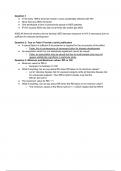
● In the early 1990’s three lab worker s were accidentally infected with HIV
● None had any AIDS risk factor
● One developed a form of pneumonia typical of AIDS patients
● IF HIV causes AIDS why did not all three lab worker get AIDS
ANS) All three lab workers did not develop AIDS because exposure to HIV is necessary but not
sufficient for disease development
Question 2: True or False? Provide a brief justification
● A casual factor is sufficient if its presence is required for the occurrence of the effect
○ False, this is consequence of necessary factor for disease development
● An association which his not statistically significant cannot be causal
○ False, an association may be casual but due to small sample size may not
appear statistically significant in particular study
Question 3: Minimum and Maximum values: RR vs. RD
● Minimum value for RR=0
○ because it is between 0~100
● What if anything can we say about RD when RR takes on its minimum values?
○ Let p1 denotes disease risk for exposed subjects while p0 denotes disease risk
for unexposed subjects. Thus RR=p1/p0=0 implies only that the
RD=p1-p0=-p0<0
● The maximum value for RD= +1
● What if anything, can we say about RR when the RD takes on its minimum value?
○ The minimum values of the RD=p1-p0=0-1=-1 which implies that the RR=0
● In the early 1990’s three lab worker s were accidentally infected with HIV
● None had any AIDS risk factor
● One developed a form of pneumonia typical of AIDS patients
● IF HIV causes AIDS why did not all three lab worker get AIDS
ANS) All three lab workers did not develop AIDS because exposure to HIV is necessary but not
sufficient for disease development
Question 2: True or False? Provide a brief justification
● A casual factor is sufficient if its presence is required for the occurrence of the effect
○ False, this is consequence of necessary factor for disease development
● An association which his not statistically significant cannot be causal
○ False, an association may be casual but due to small sample size may not
appear statistically significant in particular study
Question 3: Minimum and Maximum values: RR vs. RD
● Minimum value for RR=0
○ because it is between 0~100
● What if anything can we say about RD when RR takes on its minimum values?
○ Let p1 denotes disease risk for exposed subjects while p0 denotes disease risk
for unexposed subjects. Thus RR=p1/p0=0 implies only that the
RD=p1-p0=-p0<0
● The maximum value for RD= +1
● What if anything, can we say about RR when the RD takes on its minimum value?
○ The minimum values of the RD=p1-p0=0-1=-1 which implies that the RR=0