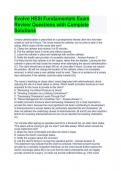
Evolve HESI Fundamentals Exam Review Questions with Complete Solutions
Evolve HESI Fundamentals Exam Review Questions with Complete Solutions The nurse is aware that malnutrition is a common problem among clients served by a community health clinic for the homeless. Which laboratory value is the most reliable indicator of chronic protein malnutrition? A. Low serum albumin level B. Low serum transferrin level C. High hemoglobin level D. High cholesterol level - Answer-Answer: A Long-term protein deficiency is required to cause significantly lowered serum albumin levels (A). Albumin is made by the liver only when adequate amounts of amino acids (from protein breakdown) are available. Albumin has a long half-life, so acute protein loss does not significantly alter serum levels. (B) is a serum protein with a half-life of only 8 to 10 days, so it will drop with an acute protein deficiency. Neither (C or D) are clinical measures of protein malnutrition. The nurse identifies a potential for infection in a patient with partial-thickness (second-degree) and full-thickness (third-degree) burns. What intervention has the highest priority in decreasing the client's risk of infection? A. Administration of plasma expanders B. Use of careful hand washing technique C. Application of a topical antibacterial cream D. Limiting visitors to the client with burns - Answer-Answer: B Careful hand washing technique (B) is the single most effective intervention for the prevention of contamination to all clients. (A) reverses the hypovolemia that initially accompanies burn trauma but is not related to decreasing the proliferation of infective organisms. (C and D) are recommended by various burn centers as possible ways to reduce the chance of infection. (B) is a proven technique to prevent infection. Which serum laboratory value should the nurse monitor carefully for a client who has a nasogastric (NG) tube to suction for the past week? A. White blood cell count B. Albumin C. Calcium D. Sodium - Answer-Answer: D Monitoring serum sodium levels (D) for hyponatremia is indicated during prolonged NG suctioning because of loss of fluids. Changes in levels of (A, B, or C) are not typically associated with prolonged NG suctioning.
Escuela, estudio y materia
- Institución
- Evolve HESI
- Grado
- Evolve HESI
Información del documento
- Subido en
- 24 de marzo de 2024
- Número de páginas
- 22
- Escrito en
- 2023/2024
- Tipo
- Examen
- Contiene
- Preguntas y respuestas
Temas
-
state nurse practice act
-
evolve hesi fundamentals exam review questions wit
-
determines that the client is confused
-
ask the client to describe the routine that the cl
-
instruction is most important for

Documento también disponible en un lote