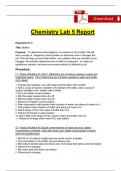
Chemistry Lab 5 Report
Experiment #:5
Title: Buffers
Purpose: : To determine what happens if a solution is not a buffer. We will
add a couple of reagents to each solution to determine how it changes the
pH. This will help us prove that buffers are solutions that are resistant to pH
changes. We will also determine how a buffer is composed to create an
equilibrium solution, and see how enzyme activity is affected by pH
Procedure:
(1) Study of Buffers #1 (Part 1 Determine pH of sodium acetate in water and
buffer(Kac label), Part 2 determine pH of sodium acetate in water and buffer
(HCL label)
1. Prepare two beakers, one with water and the other with a buffer.
2. Add a scoop of sodium acetate to the beaker with water, add a scoop of
sodium acetate to the beaker with a buffer
3. Put a pH meter in each beaker
3. Mix the water solution then dry off
4. Mix the buffer solution then dry off
5. Notice pH change in each solution
6. After observation add another fresh solution of water and place pH meter in it
7. Add another fresh solution of buffer and place pH meter in it
8. Add 5 drops of HCL into water & buffer then mix
9. Notice pH change in each solution
10. Add a little more drops of HCL acid to water and buffer and mix
11. Notice pH change when more HCL was added
(2) Study of Buffers #2 (Equal concentrations of base and acid, higher
concentration of lactate base than lactic acid, higher concentration of lactic
acid than lactate base)
1. Mix 50 mL of sodium lactate base and lactic acid in a beaker
2. Put a pH meter in into buffer mix and observe pH
3. Mix sodium lactate base and lactic acid, more base than lactic acid into beaker
4. Observe pH changes
5. Mix more acid than base into beaker
6. Observe pH changes
Experiment #:5
Title: Buffers
Purpose: : To determine what happens if a solution is not a buffer. We will
add a couple of reagents to each solution to determine how it changes the
pH. This will help us prove that buffers are solutions that are resistant to pH
changes. We will also determine how a buffer is composed to create an
equilibrium solution, and see how enzyme activity is affected by pH
Procedure:
(1) Study of Buffers #1 (Part 1 Determine pH of sodium acetate in water and
buffer(Kac label), Part 2 determine pH of sodium acetate in water and buffer
(HCL label)
1. Prepare two beakers, one with water and the other with a buffer.
2. Add a scoop of sodium acetate to the beaker with water, add a scoop of
sodium acetate to the beaker with a buffer
3. Put a pH meter in each beaker
3. Mix the water solution then dry off
4. Mix the buffer solution then dry off
5. Notice pH change in each solution
6. After observation add another fresh solution of water and place pH meter in it
7. Add another fresh solution of buffer and place pH meter in it
8. Add 5 drops of HCL into water & buffer then mix
9. Notice pH change in each solution
10. Add a little more drops of HCL acid to water and buffer and mix
11. Notice pH change when more HCL was added
(2) Study of Buffers #2 (Equal concentrations of base and acid, higher
concentration of lactate base than lactic acid, higher concentration of lactic
acid than lactate base)
1. Mix 50 mL of sodium lactate base and lactic acid in a beaker
2. Put a pH meter in into buffer mix and observe pH
3. Mix sodium lactate base and lactic acid, more base than lactic acid into beaker
4. Observe pH changes
5. Mix more acid than base into beaker
6. Observe pH changes