ATI TEAS 7 SCIENCE
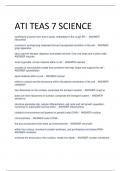
ATI TEAS 7 SCIENCE synthesize proteins from amino acids, embedded in the rough ER. - ANSWER ribosomes involved in synthesizing materials that are transported out/within of the cell - ANSWER golgi apparatus sacs used for storage, digestion and waste removal. Only one large one in plant cells - ANSWER vacuole small organelle, moves material within a cell - ANSWER vesicles consists of microtubules (made from proteins) that help shape and support the cell - ANSWER cytoskeleton liquid material within a cell - ANSWER cytosol refers to cytosol and the structures within the plasma membrane of the cell - ANSWER cytoplasm has ribosomes on the surface, comprises the transport system - ANSWER rough er does not have ribosomes on surface, comprises the transport system - ANSWER smooth er structure generates atp, cellular differentiation, cell cycle and cell growth regulation. numerous in eukaryotes (animal cells) - ANSWER mitochondria contains chromosomes and passes on genetic traits (DNA) - ANSWER nucleus chromosomes - ANSWER rods of DNA the dna and proteins that make up chromosomes - ANSWER chromatin within the nucleus, involved in protein synthesis, and synthesizes and stores RNA - ANSWER nucleolus encloses the structures of the nucleus, made from lipids - ANSWER nuclear membrane involved in the exchange of material between the nucleus and cytoplasm - ANSWER nuclear pores liquid within the nucleus - ANSWER nucleoplasm involved in the transportation of substances throughout the cell. It plays a primary role in the metabolism of carbohydrates, synthesis of lipids, steroids and proteins. - ANSWER Endoplasmic reticulum protect the cell by engulfing the foreign bodies entering the cell and help in cell renewal. - ANSWER lysosomes primary organelles for photosynthesis. It contains the pigment called chlorophyll. - ANSWER chloroplasts solid to liquid - ANSWER melting liquid to solid - ANSWER freezing liquid to gas - ANSWER vaporization solid to gas - ANSWER sublimation gas to solid - ANSWER deposition gas to liquid - ANSWER condensation ph lower than 7 - ANSWER acidic (water ,hydrochloric acid) pH greater than 7 - ANSWER base (cleaning ingredients) How can you calculate the number of protons of an element? - ANSWER number of protons is the same as the atomic number on the top of the element how do you calculate the number of neutrons? - ANSWER Atomic Mass - Atomic Number = # of Neutrons Mitosis - ANSWER The daughter cell is an exact replica of the parent cell Meiosis - ANSWER daughter cells have different gene coding than parent cell INTERPHASE - ANSWER cell prepares for division by replicating its genetic and cytoplasmic material PROPHASE - ANSWER Chromosomes become visable, nuclear envelop dissolves, spindle forms METAPHASE - ANSWER Spindle moves to the *center* of the cell and chromosome pairs *align* along the center of the spindle structure. ANAPHASE - ANSWER chromosomes start to pull away from each other (daughter chromosomes TELOPHASE - ANSWER spindle disintegrates, nuclear membrane reforms, chromosomes revert to chromatin. CYTOKINESIS - ANSWER physical pulling of the cell into two cells. covalent bond - ANSWER sharing of electrons between 2 or more atoms ionic bonds - ANSWER relationship between two oppositely charged ions electrons shared equally - ANSWER nonpolar covalent bond electrons shared unequally - ANSWER polar covalent bond ion - ANSWER an atom gains or loses electrons, making it negatively or positively charged genotype - ANSWER genes forming an individual recessive genes - ANSWER genes that aren't expressed allele - ANSWER determines the manifestation of genes cation - ANSWER positively formed when an atom loses one or more electron anion - ANSWER formed when an atom gains one or more electrons segmentation - ANSWER involuntary process occurring in the large intestine haustral contractions - ANSWER form of segmentation that moves chyme from one haustrum to the next Mass peristalsis - ANSWER movements that occur 2-4 a day to push chyme towards the rectum salivary amylase - ANSWER begins chemical breakdown of polysaccharides into simpler sugars lingual lipase - ANSWER breaks down lipids mucin - ANSWER a protein that helps to form a gel-like coating that lubricates the bolus of food parietal cells of stomach - ANSWER secrete HCl and intrinsic factor for B12 absorp
Información del documento
- Subido en
- 22 de marzo de 2024
- Número de páginas
- 6
- Escrito en
- 2023/2024
- Tipo
- Examen
- Contiene
- Preguntas y respuestas