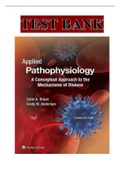
Test Bank
Applied Pathophysiology A Conceptual
Approach 4th Edition Judi Nath
,Test Bank For Applied Pathophysiology A Conceptual Approach 4th Edition Judi Nath
Chapter 1, Introduction to Pathophysiology
1. Which term is defined as the study of the mechanisms of
human body functioning?
a. Pathology
b. Physiology
c. Anatomy
d. Pathophysiology
ANS: B
Feedback: Physiology is the study of the mechanisms of
human body functioning. Pathology is the study of
changes in cells and tissues as a result of injury or disease.
Anatomy is the study of body structures. Pathophysiology
is the study of mechanisms of disease.
PTS: 1 REF: Page and Header: 2,
Defining Pathophysiology OBJ: 1
NAT: Client Needs: Physiological Integrity: Physiological
Adaptation TOP: Chapter: 1 KEY: Integrated
Process: Teaching/Learning BLM: Cognitive Level: Remember
NOT: Multiple Choice
2. Which statement best describes the health–illness continuum?
a. It is a dynamic entity.
b. It is based on objective data.
c. It represents two exclusive categories.
d. It is focused on physical well-being.
ANS: A
Feedback: Health and illness are part of a dynamic continuum. It is based on one’s
perceptions and is subjective. There are a variety of descriptions one can use along the
continuum to describe their current state. These range from “extremely healthy” to
“extremely ill.” Because it is a dynamic continuum, it represents more than two exclusive
categories. The health–illness continuum includes the body, mind, and spirit, not just
physical well-being.
PTS: 1 REF: Page and Header: 4, Individual Health
OBJ: 1 NAT: Client Needs: Health Promotion and Maintenance
TOP: Chapter: 1 KEY: Integrated Process: Teaching/Learning
BLM: Cognitive Level: Remember NOT: Multiple Choice
3. Which concept is often equated with health?
a. Homeostasis
b. Disease
c. Objectivity
d. An uneventful physical examination
ANS: A
,Test Bank For Applied Pathophysiology A Conceptual Approach 4th Edition Judi Nath
Feedback: Homeostasis is an important body goal and is often reflected in the client’s
perception of the health–illness continuum. Disease is the functional impairment of cells,
tissues, organs, or organ systems. Because health is reflected in the client’s perception of the
health–illness continuum, it is subjective, not objective. An uneventful physical examination
would only be on aspect of health. The health–illness continuum includes the body, mind,
and spirit.
PTS: 1 REF: Page and Header: 4, Individual Health
OBJ: 1 NAT: Client Needs: Health Promotion and Maintenance
TOP: Chapter: 1 KEY: Integrated Process: Teaching/Learning
BLM: Cognitive Level: Remember NOT: Multiple Choice
4. Which term is defined as the functional impairment of cells, tissues, organs, or organ
systems?
a. Injury
b. Pathophysiology
c. Disease
d. Syndrome
ANS: C
Feedback: Disease is defined as the functional impairment of cells, tissues, organs, or organ
systems. Injury causes changes to cells, pathophysiology refers to the study of mechanisms
of disease, and syndrome is used to describe specific conditions with predictive patterns.
PTS: 1 REF: Page and Header: 5, Population Health
OBJ: 1
NAT: Client Needs: Physiological Integrity: Physiological Adaptation
TOP: Chapter: 1 KEY: Integrated Process: Teaching/Learning
BLM: Cognitive Level: Remember NOT: Multiple Choice
5. The nurse is planning education on the importance of wearing a helmet when riding a bike.
What level of prevention is the nurse describing?
a. Primary
b. Secondary
c. Tertiary
d. Quaternary
ANS: A
Feedback: Primary prevention, such as wearing a bike helmet focuses on protecting people
from developing a disease or injury. Secondary prevention is the early detection of disease
through screening and early treatment. Tertiary prevention focuses on rehabilitation after
diagnosis of a disease or injury. Quaternary prevention relates to overmedicalization.
PTS: 1 REF: Page and Header: 5, Disease Prevention
OBJ: 4 NAT: Client Needs: Health Promotion and Maintenance
TOP: Chapter: 1 KEY: Integrated Process: Teaching/Learning
BLM: Cognitive Level: Apply NOT: Multiple Choice
6. A nurse in a rehabilitation unit is assisting a client who has had a stroke with relearning how
to perform activities of daily living. What level of prevention is the nurse implementing?
Page 2 of 191
, Test Bank For Applied Pathophysiology A Conceptual Approach 4th Edition Judi Nath
a. Primary
b. Secondary
c. Tertiary
d. Quaternary
ANS: C
Feedback: Tertiary prevention focuses on rehabilitation after diagnosis of a disease or
injury, such as rehabilitation following a stroke. Primary prevention focuses on protecting
people from developing a disease or injury. Secondary prevention is the early detection of
disease through screening and early treatment. Quaternary prevention relates to
overmedicalization.
PTS: 1 REF: Page and Header: 5, Disease Prevention
OBJ: 2 NAT: Client Needs: Health Promotion and Maintenance
TOP: Chapter: 1 KEY: Integrated Process: Teaching/Learning
BLM: Cognitive Level: Apply NOT: Multiple Choice
7. What term describes how a disease starts and develops, from onset to the point when the
disease presents itself?
a. Etiology
b. Pathophysiology
c. Pathogenesis
d. Pathology
ANS: C
Feedback: Pathogenesis is the term to describe how a disease starts and develops, from
onset to the point when the disease presents itself. Etiology refers to the precise cause of a
disease. Pathophysiology is the term used to define the mechanisms of human body
functioning. Pathology refers to studying the causes and effects of disease.
PTS: 1 REF: Page and Header: 2, Pathogenesis OBJ: 1
NAT: Client Needs: Health Promotion and Maintenance TOP: Chapter: 1
KEY: Integrated Process: Teaching/Learning
BLM: Cognitive Level: Remember NOT: Multiple Choice
8. A client has been diagnosed with an illness and no one is sure of the cause. What term
describes this condition?
a. Idiopathic
b. Iatrogenic
c. Nosocomial
d. Etiologic
ANS: A
Feedback: Idiopathic is the term used to describe disease with an unknown etiology.
Iatrogenic disease is inadvertently caused by medical treatment. Nosocomial disease results
from exposure in the healthcare environment. Etiologic disease has a precise cause.
PTS: 1 REF: Page and Header: 2, Etiology OBJ: 1
NAT: Client Needs: Health Promotion and Maintenance TOP: Chapter: 1
KEY: Integrated Process: Teaching/Learning
Page 3 of 191
Applied Pathophysiology A Conceptual
Approach 4th Edition Judi Nath
,Test Bank For Applied Pathophysiology A Conceptual Approach 4th Edition Judi Nath
Chapter 1, Introduction to Pathophysiology
1. Which term is defined as the study of the mechanisms of
human body functioning?
a. Pathology
b. Physiology
c. Anatomy
d. Pathophysiology
ANS: B
Feedback: Physiology is the study of the mechanisms of
human body functioning. Pathology is the study of
changes in cells and tissues as a result of injury or disease.
Anatomy is the study of body structures. Pathophysiology
is the study of mechanisms of disease.
PTS: 1 REF: Page and Header: 2,
Defining Pathophysiology OBJ: 1
NAT: Client Needs: Physiological Integrity: Physiological
Adaptation TOP: Chapter: 1 KEY: Integrated
Process: Teaching/Learning BLM: Cognitive Level: Remember
NOT: Multiple Choice
2. Which statement best describes the health–illness continuum?
a. It is a dynamic entity.
b. It is based on objective data.
c. It represents two exclusive categories.
d. It is focused on physical well-being.
ANS: A
Feedback: Health and illness are part of a dynamic continuum. It is based on one’s
perceptions and is subjective. There are a variety of descriptions one can use along the
continuum to describe their current state. These range from “extremely healthy” to
“extremely ill.” Because it is a dynamic continuum, it represents more than two exclusive
categories. The health–illness continuum includes the body, mind, and spirit, not just
physical well-being.
PTS: 1 REF: Page and Header: 4, Individual Health
OBJ: 1 NAT: Client Needs: Health Promotion and Maintenance
TOP: Chapter: 1 KEY: Integrated Process: Teaching/Learning
BLM: Cognitive Level: Remember NOT: Multiple Choice
3. Which concept is often equated with health?
a. Homeostasis
b. Disease
c. Objectivity
d. An uneventful physical examination
ANS: A
,Test Bank For Applied Pathophysiology A Conceptual Approach 4th Edition Judi Nath
Feedback: Homeostasis is an important body goal and is often reflected in the client’s
perception of the health–illness continuum. Disease is the functional impairment of cells,
tissues, organs, or organ systems. Because health is reflected in the client’s perception of the
health–illness continuum, it is subjective, not objective. An uneventful physical examination
would only be on aspect of health. The health–illness continuum includes the body, mind,
and spirit.
PTS: 1 REF: Page and Header: 4, Individual Health
OBJ: 1 NAT: Client Needs: Health Promotion and Maintenance
TOP: Chapter: 1 KEY: Integrated Process: Teaching/Learning
BLM: Cognitive Level: Remember NOT: Multiple Choice
4. Which term is defined as the functional impairment of cells, tissues, organs, or organ
systems?
a. Injury
b. Pathophysiology
c. Disease
d. Syndrome
ANS: C
Feedback: Disease is defined as the functional impairment of cells, tissues, organs, or organ
systems. Injury causes changes to cells, pathophysiology refers to the study of mechanisms
of disease, and syndrome is used to describe specific conditions with predictive patterns.
PTS: 1 REF: Page and Header: 5, Population Health
OBJ: 1
NAT: Client Needs: Physiological Integrity: Physiological Adaptation
TOP: Chapter: 1 KEY: Integrated Process: Teaching/Learning
BLM: Cognitive Level: Remember NOT: Multiple Choice
5. The nurse is planning education on the importance of wearing a helmet when riding a bike.
What level of prevention is the nurse describing?
a. Primary
b. Secondary
c. Tertiary
d. Quaternary
ANS: A
Feedback: Primary prevention, such as wearing a bike helmet focuses on protecting people
from developing a disease or injury. Secondary prevention is the early detection of disease
through screening and early treatment. Tertiary prevention focuses on rehabilitation after
diagnosis of a disease or injury. Quaternary prevention relates to overmedicalization.
PTS: 1 REF: Page and Header: 5, Disease Prevention
OBJ: 4 NAT: Client Needs: Health Promotion and Maintenance
TOP: Chapter: 1 KEY: Integrated Process: Teaching/Learning
BLM: Cognitive Level: Apply NOT: Multiple Choice
6. A nurse in a rehabilitation unit is assisting a client who has had a stroke with relearning how
to perform activities of daily living. What level of prevention is the nurse implementing?
Page 2 of 191
, Test Bank For Applied Pathophysiology A Conceptual Approach 4th Edition Judi Nath
a. Primary
b. Secondary
c. Tertiary
d. Quaternary
ANS: C
Feedback: Tertiary prevention focuses on rehabilitation after diagnosis of a disease or
injury, such as rehabilitation following a stroke. Primary prevention focuses on protecting
people from developing a disease or injury. Secondary prevention is the early detection of
disease through screening and early treatment. Quaternary prevention relates to
overmedicalization.
PTS: 1 REF: Page and Header: 5, Disease Prevention
OBJ: 2 NAT: Client Needs: Health Promotion and Maintenance
TOP: Chapter: 1 KEY: Integrated Process: Teaching/Learning
BLM: Cognitive Level: Apply NOT: Multiple Choice
7. What term describes how a disease starts and develops, from onset to the point when the
disease presents itself?
a. Etiology
b. Pathophysiology
c. Pathogenesis
d. Pathology
ANS: C
Feedback: Pathogenesis is the term to describe how a disease starts and develops, from
onset to the point when the disease presents itself. Etiology refers to the precise cause of a
disease. Pathophysiology is the term used to define the mechanisms of human body
functioning. Pathology refers to studying the causes and effects of disease.
PTS: 1 REF: Page and Header: 2, Pathogenesis OBJ: 1
NAT: Client Needs: Health Promotion and Maintenance TOP: Chapter: 1
KEY: Integrated Process: Teaching/Learning
BLM: Cognitive Level: Remember NOT: Multiple Choice
8. A client has been diagnosed with an illness and no one is sure of the cause. What term
describes this condition?
a. Idiopathic
b. Iatrogenic
c. Nosocomial
d. Etiologic
ANS: A
Feedback: Idiopathic is the term used to describe disease with an unknown etiology.
Iatrogenic disease is inadvertently caused by medical treatment. Nosocomial disease results
from exposure in the healthcare environment. Etiologic disease has a precise cause.
PTS: 1 REF: Page and Header: 2, Etiology OBJ: 1
NAT: Client Needs: Health Promotion and Maintenance TOP: Chapter: 1
KEY: Integrated Process: Teaching/Learning
Page 3 of 191